Greek mythology · Mythical wars
Titanomachy: the war between the Olympians and the Titans
In brief
The full story of the cosmic war between Zeus and the Olympians against Cronus and the Titans, which established the Greek divine order.
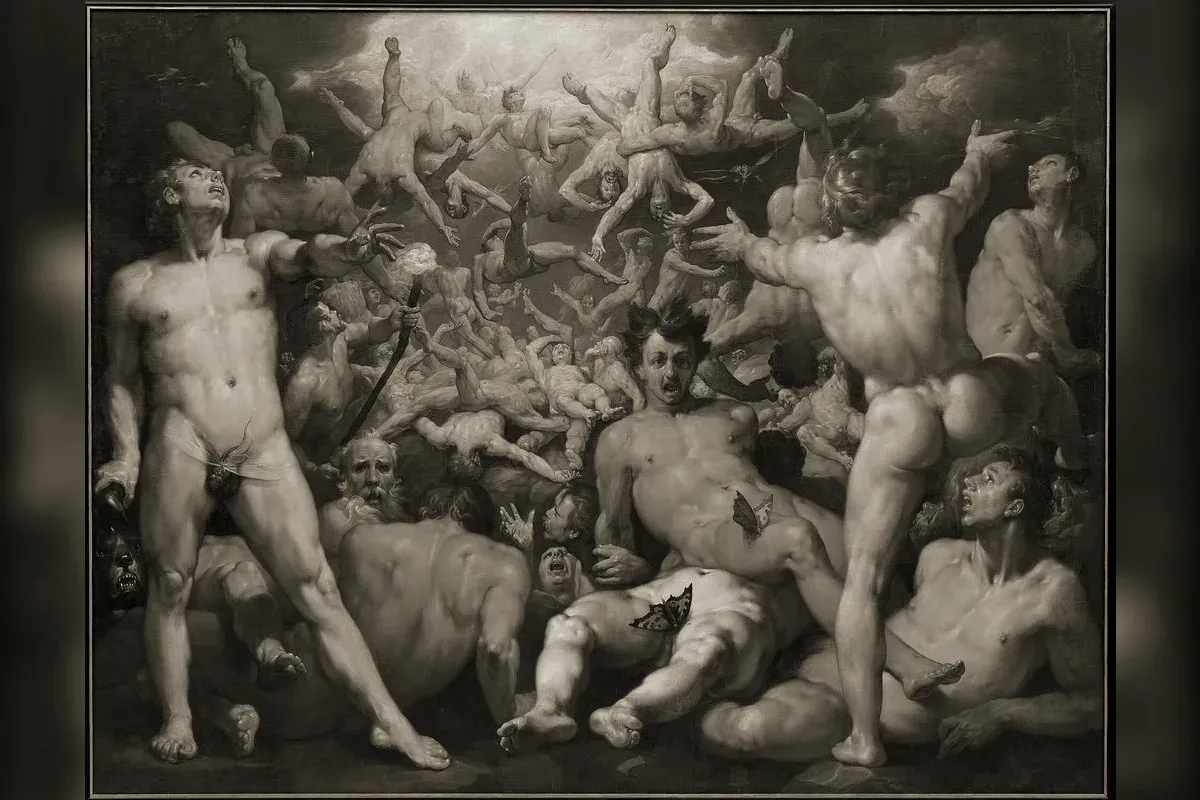
Before Olympus rules the world, the universe belongs to the Titans, children of Sky and Earth. Their king, Cronus, had already overthrown his own father. Yet prophecy now turns against him in the same way: one of his children is destined to dethrone him. To escape that fate, Cronus swallows each newborn as soon as it is born.
Zeus escapes the prophecy
Rhea finally refuses to lose another child. She gives birth in secret on Crete and hands Cronus a stone wrapped in swaddling clothes, which he devours without noticing the trick. Hidden away, Zeus grows to adulthood, nourished by Amalthea and guarded by the Curetes, who drown out his cries with clashing shields.
The reversal of power
Once grown, Zeus returns and forces Cronus to disgorge the children he swallowed. One by one, Hera, Demeter, Hestia, Poseidon, and Hades emerge. With his siblings restored, Zeus declares war on Cronus and the elder generation of Titans.
This is not a single duel but a struggle over the structure of the cosmos itself: who will govern the sky, the seas, the underworld, and the order of gods and mortals?
A ten-year war
The Olympians take position on Mount Olympus, while the Titans hold Mount Othrys. For years, neither side can secure a final victory. According to the counsel of Gaia, Zeus descends into Tartarus and frees the Cyclopes and the Hundred-Handers, monstrous beings imprisoned by Cronus.
In gratitude, the Cyclopes forge the weapons that define the Olympian regime:
- the thunderbolt for Zeus,
- the trident for Poseidon,
- the cap of invisibility for Hades.
Armed at last with divine force equal to their claim, the Olympians break the deadlock.
Victory and the division of the world
The Hundred-Handers bombard the Titans with mountains and boulders while Zeus unleashes the thunderbolt that becomes the sign of his kingship. The Titans are defeated and hurled into Tartarus, where they are guarded by the very beings Cronus once kept chained.
After the war, the brothers divide the world by lot. Zeus receives the sky and supreme authority, Poseidon the sea, and Hades the underworld. The earth remains shared. The Olympian order begins here.
Why the Titanomachy matters
The Titanomachy is the founding conflict behind later Greek mythology. Without it, there is no stable Olympus, no reign of Zeus, and no framework for the myths of gods, heroes, and epic wars to come. It is the backdrop for the divine family around Zeus and for the world later inhabited by gods such as Athena, Apollo, Artemis, and Hermes.
It also establishes a pattern that Greek myth repeats often: each new order fears being overthrown in turn. The Titanomachy is therefore not only a victory story, but a myth about succession, legitimacy, and the fragile birth of order.
The war’s aftermath also shapes the fate of Prometheus, the Titan who chose Zeus’s side and whose punishment — for later stealing fire to give to humanity — becomes one of the most powerful stories born directly from this cosmic realignment of power.
Further reading
For the full genesis of the world that precedes this war, from Chaos to the first divine generations, read the Greek creation myth. For the fate of the Titan who took Zeus’s side and was then punished, read Prometheus and the theft of fire. For the primordial Earth who steered the Olympian victory, see the page on Gaia. For the first deity to join Zeus before the fighting even began, and the bargain that ties her to him permanently, see Nike. For the eldest Titan who never took up arms at all and came through the war with his rank intact, see Oceanus.
Story beats
- 01Zeus is hidden in Crete after Rhea saves him from Cronus
- 02Cronus is forced to disgorge Zeus's swallowed siblings
- 03The Cyclopes and Hundred-Handers are freed from Tartarus
- 04The divine weapons are forged: thunderbolt, trident, cap of invisibility
- 05A ten-year war opposes Olympus to the Titans
- 06The defeated Titans are cast into Tartarus
Ancient sources
- Hesiod, Theogony
- Apollodorus, Library
See also
Related entries
- Zeus, king of the gods in Greek mythology
- Poseidon, god of the sea in Greek mythology
- Hades, god of the Underworld in Greek mythology
- Gaia, the primordial Earth and mother of the Greek gods
- Cronus, king of the Titans and father of Zeus in Greek mythology
- Atlas, the Titan who holds up the sky in Greek mythology
- Mount Olympus: home of the gods in Greek mythology
- Tartarus: the primordial abyss and Titan prison in Greek mythology
- The Thunderbolt of Zeus: divine weapon and symbol of supreme power
Frequently asked questions
What is the Titanomachy in Greek mythology?
The Titanomachy is the ten-year cosmic war in which Zeus and the Olympians overthrow Cronus and the Titans, establishing the Olympian order.
Which gods win the Titanomachy?
Zeus, along with his siblings and allies such as the Cyclopes and the Hundred-Handers, defeats the Titans and divides the world among the Olympian rulers.
What happens to the Titans after the Titanomachy?
The defeated Titans are cast into Tartarus, where they remain imprisoned under the guard of the Hundred-Handers in the most common versions of the myth.