Greek mythology · Gods & goddesses
Poseidon, god of the sea in Greek mythology
In brief
Poseidon, lord of the seas and earthquakes: attributes, genealogy, major myths and ancient sanctuaries of the Greek god of the oceans.
- sea
- oceans
- earthquakes
- horses
- +4
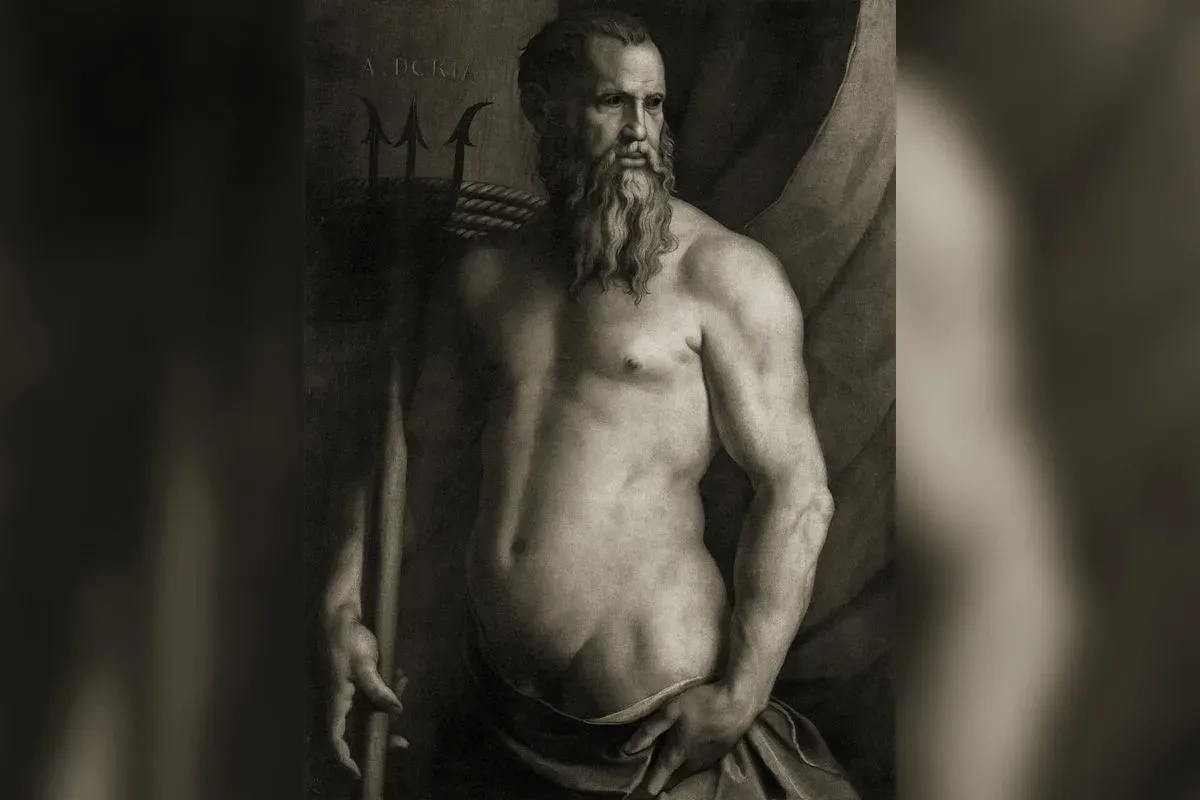
Poseidon is one of the three supreme powers of Olympus: brother of Zeus and Hades, he receives the seas and waters as his share and rules from his underwater palaces over everything touching ocean, earthquakes, and horses.
Birth and inheritance
Son of Cronus and Rhea, Poseidon is swallowed at birth like his siblings. Freed after Zeus’s victory in the Titanomachy, he draws the sea as his domain in the lot cast among the three brothers. Zeus keeps the sky, Hades the underworld; the Earth remains common ground.
The Cyclopes forge him the trident, both weapon and symbol of his authority over the waves. He marries Amphitrite, a sea-goddess, and fathers Triton, the fish-tailed sea god whose conch commands the waves.
Master of waters and tremors
Poseidon is also the Earth-Shaker: a blow of his trident can open springs, create chasms, and shake continents. Sailors offered him sacrifices before every voyage. His mood directly governs storms and shipwrecks.
He is equally linked to horses — one tradition holds that he created the first horse by striking the ground with his trident.
Divine rivalries
Poseidon is fiercely protective of his authority and repeatedly clashes with other gods. He contests Athena for the patronage of the city that will become Athens: he offers a saltwater spring, she an olive tree. The citizens choose the olive and Athena. Poseidon’s grudge against the Athenians threads through later mythology.
He takes the Greek side in the Trojan War and relentlessly delays Odysseus’s homecoming after the hero blinds his son Polyphemus, the Cyclops.
Father of heroes and monsters
Poseidon is one of the most prolific divine fathers in Greek mythology. He is the father of Theseus, the national hero of Athens — a powerful irony for the god Athens rejected in favor of Athena. He also sends the white bull to King Minos of Crete. When Minos keeps the animal rather than sacrificing it, Poseidon afflicts Pasiphae, the king’s wife, with a consuming passion for the beast. From this monstrous union is born the Minotaur, half man and half bull, imprisoned in the Labyrinth of Knossos.
Two other traditions explain relationships displayed in the tree. In Hesiod, Pegasus springs from Medusa after she has lain with Poseidon. In Arcadia, Pausanias reports that Poseidon pursues Demeter in the form of a horse; their union produces a daughter whose name was reserved for initiates and the horse Arion. This union therefore belongs to a local cult tradition rather than to every Greek account.
Cult and sanctuaries
Cape Sounion, at the southern tip of Attica, held one of Poseidon’s most imposing temples, visible from the sea. Corinth, a maritime city, gave him a major cult. The Isthmian Games were held in his honor.
Further reading
To place Poseidon within the Olympian genealogy, read the page on Zeus. To understand how the brothers came to divide the world, read the Titanomachy. To understand the other side of that division of power, continue with Hades. For Poseidon’s civic rivalry on land, see Athena. For his heroic son, read the page on Theseus. For the creature born of his revenge against Minos, see the page on the Minotaur. For a deep dive into the weapon that defines his power, consult the page on the trident of Poseidon.
Ancient sources
- Homer, Iliad, 15.187-193
- Homer, Odyssey, 5.282-381 and 9.526-536
- Hesiod, Theogony, lines 453-455
- Homeric Hymn to Poseidon (no. 22)
- Apollodorus, Library, 3.14.1
- Hesiod, Theogony, lines 278-286
- Pausanias, Description of Greece, 8.25.5-7
See also
Related entries
- Cronus, king of the Titans and father of Zeus in Greek mythology
- Rhea, mother of Zeus and the Olympians in Greek mythology
- Theseus, hero of Athens and slayer of the Minotaur
- Pegasus, the winged horse of Greek mythology
- Triton, Greek sea god of the conch and son of Poseidon
- Demeter, goddess of the harvest and agriculture
Stories featuring this entity
Frequently asked questions
Who is Poseidon's Roman counterpart?
Neptune, who inherits his maritime attributes but remains a less central figure in Roman religion.
Why is Poseidon also the god of earthquakes?
Ancient Greeks associated earthquakes with movements of underground waters and the fury of the god of the deep. Poseidon received the epithet Ennosigaios, 'Earth-Shaker.'
Why did Poseidon lose Athens to Athena?
In a contest for the city's patronage, Poseidon struck the Acropolis and produced a saltwater spring, while Athena produced an olive tree. The citizens chose the olive, judging it more useful.