Greek mythology · Gods & goddesses
Zeus, king of the gods in Greek mythology
In brief
Zeus, king of Olympus: attributes, genealogy, key myths, etymology of his name and ancient cult across the Greek world.
- sky
- thunder
- justice
- hospitality
- +4
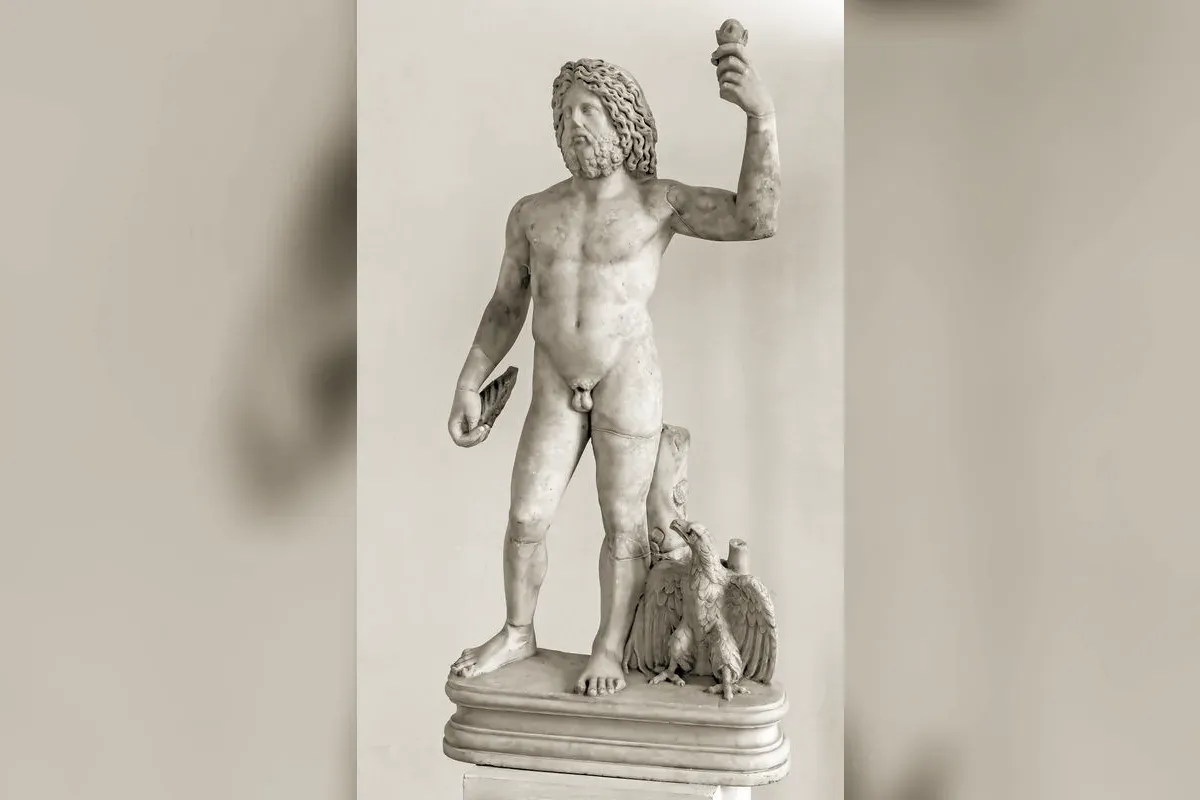
Zeus stands at the heart of the Greek pantheon: king of Olympus, god of the sky and thunder, guarantor of cosmic order and human justice. His name reaches back to the deepest Indo-European layer, where it already designates the personified “bright sky.”
Birth and survival
Son of the Titan Cronus and Rhea, Zeus is born under a dire prophecy: his father, fearing he will be overthrown by his children, swallows each newborn. To save the last, Rhea hides him in a cave on Mount Ida in Crete, where the goat Amalthea nurses him and the Curetes drown his cries by clashing their shields.
The Titanomachy
Grown to adulthood, Zeus frees his swallowed siblings and leads the Olympians in a ten-year cosmic war against the Titans. The full story is told in the Titanomachy. After victory, he divides the world with his brothers Poseidon (the seas) and Hades (the underworld), keeping the sky and supreme sovereignty for himself.
Domains and cult
Zeus is far more than a warrior god: he protects strangers (Zeus Xenios), oaths (Zeus Horkios) and the assembly of the gods. From Mount Olympus, the mountain home of the gods, he wields the thunderbolt forged by the Cyclopes — the ultimate symbol of his sovereignty. His chief sanctuary at Olympia hosted the panhellenic Games in his honor.
His genealogy combines several ancient traditions. With Hera, Zeus fathers Ares and Hephaestus; with Leto, Apollo and Artemis; with Maia, Hermes; with Demeter, Persephone; and with Mnemosyne, the Muses, including Calliope. The Iliad also makes Dione the mother of Aphrodite and presents Zeus as her father, whereas Hesiod tells the competing story of her birth from sea foam.
Among his mortal unions, Semele gives birth to Dionysus, Alcmene to Heracles, and Danae to Perseus. The site’s tree brings these attested lineages together without implying that they all come from one ancient account.
Further reading
For the founding conflict of the Olympian order, read the Titanomachy. For the mountain home of the gods he rules, see the page on Mount Olympus. For his iconic weapon, read the page on the Thunderbolt of Zeus. For Zeus’s brothers in that order, continue with Poseidon and Hades. For his children among the major gods, read Athena, Apollo and Artemis. For his craftsman and wine-god children, read the pages on Hephaestus and Dionysus. For his heroic sons, read the pages on Heracles and Perseus. For the Titan Zeus punished for giving fire to mankind, see the page on Prometheus and read Prometheus and the theft of fire. For the birth of the Greek world that culminates in Zeus’s reign, read the Greek creation myth.
Ancient sources
- Hesiod, Theogony, lines 453-506 and 617-735
- Homer, Iliad, 15.187-193
- Homeric Hymn to Zeus (no. 23)
- Callimachus, Hymn to Zeus
- Apollodorus, Library, 1.1.5-1.2.1
- Hesiod, Theogony, lines 886-944
- Homeric Hymn to Hermes, lines 1-18
- Apollodorus, Library, 2.4.1 and 2.4.8
See also
Related entries
- Cronus, king of the Titans and father of Zeus in Greek mythology
- Rhea, mother of Zeus and the Olympians in Greek mythology
- Athena, goddess of wisdom and strategic warfare
- Apollo, god of light, arts and prophecy in Greek mythology
- Artemis, goddess of the hunt and the wilderness
- Hermes, messenger of the gods and guide of souls
- Ares, god of war in Greek mythology
- Hephaestus, divine craftsman in Greek mythology
- Dionysus, god of wine and theater in Greek mythology
- Heracles, the hero of the Twelve Labors
- Perseus, slayer of Medusa and founder of Mycenae
- Aphrodite, goddess of love and beauty in Greek mythology
- Calliope, Muse of epic poetry in Greek mythology
- Persephone, queen of the underworld and goddess of spring
- Helen of Troy, Sparta's queen at the heart of the war
- Metis, Greek goddess of cunning and first wife of Zeus
- Themis, Greek goddess of divine law and order
- Mnemosyne, Greek goddess of Memory and mother of the Muses
- Hera, queen of the gods and goddess of marriage
- Maia, mother of Hermes and eldest of the Pleiades
- Demeter, goddess of the harvest and agriculture
- Dione, the goddess whose name is the feminine of Zeus
- Leto, mother of Apollo and Artemis in Greek mythology
- Alcmene, mother of Heracles in Greek mythology
- Danae, mother of Perseus and prisoner of the bronze chamber
- Semele, mortal mother of Dionysus in Greek mythology
Frequently asked questions
Who is Zeus' Roman counterpart?
Jupiter, who shares most of Zeus' attributes and functions.
Why does Zeus wield the thunderbolt?
The Cyclopes forged the thunderbolt for Zeus after he freed them from Tartarus; it symbolizes his dominion over the sky.
Where does Zeus rule from in Greek mythology?
Zeus rules from Olympus, the mountain home of the gods, where he presides over the divine assembly and upholds cosmic order.