Greek mythology · Gods & goddesses
Artemis, goddess of the hunt and the wilderness
In brief
Artemis, virgin goddess of the hunt, the moon, and wild animals: attributes, birth, key myths and cult in Greek mythology.
- hunting
- wilderness
- moon
- childbirth
- +5
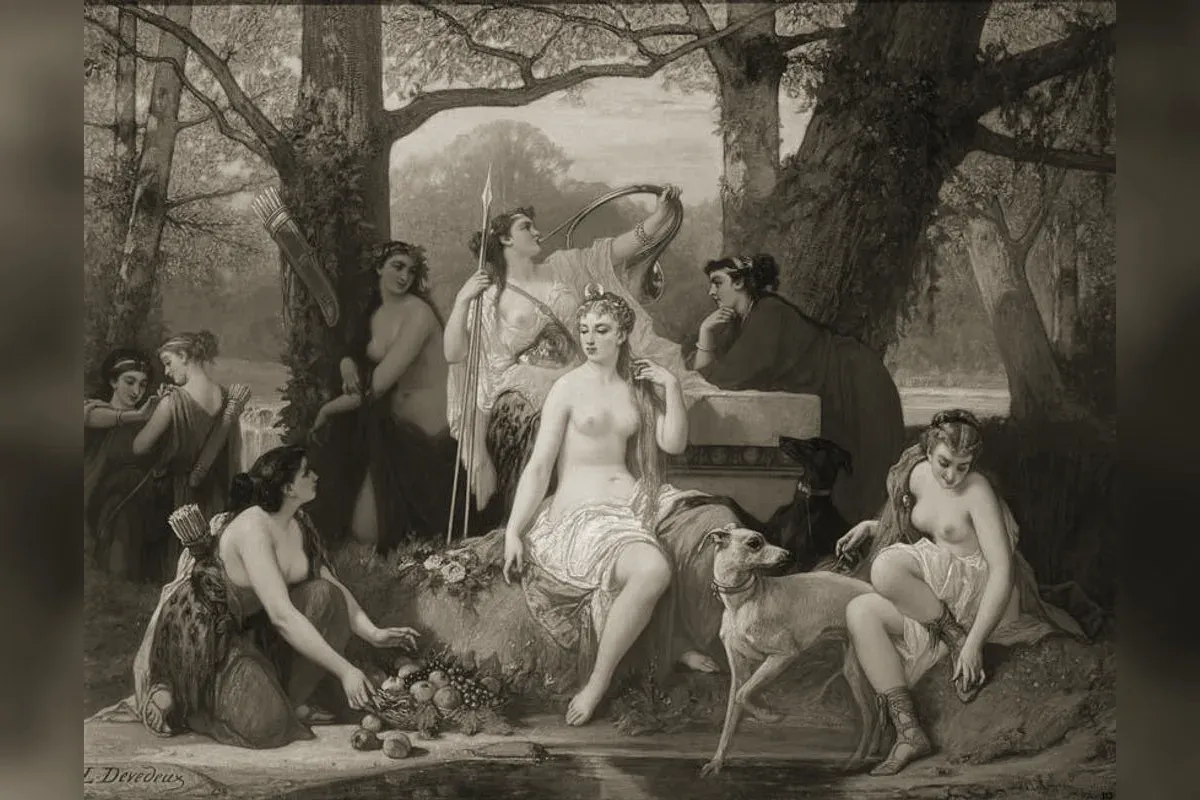
Artemis is the virgin goddess of the hunt, wilderness, moon, and the protection of women in childbirth. Twin sister of Apollo, daughter of Zeus and Leto, she rules over spaces beyond civilization — forests, mountains, borderlands — and over the passage from childhood to adulthood.
Birth on Delos
The birth of the twins Apollo and Artemis is made difficult by Hera’s jealousy, which bars any fixed land from sheltering their mother Leto. The floating island of Delos finally consents to receive her. One tradition holds that Artemis is born first and then helps her mother deliver Apollo — which earns her an association with birth-protection despite her virginal nature.
The huntress and her companions
Artemis lives in the forests, accompanied by a retinue of nymphs and young mortal women who have sworn chastity to join her. She roams the mountains, bow in hand, hunts deer and boar, and protects wild animals from excessive hunting — a characteristic tension: she is both huntress and guardian of game.
Her anger at violations of her domain is legendary: Actaeon, a hunter who glimpses her bathing, is transformed into a stag and torn apart by his own dogs. Her wrath at Agamemnon, who boasts of hunting better than she does, immobilizes the Greek fleet at Aulis and demands the sacrifice of Iphigenia.
Goddess of the moon and rites of passage
Artemis is associated with the crescent moon and the night, mirroring her brother Apollo’s link to the sun and light. She presides over female rites of passage: girls dedicated their childhood dolls to her before marriage.
At Brauron in Attica, girls from noble Athenian families lived as sacred bears (arktoi) for several months in her sanctuary — a rite connected with taming the wild within before entering civic life.
Cult and sanctuaries
Artemis’s greatest sanctuary was the Temple of Artemis at Ephesus, one of the Seven Wonders of the ancient world — where the goddess appeared in a markedly oriental form quite unlike the classical huntress image. The sanctuary at Brauron in Attica was one of the most important female cult sites in Greece.
Further reading
To place Artemis within the Olympian family, read the pages on Zeus and Apollo, her twin brother. For the myth of Iphigenia’s sacrifice tied to her anger, explore the cycle of the Trojan War.
Ancient sources
- Homeric Hymn to Artemis (no. 27)
- Callimachus, Hymn to Artemis
- Homer, Iliad, 21.468-513
- Apollodorus, Library, 1.4.1
- Ovid, Metamorphoses, 3.138-252
See also
Frequently asked questions
Who is Artemis's Roman counterpart?
Diana, Roman goddess of the hunt and the moon, who inherits most of Artemis's attributes and symbolism.
Is Artemis the goddess of the moon?
Progressively, yes. Originally, Selene is the strictly lunar deity. Artemis becomes associated with the moon mainly from the Classical period onward, particularly through her links with night and nocturnal hunting.
Why does Artemis punish Actaeon?
The hunter Actaeon stumbles upon Artemis bathing naked with her nymphs. The goddess, furious at this violation of her modesty, transforms him into a stag. He is then torn apart by his own hunting dogs.