Greek mythology · Creatures
Medusa, the Gorgon with the Petrifying Gaze
In brief
Medusa, Gorgon with serpentine hair and a deadly gaze: origin, Athena's curse, death at the hands of Perseus, and the birth of Pegasus.
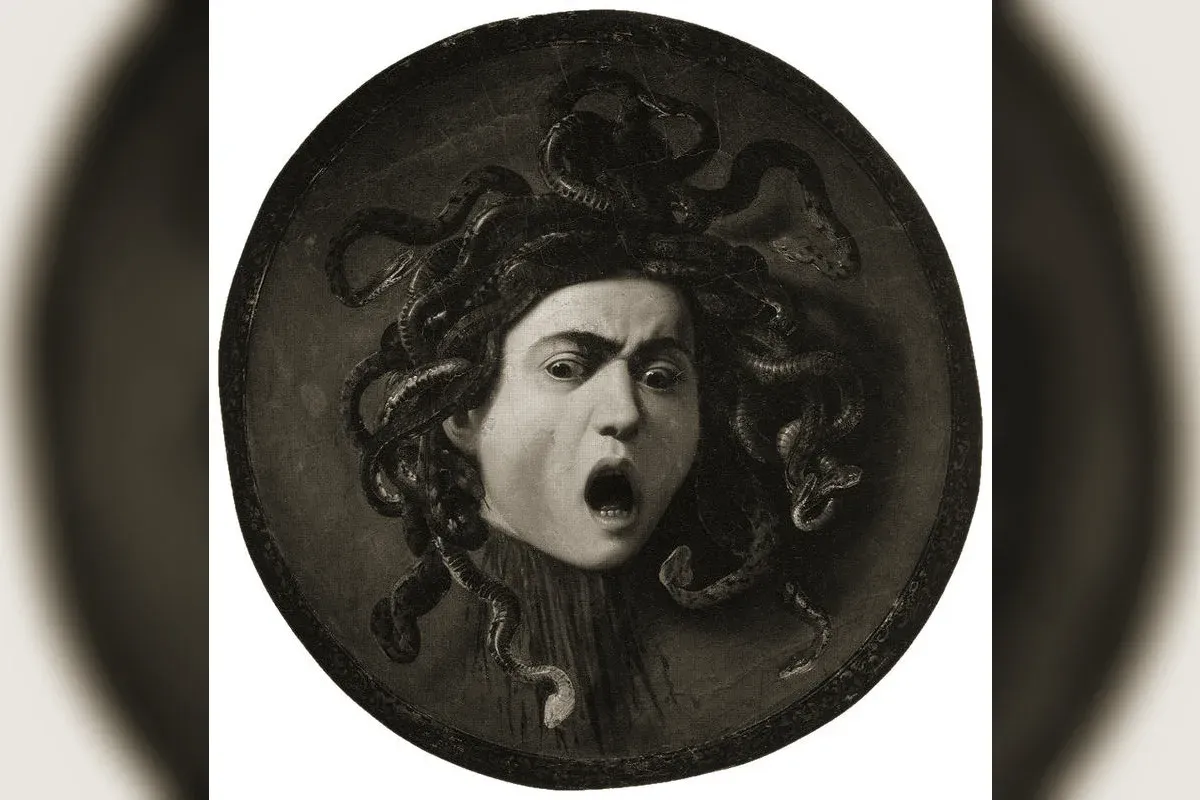
Medusa is the most famous of the three Gorgons and one of the most powerfully symbolic creatures in Greek mythology. Her gaze turns to stone anyone who meets it. She is the only mortal among her sisters. And her death at the hands of Perseus gives birth to one of mythology’s freest beings: the winged horse Pegasus.
Who is Medusa? The question of origin
Sources do not agree on Medusa’s original nature. In Hesiod’s Theogony, she is one of three daughters of Phorcys and Ceto, primordial sea deities. Her sisters Stheno and Euryale are immortal; she alone is mortal.
But the version that has most shaped posterity is Ovid’s in the Metamorphoses: Medusa was a mortal woman of remarkable beauty — her hair in particular. Poseidon assaults her in Athena’s own temple. Athena, outraged by the desecration of her sanctuary, transforms Medusa: her magnificent hair becomes serpents, her face takes on the hideous aspect of a Gorgon, and her gaze acquires its petrifying power.
This version places Medusa in a tragic position: a victim of transgression, then punished in place of the perpetrator.
The power and its limit
The terror Medusa inspires is absolute. Her gaze is instant and irreversible — stone statues litter the ground around her dwelling, the remains of all who have tried to approach her. Even the gods avoid meeting her gaze directly.
But she has one weakness: she can only petrify what she sees directly. And she sleeps.
It is precisely this flaw that Perseus exploits with the help of his divine allies.
Death and its consequences
Guided by Athena and Hermes, armed with the mirror-shield, the adamantine sickle-sword, and the winged sandals, Perseus approaches the sleeping Gorgons looking only at Medusa’s reflection in his shield. He severs her head in a single clean stroke.
From the severed neck spring two beings — born of Medusa’s ancient union with Poseidon:
- Pegasus, the white winged horse, who leaps toward the heavens.
- Chrysaor, the giant with the golden sword, whose lineage will populate the far edges of the world.
Perseus seizes the head and slips it into his kibisis (leather sack). Medusa’s immortal sisters, Stheno and Euryale, give chase, but he escapes using the cap of invisibility.
A weapon after death
Medusa’s head is no mere trophy: it still functions after her death. Perseus uses it several times:
- to petrify Atlas, when the Titan refuses to shelter him,
- to turn to stone the sea monster threatening Andromeda,
- to petrify Polydectes and his entire court on Seriphos.
He then offers the head to Athena, who fixes it to the center of her shield or aegis: the Gorgoneion, an apotropaic image that repels evil, becomes one of the most widespread motifs in Greek art.
The Gorgon in art and culture
The Gorgon mask — open mouth, fixed stare, serpentine hair — was ubiquitous in ancient Greek art: on temple pediments, shields, coins, drinking vessels. Medusa’s terror was mobilized as protection: showing death to ward off death.
This image has traveled from Antiquity to the present day: from the jellyfish (named after the creature for its radial form) to the emblem of Versace, to innumerable artistic representations, Medusa remains one of the most universally recognizable figures in all of world mythology.
Further reading
For the story of the hero who slays her, read the page on Perseus. For the goddess whose transgressed sanctuary triggers her transformation, see the page on Athena. For the god at the origin of her lineage and the assault, consult the page on Poseidon. For the winged horse born from her blood, explore the page on Pegasus. For the full narrative of the quest, read the Perseus and Medusa myth.
Ancient sources
- Hesiod, Theogony, lines 270-283
- Apollodorus, Library, 2.4.2-3
- Pindar, Pythian, 12
- Ovid, Metamorphoses, 4.765-803
See also
Frequently asked questions
Was Medusa always monstrous?
No. In the Hesiodic tradition, Medusa is a mortal (or sea deity) of great beauty. The most widely known version — popularized by Ovid — relates that she was transformed by Athena after Poseidon assaulted her in the goddess's own temple. Her monstrousness is the result of an unjust divine punishment redirected onto the victim.
What is born from Medusa's blood after her beheading?
From her blood mixed with sea foam spring two beings fathered by Poseidon: the winged horse Pegasus, and the giant warrior Chrysaor ('he of the golden sword'). Pegasus will become Bellerophon's mount and eventually a constellation.
What is Athena's aegis?
The aegis is Athena's divine shield or breastplate, fringed with serpents and bearing Medusa's head at its center (the Gorgoneion). This head continues to petrify enemies even after Medusa's death. Perseus gives it to Athena as an offering after his quest.