Greek mythology · Heroes & mortals
Perseus, slayer of Medusa and founder of Mycenae
In brief
Perseus, heroic son of Zeus and Danaë: miraculous birth, quest for Medusa's head, rescue of Andromeda, and the founding of Mycenae.
- heroic quest
- victory over monsters
- founding of cities
- winged sandals of Hermes
- +4
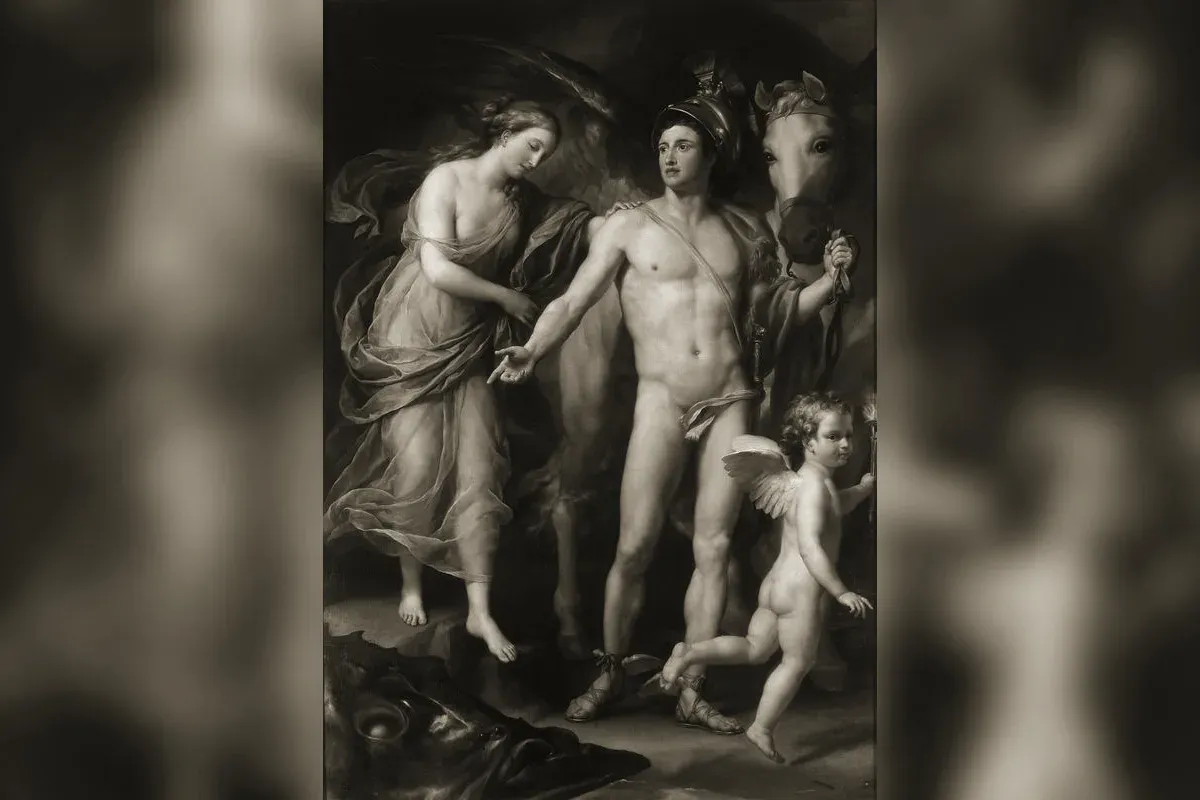
Perseus is one of the founding heroes of Greek mythology. Son of Zeus and the mortal Danae, he accomplishes what the gods themselves present as impossible: killing the Gorgon Medusa, whose gaze turns anyone who meets it to stone. His story weaves together inescapable prophecy, divine cunning, and the generosity of the gods.
A birth inside a bronze tower
King Acrisius of Argos receives a terrifying oracle: his grandson will kill him. To prevent his daughter Danaë from bearing a child, he has her locked in a bronze tower — or, in other versions, an underground chamber. But Zeus enters as a shower of gold and unites with Danaë. Perseus is born.
Unable to kill his own blood, Acrisius has the mother and child cast out to sea in a chest. They wash ashore on the island of Seriphos, where the fisherman Dictys takes them in.
The trap of Polydectes
Dictys’s brother, Polydectes, king of Seriphos, desires Danaë. To get Perseus out of the way, he pretends to demand a wedding gift worthy of kings: the head of the Gorgon Medusa. Perseus, boastful, accepts — without grasping the absurdity of the enterprise.
But the gods intervene.
Divine armament
Athena and Hermes come to Perseus’s aid. Hermes gives him his winged sandals and an adamantine sickle-sword that cuts through iron like silk. Athena provides her polished shield as a mirror — the decisive tool — and teaches him how to use it.
To obtain the remaining equipment (the kibisis, a sack to carry the head, and the cap of invisibility of Hades), Perseus must first consult the Graeae, three ancient sisters who share a single eye and a single tooth. He forces them to reveal the path to the Nymphs by stealing their eye. The Nymphs give him the missing items.
The death of Medusa
Perseus finds the three Gorgons sleeping at the edge of the world, beyond the Ocean. Only Medusa is mortal — her sisters Stheno and Euryale are immortal. Guided by the reflection in his shield, never looking directly, Perseus approaches and severs Medusa’s head in a single blow.
From the severed neck spring two beings, born of Medusa’s union with Poseidon: the winged horse Pegasus and the giant Chrysaor. Perseus slips the head into his kibisis and flies away on his winged sandals, pursued by the immortal sisters.
Andromeda and the sea monster
On his return, flying over the coast of Ethiopia, Perseus spots a young woman chained to a rock. She is Andromeda, daughter of King Cepheus, offered as a sacrifice to a sea monster sent by Poseidon to punish the vanity of her mother Cassiopeia. Perseus kills the monster — or, in some versions, shows it Medusa’s head — and frees Andromeda, whom he then marries.
The return and vengeance
Back on Seriphos, Perseus finds his mother Danaë persecuted by Polydectes. He enters the banquet hall, orders all present to avert their eyes, and produces the Gorgon’s head: Polydectes and his court are instantly petrified.
On the road back to Argos, Perseus takes part in funeral games. A discus he throws veers into the crowd and kills an unknown old man — who turns out to be Acrisius, his grandfather. The oracle has fulfilled itself despite all precautions.
Mycenae and the legacy
Too troubled to rule Argos, where he has killed the king, Perseus exchanges his kingdom for Tiryns and founds Mycenae, destined to become one of the most powerful cities of archaic Greece. He is the ancestor of the great Argive line from which, several generations later, Heracles descends.
Further reading
To understand Perseus’s divine origin, read the page on Zeus. For the creature he faces, see the page on Medusa. For his divine allies, explore the pages on Athena and Hermes. For the winged horse born from his victory, see the page on Pegasus. For the full account of the quest — from the Graeae to Andromeda — read the Perseus and Medusa myth.
Ancient sources
- Apollodorus, Library, 2.4.1-5
- Pindar, Pythian, 10 and 12
- Ovid, Metamorphoses, 4.604-803 and 5.1-249
- Hesiod, Theogony, lines 280-283
- Pausanias, Description of Greece, 2.15-16
See also
Frequently asked questions
How does Perseus kill Medusa without being turned to stone?
Perseus looks not at Medusa directly but at her reflection in the polished shield provided by Athena. This mirror allows him to approach and behead her without meeting her petrifying gaze.
What does Perseus do with Medusa's head after the quest?
Perseus uses the head several times: to petrify the Titan Atlas, to rescue Andromeda by turning the sea monster to stone, and to defeat Polydectes. He then gives it to Athena, who fixes it to her aegis.
What is the connection between Perseus and Heracles?
Perseus is the great-grandfather of Heracles. His daughter Alcmene is Heracles's mother, and Zeus is the father of both heroes. Perseus thus stands at the origin of the great Argive line of heroes.