Greek mythology · Gods & goddesses
Demeter, goddess of the harvest and agriculture
In brief
Demeter, Greek goddess of the harvest, agriculture and seasonal cycles: attributes, the myth of Persephone, the Eleusinian Mysteries and her ancient cult.
- agriculture
- harvest
- seasons
- fertility of the earth
- +6
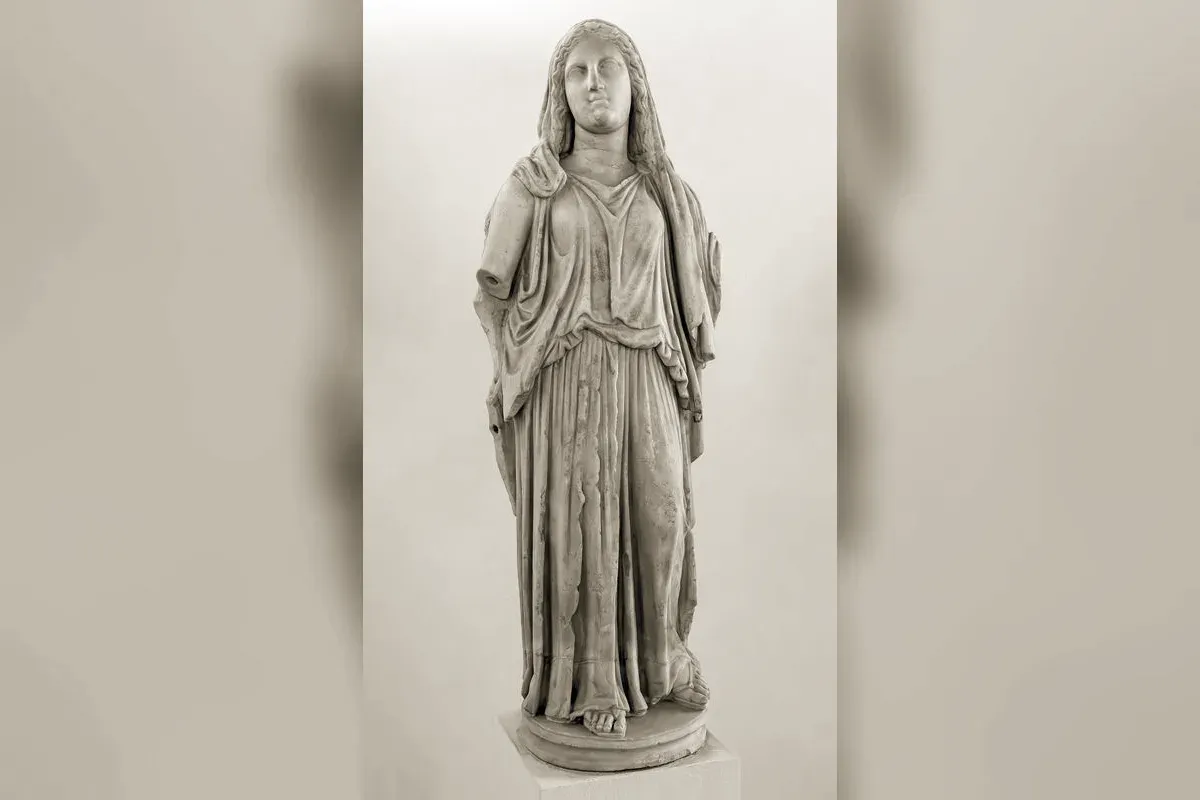
Demeter is the goddess of earth’s fertility, grain, harvest, and seasonal cycles. Sister of Zeus, Poseidon, Hades, and Hera, she is one of the Olympians closest to human concerns: without her, crops fail, hunger spreads, and civilizations collapse.
Birth and family
Daughter of Cronus and Rhea, Demeter is swallowed at birth like her siblings and freed after Zeus’s victory in the Titanomachy. Her union with Zeus produces Persephone, who will become queen of the underworld.
The abduction of Persephone and the seasons
Demeter’s central myth is the abduction of her daughter. Hades, king of the underworld, falls in love with Persephone and carries her off while she gathers flowers in the plain of Nysa. Demeter wanders nine days searching for her, torch in hand, neither eating nor drinking. Hecate finally reveals what happened.
Devastated, Demeter withdraws from Olympus and lets the earth fall barren: seeds refuse to germinate, livestock dies, humanity suffers. Zeus, faced with the extinction of humankind — and thus the end of divine offerings — negotiates. Hermes is sent to the underworld to bring Persephone back.
The return is partial: Persephone has eaten six pomegranate seeds in the realm of the dead. She must return there six months of every year. Those six months correspond to autumn and winter, when Demeter grieves and lets the earth rest. The remaining six months — spring and summer — see the two reunited and nature flourish.
The Eleusinian Mysteries
The sanctuary at Eleusis, twenty kilometers from Athens, hosted the Greater Mysteries, a cycle of initiatory rites that lasted roughly two millennia. Initiates underwent purification rituals, fasting, and secret revelation. The ancients believed these mysteries offered a blissful life after death — a remarkable promise in a religion where the afterlife was generally grim.
Demeter the law-giver
Her epithets Thesmophoros (law-bearer) and Nomios signal a broader role: she also teaches humans agriculture, the laws of communal life, and civic rights. The hero Triptolemus, whom she instructs, carries grain across the world.
Cult and sanctuaries
Beyond Eleusis, Demeter was honored across the Greek world through the Thesmophoria, a festival exclusively for married women, celebrating fertility and law. Piglets were cast into sacred pits in a ritual connected to plowing and sowing.
Further reading
For the full story of the abduction and the seasonal bargain, act by act, read The Abduction of Persephone. For the full myth of the seasons, see the page on Hades (who abducts Persephone). For Persephone as queen of the underworld, explore her own page. To place Demeter within the Olympian family, read the page on Zeus.
Ancient sources
- Homeric Hymn to Demeter (no. 2)
- Hesiod, Theogony, lines 453-455 and 912-914
- Apollodorus, Library, 1.5
- Ovid, Metamorphoses, 5.341-571
- Pausanias, Description of Greece, 8.42
See also
Related entries
Stories featuring this entity
Frequently asked questions
Who is Demeter's Roman counterpart?
Ceres, whose name gave us the word 'cereal,' is the Roman goddess of grain and agriculture. Her cult is closely linked to that of her daughter Proserpina (Persephone).
What is Demeter's connection to the seasons?
When Hades abducts Persephone, Demeter wanders the world in grief and lets the earth become barren. Zeus negotiates a partial return: Persephone spends six months in the underworld (autumn and winter) and six months with her mother (spring and summer).
What were the Eleusinian Mysteries?
The Eleusinian Mysteries were a cycle of secret initiatory rites celebrated annually near Athens in honor of Demeter and Persephone. They lasted nearly two thousand years and promised initiates a blessed life after death.