Greek mythology · Creatures
Cerberus, guardian of the Underworld in Greek mythology
In brief
Cerberus, the three-headed dog guarding the realm of Hades: origin, role in the underworld, the twelfth labor of Heracles, and other mortal intrusions.
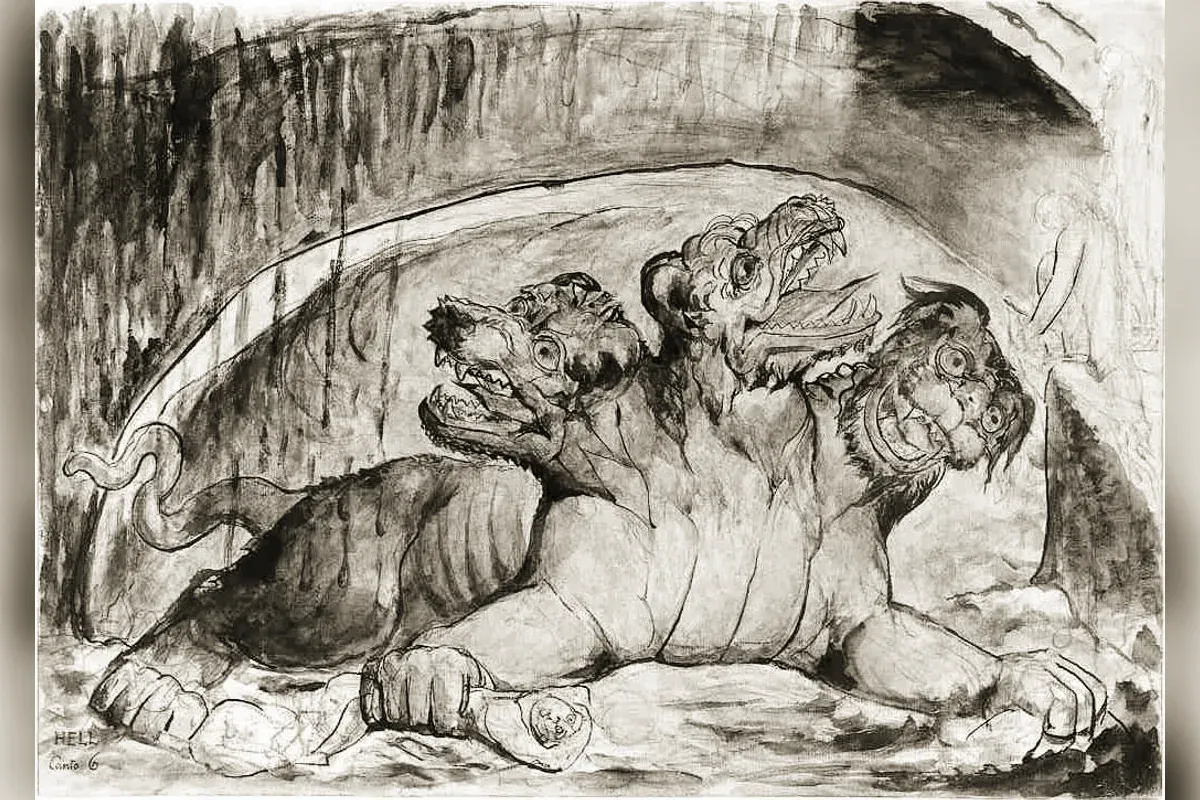
Cerberus is the most feared creature of Greek mythology — not because he attacks the living, but because he guards the absolute boundary between the world above and the realm of the dead. His post is the entrance to Hades’s domain, and his mission is simple, total, and eternal: let in, never let out.
Portrait of an infernal guardian
Cerberus is a dog of supernatural nature. Hesiod gives him fifty heads; the tradition that crossed the ages attributes three to him. His tail is a serpent, and his body bristles with additional serpent heads.
He is the son of Typhon — the greatest of all monsters, the adversary of Zeus himself — and Echidna, the mother of all Greek monsters. His siblings include the Lernaean Hydra, the Sphinx, the Chimera, and the eagle of the Caucasus. This monstrous genealogy places him at the heart of chthonic symbolism.
The guardian’s role
Cerberus is not a blind, raging monster. His role is precise: he allows the souls of the dead to enter the kingdom of the dead, but never allows anyone to leave — not the dead seeking to flee, and not the living who might venture into his domain.
This asymmetry is fundamental. Death is irreversible. Cerberus is the physical embodiment of that irreversibility. In the Greek world, no divine law is more absolute.
The successful intrusions: a gallery of heroes
Cerberus is nonetheless bypassed on several occasions. Each exception reveals something essential about the character who manages to pass:
Heracles — the twelfth and final Labor commands him to bring Cerberus back alive from the Underworld. Heracles descends with Hades’s permission, overcomes Cerberus by pure force without weapons, and presents him to Eurystheus. The terror provoked by the dog is enough to freeze the king on the spot. Cerberus is subsequently returned to the Underworld.
Orpheus — the musician descends to retrieve his wife Eurydice. His lyre and song send Cerberus to sleep, temporarily suspending his guardian role. Musical beauty disarms what force cannot overcome.
Psyche — sent to the Underworld by Aphrodite for an impossible task, Psyche puts Cerberus to sleep with a honeycake laced with a soporific. Domestic cunning overcomes the guardian that epic heroes challenge sword in hand.
Hermes — as psychopomp, guide of souls, Hermes moves freely between worlds. Cerberus does not hinder him: gods are not subject to the same boundary as mortals.
Odysseus — in Book XI of the Odyssey, Odysseus summons the souls of the dead from the edge of the world without actually crossing the gates guarded by Cerberus. He remains at the threshold of Hades, avoiding the direct confrontation.
The katabasis: descent to the Underworld as a narrative motif
In the Greek tradition, the descent to the Underworld — katabasis — is one of the most powerful narrative motifs. Cerberus is its physical threshold. To pass Cerberus is to accept symbolically crossing death. To exit alive, with his consent or despite him, is to assert a nature that transcends ordinary existence.
The descents of Heracles and Orpheus, followed by those of Odysseus in the Odyssey and Aeneas in Virgil’s Aeneid, all reprise this motif of passing the infernal guardian.
Cerberus in art and culture
The figure of Cerberus is one of the most durably present in the Western imagination. The image of an animal-guardian with multiple heads, posted at a point of no return, recurs in Babylonian, Egyptian, and Norse mythology.
In contemporary culture, Cerberus appears everywhere: from J.K. Rowling’s Harry Potter (Fluffy, the three-headed dog guarding the Philosopher’s Stone) to video games, luxury branding, and countless adaptations.
Further reading
For the complete cycle of the Twelve Labors and the twelfth labor specifically, read the Labors of Heracles. For the hero who captured him, read the page on Heracles. For the master of the domain Cerberus guards, see the page on Hades. For the god who moves freely between worlds, read the page on Hermes. For the other monsters born of the same parents Typhon and Echidna, see the pages on the Sphinx and the Lernaean Hydra. For the scene in the Odyssey where Odysseus approaches the threshold of Hades, read the Odyssey.
Ancient sources
- Hesiod, Theogony, lines 306-312 and 769-773
- Homer, Iliad, 8.366-369
- Apollodorus, Library, 2.5.12
- Virgil, Aeneid, 6.417-425
See also
Related entries
Stories featuring this entity
Frequently asked questions
How many heads does Cerberus actually have?
Three in the most widely known tradition (Hesiod, Virgil). But Pindar gives him a hundred, and other authors vary between two and fifty. The three-headed version has prevailed in Western imagination.
Who successfully enters the Underworld despite Cerberus?
Several mythological figures pass: Heracles (by force), Orpheus (with soothing music), Psyche (with a drugged honeycake), Hermes (as guide of souls), Odysseus (summoned by Circe), Aeneas (guided by the Sibyl). In each case, the method of passing Cerberus reveals something essential about the character.
What is the relationship between Cerberus and Hades?
Cerberus is Hades's guard dog — faithful, absolute, incorruptible. He is the physical instrument of the underworld's implacability: no one enters without permission, and the dead never return.