Greek mythology · Journeys & quests
The Odyssey: Odysseus's journey home in Greek mythology
In brief
Homer's Odyssey: Odysseus's ten-year journey home from Troy to Ithaca — Cyclops, Circe, the Underworld, and the final revenge against the suitors.
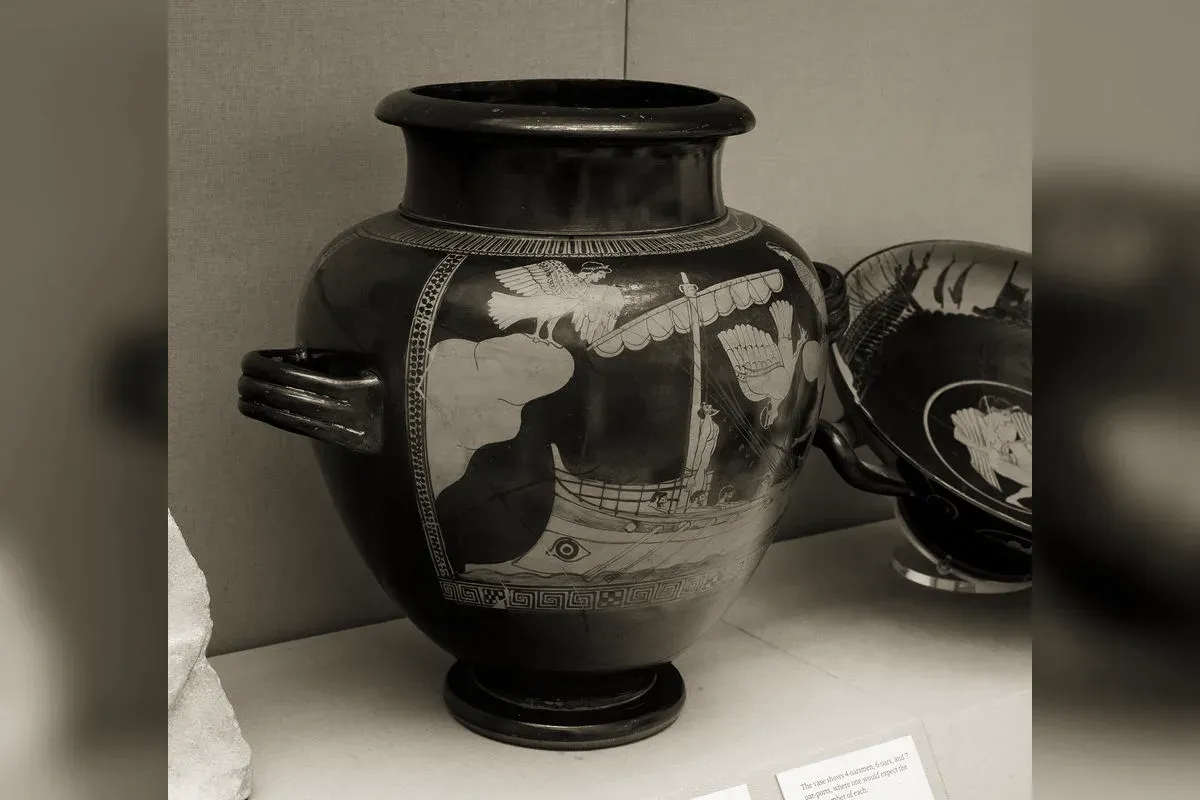
The Odyssey is one of the two great founding epics of Western civilization, attributed to Homer and composed in the eighth century BCE. It tells the ten years of wandering of Odysseus on the road home from Troy to his island of Ithaca — ten years marked by storms, monsters, divine seductions, and an unceasing longing for home.
The legacy of the Trojan War
The Odyssey begins where the Iliad ends. The Trojan War is over; Troy has fallen. But coming home is not simple: the gods are divided over the fate of the victors. Athena, angered by sacrileges committed during the sack of Troy, first turns against the Greeks before becoming Odysseus’s protector. Poseidon, furious that Odysseus blinded his son Polyphemus, will pursue him across every sea for ten years.
The Cyclops: the first great trial
The Cyclops episode is one of the most celebrated sequences in all of Antiquity. Arriving on the island of the Cyclopes, Odysseus and his companions are captured by Polyphemus, son of Poseidon, who devours his prisoners one by one. Odysseus blinds the Cyclops with an olive-wood stake hardened in fire and escapes by hiding under the wool of the sheep.
By revealing his true name to the cursing Cyclops, Odysseus commits an act of hubris that triggers Poseidon’s vengeance and extends his wandering by years.
Circe and the transformation
On the island of Aeaea lives Circe, a divine sorceress, daughter of the Sun. She transforms Odysseus’s companions into swine. Guided by Hermes, who gives him the magic herb moly to resist the enchantment, Odysseus defies the spell. Impressed, Circe restores the companions to human form. Odysseus stays with her for a year before resuming his voyage.
The Nekyia: descent to the Underworld
It is at Circe’s direction that Odysseus descends to the Underworld to consult the seer Tiresias. This Nekyia (Book XI) is one of the deepest scenes in the entire epic.
Odysseus summons the souls of the dead and speaks with:
- the shade of his mother Anticleia, who died of grief during his absence
- the seer Tiresias, who maps out his road home
- the shade of Achilles, who delivers a stunning truth: he would rather be the last of slaves among the living than king of the dead
This scene reveals the price of heroic glory — and offers a melancholy counterpoint to the choice Achilles made in life. Cerberus is evoked as the guardian of the inner gates, but Odysseus remains at the threshold without crossing the absolute boundary.
The Sirens, Charybdis and Scylla
The passage of the Sirens — whose enchanting song draws sailors to their destruction — is navigated through cunning: Odysseus has his men stop their ears with wax, and has himself lashed to the mast so he can hear without being able to yield.
Scylla and Charybdis present two opposing dangers in a narrow strait: the first a six-headed monster devouring sailors from her cliff, the second an immense whirlpool engulfing entire ships. Odysseus chooses the lesser evil — losing six men to Scylla rather than the whole ship to Charybdis.
The island of Helios and the punishment of the companions
On the island of Thrinacia, his starving companions slaughter the sacred cattle of Helios despite Odysseus’s explicit prohibition. Zeus, appealed to by Helios, unleashes a storm that destroys the ship and drowns every companion. Odysseus alone survives.
Calypso and the refusal of immortality
Stranded on the island of Ogygia, Odysseus spends seven years with the nymph Calypso, who loves him and offers immortality if he stays. He refuses. Despite the years and the temptation, he desires nothing but the return home. It is Athena who intercedes with Zeus so that Hermes orders Calypso to release him.
This refusal of immortality is the central moral gesture of the epic: Odysseus chooses the human condition, with all its mortality and pain, over a meaningless eternity.
Phaeacia and the story within the story
After yet another shipwreck, Odysseus arrives in Phaeacia where the princess Nausicaa receives him. Before King Alcinous, he recites the entirety of his story — Books IX through XII of the Odyssey present themselves as Odysseus’s own account of himself. The Phaeacians return him to Ithaca while he sleeps.
The return and the reckoning
Back in Ithaca, Odysseus disguises himself as a beggar. He finds his palace overrun by suitors competing for Penelope’s hand, waiting for twenty years. His faithful wife has held them off through a ruse: she weaves a burial shroud by day and unravels it by night, promising to choose once the work is done.
Athena orchestrates the final reckoning. Only Odysseus can string the bow that belongs to him and shoot an arrow through twelve axes lined in a row. The massacre of the suitors that follows is merciless. Odysseus finds Penelope — and the twenty-year circle closes.
The Odyssey as a universal narrative model
The Odyssey gave world literature the word “odyssey” — any long journey marked by transformative trials. It laid the foundations for travel narrative, the picaresque novel, and the inner quest. From Virgil to Joyce, from Dante to Camus, it has never ceased to be rewritten.
Further reading
For the hero whose shade teaches Odysseus the vanity of posthumous glory, read the page on Achilles. For Athena, Odysseus’s protector throughout the journey, see her page. For Poseidon whose anger drives the wandering, read his page. For the creature whose blinding triggers the curse, read the page on the Cyclopes. For the war that precedes the poem, read the full story of the Trojan War. For the failed homecoming the poem keeps setting against Odysseus’s own, see Agamemnon, and for the wife who is Clytemnestra’s exact opposite, Penelope.
Story beats
- 01Departure from Troy and Poseidon's storm
- 02The Cyclopes' island: blinding of Polyphemus
- 03Circe's island: transformation of companions and a year's stay
- 04Descent to the Underworld: consulting Tiresias and the shade of Achilles
- 05The Sirens, Charybdis and Scylla: passing the monsters
- 06Island of Helios: death of the companions
- 07Ogygia: seven years with Calypso
- 08Phaeacia: Nausicaa's welcome and the telling of the epic
- 09Return to Ithaca disguised as a beggar
- 10Final revenge: slaughter of the suitors, reunion with Penelope
Ancient sources
- Homer, Odyssey
- Apollodorus, Epitome
- Ovid, Metamorphoses
See also
Related entries
- Odysseus, the hero of the Odyssey in Greek mythology
- Athena, goddess of wisdom and strategic warfare
- Telemachus, son of Odysseus and prince of Ithaca in Greek mythology
- Menelaus: King of Sparta, Helen's husband and the Trojan War
- Poseidon, god of the sea in Greek mythology
- Scylla, the six-headed sea monster of the strait
- The Sirens, deadly enchanters of Greek mythology
- Mount Olympus: home of the gods in Greek mythology
Frequently asked questions
How long does Odysseus's journey take?
Ten years after the fall of Troy — which itself lasted ten years. Odysseus is therefore away from home for twenty years in total before reuniting with Penelope and his son Telemachus.
What is Athena's role in the Odyssey?
Athena is Odysseus's protector throughout the voyage. She pleads his cause before Zeus, guides his son Telemachus on his own quest, and at the end helps Odysseus string the bow during the contest that decides the fate of the suitors.
What is the Nekyia?
The Nekyia (Book XI of the Odyssey) is the scene in which Odysseus summons the souls of the dead. He consults the seer Tiresias for guidance and speaks with the shade of Achilles, who tells him he would rather be the lowest of the living than king of the dead.