Greek mythology · Heroes & mortals
Heracles, the hero of the Twelve Labors
In brief
Heracles, demigod son of Zeus and Alcmene: birth, Twelve Labors, major exploits, and the apotheosis of the greatest hero in Greek mythology.
- divine strength
- heroic courage
- protection of mortals
- redemption through trial
- +3
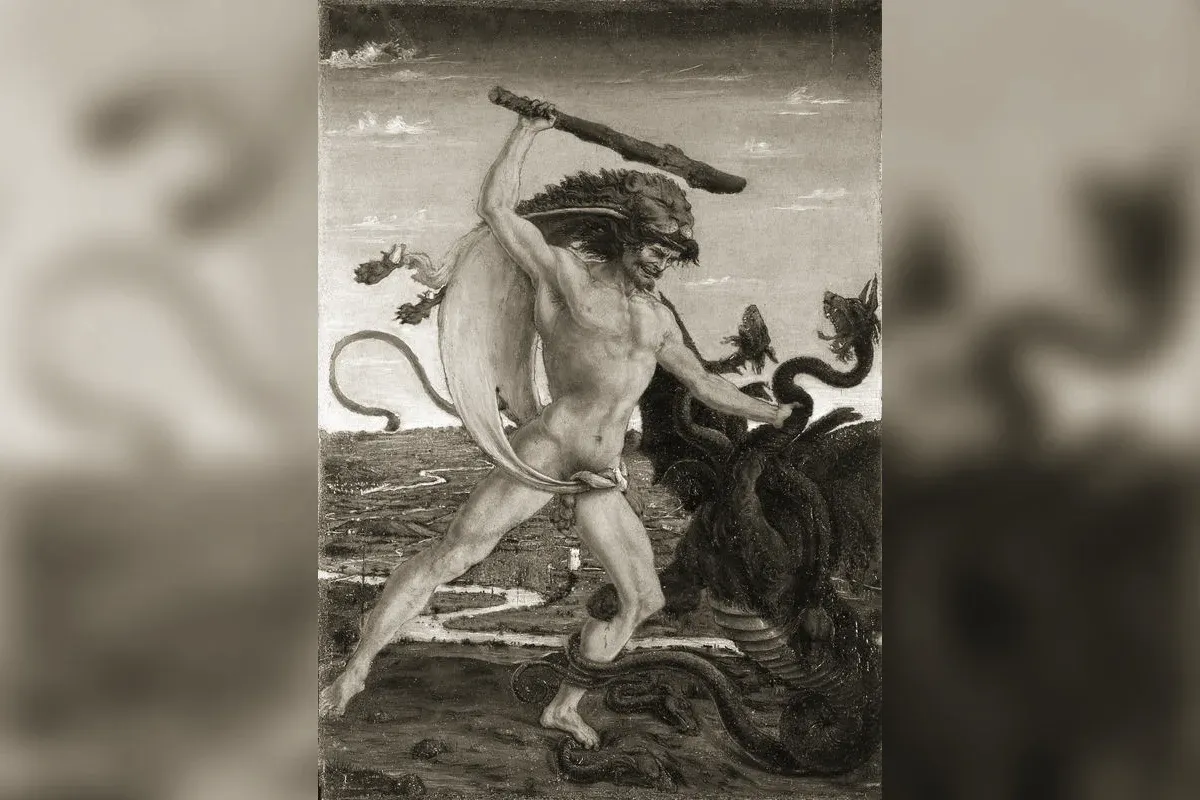
Heracles is the supreme hero of Greek mythology. Son of Zeus and the mortal Alcmene, he embodies the boundary between humanity and divinity: endowed with superhuman strength, he lives through an existence marked by suffering, redemption, and glory, culminating in final apotheosis on Olympus.
A birth shadowed by divine jealousy
Zeus comes to Alcmene, queen of Thebes, disguised as her husband Amphitryon, who is away at war. From this union Heracles is born. Hera, Zeus’s jealous wife, first tries to delay the birth in order to rob the child of the divine inheritance Zeus had promised. She then sends two serpents into his cradle. The infant strangles them with his bare hands — a blazing first sign of his prodigious strength.
Hera’s hatred never fades: it is the tragic engine of Heracles’s entire life, from birth to death.
Madness and guilt
As an adult, Heracles marries Megara and lives as a man. Hera then strikes him with furious madness. In this state he slaughters his own wife and children, believing himself to be fighting enemies. When he comes back to his senses, the horror of his act crushes him.
Consulted, the oracle at Delphi delivers its verdict: serve Eurystheus, king of Tiryns, for twelve years and accomplish whatever trials he sets. This is how the Twelve Labors are born — simultaneously punishment, expiation, and path toward immortality.
The Twelve Labors
Eurystheus, guided by Hera, devises tasks intended to be impossible:
- The Nemean Lion — strangled bare-handed; its invulnerable hide becomes Heracles’s armor.
- The Lernaean Hydra — a nine-headed monster whose heads regrow; Heracles cuts them off and cauterizes the stumps with a torch.
- The Ceryneian Hind — with golden hooves and bronze horns, captured alive after a year-long chase.
- The Erymanthian Boar — immobilized in snow and brought back alive to the terrified Eurystheus cowering in a storage jar.
- The Augean Stables — cleaned in a single day by diverting the rivers Alpheus and Peneus through them.
- The Stymphalian Birds — driven away using bronze clappers provided by Athena.
- The Cretan Bull — captured alive and brought back from the island of King Minos.
- The Mares of Diomedes — these man-eating horses are calmed after Heracles feeds them their own cruel master.
- The Belt of Hippolyta — taken from the queen of the Amazons, daughters of Ares, despite Hera’s interference.
- The Cattle of Geryon — driven back from the far western edge of the world, beyond the pillars Heracles erects to mark the limits of the known world.
- The Apples of the Hesperides — stolen from the celestial garden with the help of Atlas, a plan counseled by Athena.
- Cerberus — brought up alive from the underworld of Hades bare-handed, and then returned.
The hero of all worlds
Beyond the Twelve Labors, Heracles travels the full expanse of the mythic world. He joins the Argonauts, led by Jason, on the quest for the Golden Fleece before being separated from the expedition. He participates in the Gigantomachy, the war of the Giants against the Olympians — the gods needing a mortal’s hand to win the final victory. He also frees the Titan Prometheus, chained in the Caucasus for centuries, by slaying the eagle that devoured his liver.
Hermes serves as his guide on certain journeys; Athena assists him in his most delicate labors. Ares, father of the Amazons, and Poseidon, lord of the seas he must cross, are among the divinities he confronts or must appease.
Death and apotheosis
Heracles’s end is as tragic as his life. His wife Deianira, believing she is using a love charm, gives him a tunic soaked in the poisoned blood of the centaur Nessus — who had told her it would ensure his fidelity. The poison eats into Heracles’s flesh.
Unable to bear the agony, he has a funeral pyre built on Mount Oeta and lies down upon it. Zeus receives his soul into the heavens. His mortal part consumed by flame, Heracles is raised to Olympus, immortalized, and marries Hebe, goddess of eternal youth.
A universal legacy
Heracles is one of the most widely adopted figures of Antiquity. Embraced by Rome as Hercules, his image has crossed the centuries to the present day: a symbol of brute force, yes, but above all an archetype of redemption through trial — suffering accepted as the road to something greater than oneself.
Further reading
For the complete cycle of the Twelve Labors and their significance, read the Labors of Heracles. For his divine genealogy, read the pages on Zeus and Hera. For the second labor and the venom that would ultimately cause his death, see the page on the Lernaean Hydra. For the twelfth labor in the underworld, see the page on Hades. For the divine assistance he received, explore the pages on Athena and Hermes. For the Argonaut quest he joined, read Jason and the Golden Fleece. For the sanctuary whose oracle set him on the path of his labors, consult the page on Delphi. For the hybrid creatures he clashed with — notably during the wine-jar episode with Pholus — read the page on Centaurs. For the opponent he pins in a wrestling hold beside Alcestis’s tomb in Euripides, see Thanatos.
Ancient sources
- Apollodorus, Library, 2.4.8-2.7.7
- Hesiod, Shield of Heracles
- Sophocles, Women of Trachis
- Euripides, Heracles
- Diodorus Siculus, Library of History, 4.8-39
See also
Frequently asked questions
What is the difference between Heracles and Hercules?
Heracles is the Greek name of the hero; Hercules is his Roman counterpart. Both share the same Twelve Labors and legendary strength, but Hercules occupies a distinct place in Roman religion — more closely associated with commerce and the protection of merchants.
Why does Heracles perform the Twelve Labors?
Hera strikes Heracles with a fit of madness. In his delirium, he kills his wife Megara and their children, believing them to be enemies. To atone for this involuntary crime, the oracle at Delphi orders him to serve King Eurystheus of Tiryns for twelve years and complete whatever tasks Eurystheus assigns.
Does Heracles end as a god or a mortal hero?
He is born mortal but his divine nature ultimately prevails. Consumed by the poison on the shirt of Nessus, he mounts his own funeral pyre on Mount Oeta. Zeus gathers his soul, immortalizes him, and installs him on Olympus, where he marries Hebe, goddess of eternal youth.