Greek mythology · Creatures
The Minotaur, Monster of the Labyrinth of Crete
In brief
The Minotaur, half-man half-bull creature imprisoned in Daedalus's Labyrinth: origin, the cult at Knossos, Athens's tribute, and death at the hands of Theseus.
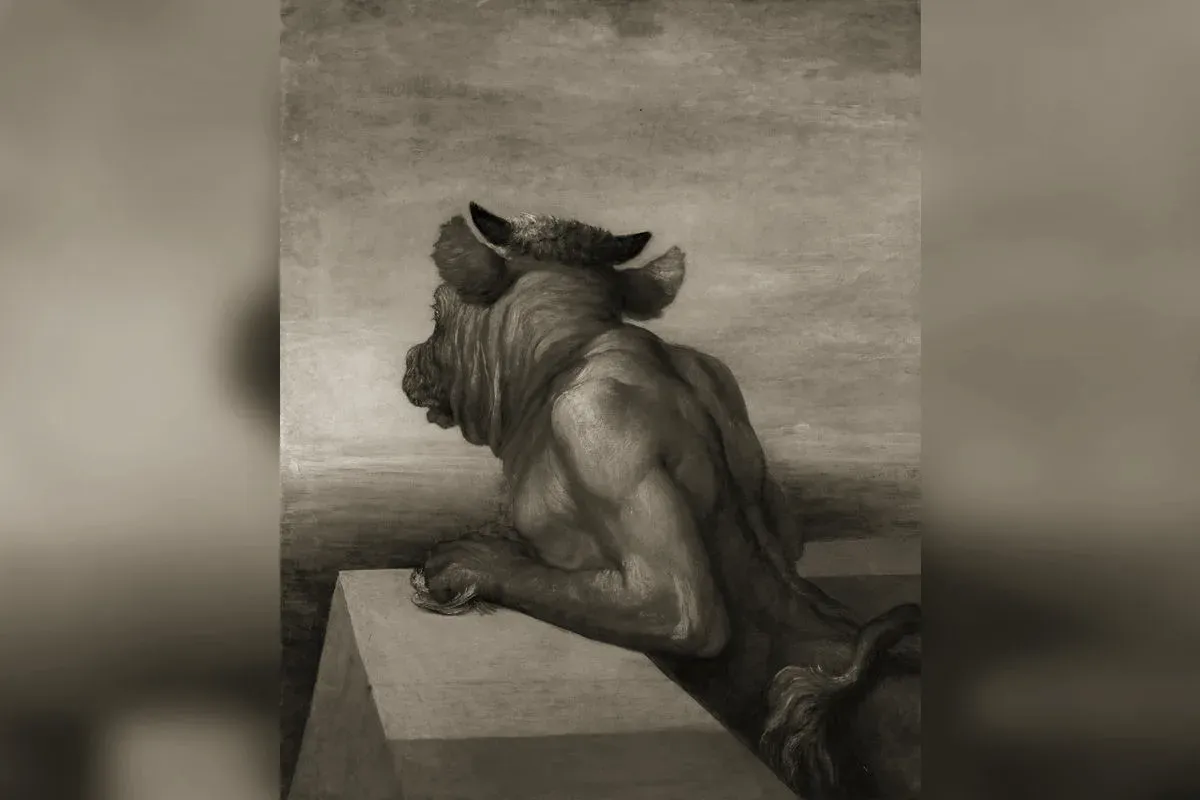
The Minotaur is one of the most striking figures in Greek mythology: a bull-headed, human-bodied being, born of divine punishment, imprisoned in a stone maze, fed on human flesh. His entire existence is a punishment — and his death, the liberation of Athens.
A birth as punishment
Everything begins with Minos’s arrogance. When Poseidon sends him the magnificent Cretan Bull to be sacrificed in his honor, Minos, dazzled, decides to keep it and substitutes another animal. Poseidon, outraged, takes a refined revenge: he afflicts Pasiphae, the wife of Minos, with a consuming and unnatural passion for the white bull.
Pasiphae, overcome by this divine madness, asks the ingenious Daedalus to build a hollow wooden cow covered in hide. She conceals herself inside it to unite with the bull. From this union the Minotaur is born: the head and shoulders of a bull, the body of a man.
The child of royal shame
Minos refuses to expose the creature — too revealing of divine punishment — but cannot kill it. He commissions Daedalus to build a Labyrinth (labyrinthos) beneath the palace of Knossos: a prison of intertwined corridors whose architecture makes escape impossible. The Minotaur is locked inside, fed first on animals, then on human flesh.
The link between the Minotaur and Poseidon is direct: the creature is the son of Poseidon’s bull, born of Minos’s transgression against the god of the sea.
The tribute of Athens
The death of Androgeus, son of Minos, killed in Athens during athletic games, gives Minos the pretext for a punitive expedition. Athens capitulates and accepts a terrible tribute: every nine years, seven young men and seven young women are sent to Crete and delivered to the Labyrinth to feed the monster.
Two tributes have already been paid when Theseus, son of the king of Athens, volunteers to end the cycle.
Death at the hands of Theseus
Theseus arrives at Knossos with the designated victims. Ariadne, daughter of Minos, falls in love with him and helps: she gives him a ball of thread to tie at the entrance to the Labyrinth. Theseus enters the maze, threads his way through the darkness to its heart, and there faces the Minotaur.
In the oldest versions, he kills it with his bare hands — heroic strength against the monster’s brute force. In others, he strikes it down with his sword. He follows the thread back out, frees the other Athenian youths, and leaves Crete with Ariadne.
The symbolic dimension
In the Greek world, the Minotaur represents the boundary between humanity and animality, between civilization and savagery. Imprisoned beneath the city, he is its shadow: disorder contained beneath apparent order. The Labyrinth itself is the image of everything that exceeds reason — and from which the hero must find the way out.
Archaeology at Knossos has uncovered a genuinely labyrinthine palace whose frescoes depict bull-leaping scenes (taurokathapsia). Some scholars see in this the real source of the myth.
A monster with many faces
Later sources partially humanize the Minotaur. The poet Ovid, in the Metamorphoses, suggests ambiguity: is Asterion (his proper name) truly a predator, or a being trapped in a condition he never chose? This reading has inspired countless modern retellings, from literature to graphic novels.
Further reading
For the god at the origin of his birth, read the page on Poseidon. For the hero who ends his life, see the page on Theseus. For the full account of the Labyrinth, Ariadne’s thread, and the monster’s death, read Theseus and the Minotaur.
Ancient sources
- Apollodorus, Library, 3.1.3-4
- Apollodorus, Epitome, 1.7-9
- Plutarch, Theseus, 15-19
- Ovid, Metamorphoses, 8.152-182
- Diodorus Siculus, Library of History, 4.77
See also
Frequently asked questions
What is the Minotaur's real name?
Some sources, notably the Pseudo-Apollodorus in his Library, give him the proper name Asterion — the same name as his grandfather, the king of Crete. 'Minotaur' is a descriptive term, not a personal name.
Why did Athens have to send young people to the Minotaur?
Minos's son Androgeus was killed in Athens during an athletic competition. To avenge his death, Minos sent his fleet and imposed a tribute on Athens: seven boys and seven girls every nine years, delivered to the Minotaur in the Labyrinth.
Who built the Labyrinth?
The Labyrinth was designed and built by Daedalus, architect and inventor in the service of King Minos. Its design was so complex that no one could find the way out unaided — not even its creator, who eventually escaped by fashioning wings of feathers and wax for himself and his son Icarus.