Greek mythology · Heroes & mortals
Theseus, hero of Athens and slayer of the Minotaur
In brief
Theseus, Athenian hero and son of Poseidon and Aegeus: the road of exploits, victory over the Minotaur in the Labyrinth, and the founding of Athenian identity.
- heroic justice
- protection of Athens
- victory over monsters
- founding of civic institutions
- +3
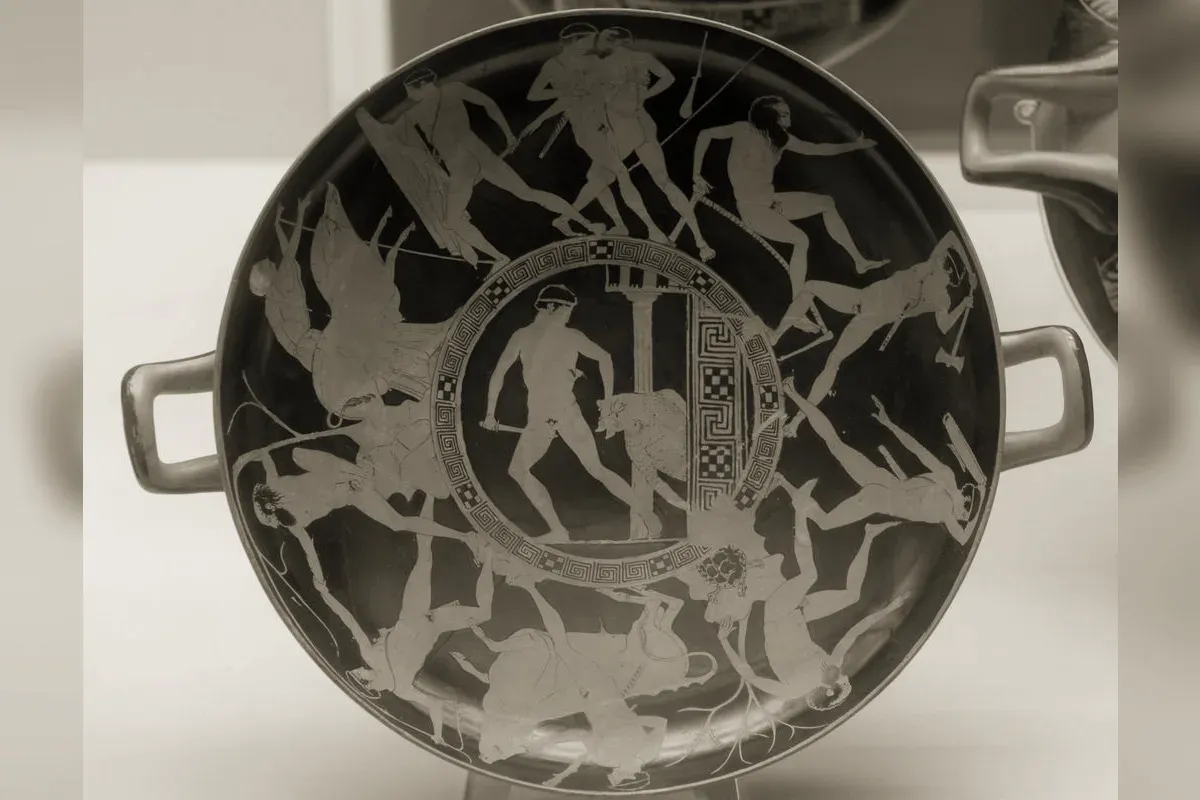
Theseus is the national hero of Athens, its civic counterpart to Heracles. Son of both the god Poseidon and the mortal king Aegeus, he unites divine legitimacy and dynastic authority in one person. Where Heracles is the hero of brute strength, Theseus is the hero of intelligence, justice, and political foundation.
The double birth
On the night Aegeus departs from Troezen, he unites with Aethra, daughter of King Pittheus. But according to the most widespread version, Poseidon also unites with Aethra that same night. Theseus inherits from both: Aegeus’s royal legitimacy and the divine power of the master of the seas.
Before leaving, Aegeus hides his sword and sandals beneath a rock in Troezen: “When the child can lift this stone, send him to find me.”
The road to Athens: six exploits
As soon as Theseus can lift the rock and recover the sword, he refuses the safe sea route and chooses the overland road to Athens — infested with bandits and monsters. This path is itself a series of heroic trials:
- Periphetes (the club-bearer), beaten with his own weapon.
- Sinis (the pine-bender), killed by his own technique: bound between two bent pine trees.
- The Sow of Crommyon, a monster ravaging the countryside, slaughtered.
- Sciron, a bandit who forced travelers to wash his feet before kicking them into the sea — hurled in himself.
- Cercyon, an invincible wrestler, defeated by technique rather than strength.
- Procrustes, the innkeeper who adjusted guests to his bed by stretching or cutting them — subjected to the same fate.
Theseus arrives in Athens covered in victories. Aegeus recognizes him by his sword before a poisoning attempt contrived by Medea can succeed.
The tribute to Crete
Athens pays a terrible tribute to King Minos of Crete: every nine years, seven young men and seven young women are sent to the Labyrinth to feed the Minotaur, half man and half bull. The third cycle approaches.
Theseus volunteers, intending to kill the monster. Athena grants him her protection. He embarks under black sails — the sign of mourning — with a promise to hoist white ones if he returns alive.
Ariadne and the thread
In Knossos, Ariadne, daughter of Minos, falls in love with Theseus. She gives him a ball of thread: he ties it at the entrance to the Labyrinth and unwinds it as he advances. It is the only way not to get lost in the immensity of the Labyrinth built by Daedalus for her father Minos.
Victory over the Minotaur
In the depths of the Labyrinth, Theseus confronts the Minotaur, born of the unnatural coupling of Pasiphae (Minos’s wife) with a white bull sent by Poseidon. Theseus kills it — with his bare hands in the oldest versions, with his sword in others — and follows the thread back out.
He takes Ariadne and the surviving Athenian youths with him. The fleet puts out to sea.
The fatal mistake and the death of Aegeus
In the euphoria of his return, Theseus forgets to swap the black sails for white ones. Aegeus, watching from the cliffs of the Acropolis, sees the dark sails and, believing his son dead, throws himself into the sea. The sea takes the name of the Aegean in memory of that loss.
Theseus returns as king, but crushed by guilt.
The founder of unified Athens
Once king of Athens, Theseus accomplishes a major political feat: the synoikism, the unification of the various cities and communities of Attica into a single state centered on Athens. He also establishes the Isthmian Games and the institution of hospitality toward strangers and suppliants.
Protected by Athena, child of Poseidon, he is the hero who reconciles the force of the waves and the wisdom of the city.
Further reading
For Theseus’s divine father, read the page on Poseidon. For the creature he fights, see the page on the Minotaur. For the goddess who protects him, explore the page on Athena. For the full account of the Labyrinth, Ariadne’s thread, and the founding of Athens, read Theseus and the Minotaur. For another hero whose clash with a monster at a city’s gates seals a tragic fate, read the page on Oedipus.
Ancient sources
- Plutarch, Theseus
- Apollodorus, Library, 3.15-16 and Epitome, 1
- Bacchylides, Dithyrambs, 17-18
- Ovid, Metamorphoses, 8.152-182
See also
Frequently asked questions
Is Theseus the son of Poseidon or King Aegeus?
Both, according to Greek mythology. His mother Aethra unites with the mortal Aegeus and the god Poseidon on the same night. Theseus therefore has a double paternity: a human father who passes him the throne of Athens, and a divine father who grants him power over the seas.
How does Theseus escape the Labyrinth?
Ariadne, daughter of King Minos and in love with Theseus, gives him a ball of thread. He ties it at the entrance and unwinds it as he goes deeper into the maze. After killing the Minotaur, he follows the thread back to the exit.
Why is the Aegean Sea named after Aegeus?
Before sailing for Crete, Theseus promises his father Aegeus to hoist white sails if he returns victorious. Forgetting his promise in the euphoria of victory, he returns with the black sails of mourning. Aegeus, believing his son dead, throws himself into the sea from the cliffs of Athens — a sea that thereafter bears his name.