Greek mythology · Gods & goddesses
Dionysus, god of wine and theater in Greek mythology
In brief
Dionysus, Greek god of wine, ecstasy, and theater: double birth, mystery cult, thyrsus and panther. The last of the Olympians.
- wine
- ecstasy
- theater
- vegetation fertility
- +6
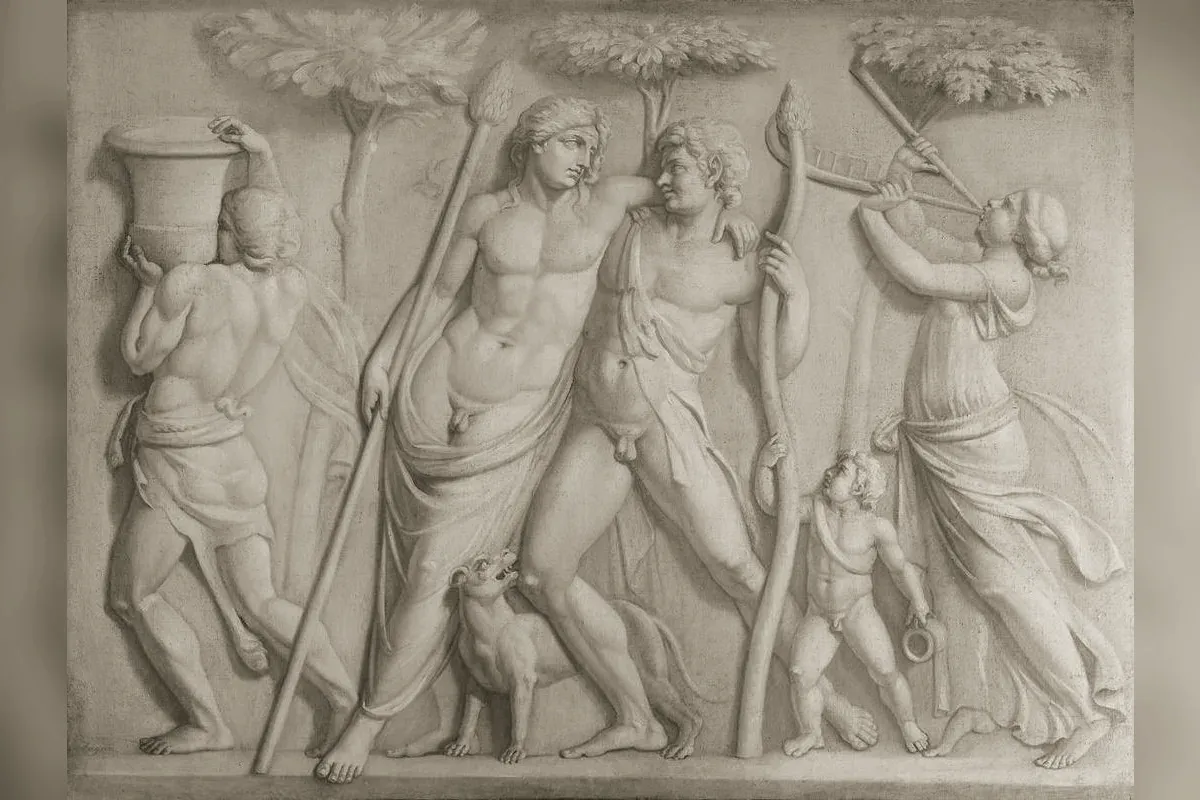
Dionysus is the last of the twelve Olympians to establish himself in the Greek pantheon, and possibly the most complex. God of wine, ecstasy, vegetation, and theater, he represents everything that exceeds reason, dissolves social boundaries, and opens toward the other. His cult — one of the most powerful of Antiquity — crossed centuries and civilizations.
A birth accomplished twice
The birth of Dionysus is among the most singular in all of Greek mythology. His mother, Semele, is a Theban princess, daughter of Cadmus and Harmonia. Zeus falls in love with her and visits her in mortal guise. Hera, consumed by jealousy, persuades Semele to ask Zeus to reveal himself in his full divine glory.
Zeus, bound by an unbreakable oath, appears in the blazing splendor of the thunderbolt. The radiance instantly kills the mortal woman. But Zeus saves the unborn child by sewing it into his own thigh, carrying it to term himself. Dionysus is thus born from his father’s thigh — he is dithyrambos, twice-born.
This double birth grants him a peculiar standing: son of a burnt mortal and a sovereign god, he lives at the boundary between two worlds.
Hera’s persecution and the nurses
Hera’s hatred does not relent. From the moment of Dionysus’s birth she seeks his destruction. Hermes entrusts him to several nurses in succession: first to the nymphs of Nysa, who teach him the secrets of the vine, then to his aunt Ino, a Theban queen. Hera drives each guardian to madness.
Eventually Dionysus is placed in the care of Rhea (or Cybele, depending on the version), who raises him in secret in Asia Minor until adulthood.
The god of intoxication and liberation
Dionysus discovers wine during his formative years in Asia. He then travels the world — Egypt, India, Thrace, Greece — accompanied by his retinue: the Maenads (initiated women in ecstatic states), Satyrs (half-men, half-goats), the god Pan, and Silenus, his aged tutor. It was for sheltering the straying Silenus that King Midas received from the god his ruinous golden touch.
His passage is liberation as much as conquest. Where he is welcomed, he teaches viticulture and the rites of his cult; where he is rejected, he punishes with implacable precision. King Pentheus of Thebes, who refuses to acknowledge the god, is torn apart by the Maenads in a sacred frenzy — his own mother Agave participating in the killing in a state of divine trance.
Ariadne and divine tenderness
After avenging his mother and conquering the world, Dionysus finds lasting love: Ariadne, daughter of King Minos, abandoned by Theseus on the island of Naxos. Dionysus discovers her and makes her his divine companion. Their union is one of the rare happy love stories in the Greek pantheon.
He gives Ariadne a crown later transformed into a constellation — the Corona Borealis.
Theater, the legacy of Dionysus
The link between Dionysus and Greek theater is not metaphorical — it is institutional. The Great Dionysia of Athens, held each spring, included competitions of tragedies, comedies, and satyr plays. The Theater of Dionysus on the south slope of the Acropolis is the oldest theater in the Western world.
Tragedy grew out of dithyrambs — choral songs in Dionysus’s honor — and theatrical performances long served as religious ceremonies, with masked actors embodying Dionysiac forces. Without Dionysus, there is no Sophocles, no Euripides, no Aristophanes.
His place in the Olympian pantheon
Dionysus is often presented as the last to arrive on Olympus. It is frequently claimed that Hestia yielded her place at the divine banquet to avoid conflict: no ancient source reports this, and the story is a modern mythographers’ device for reconciling divine lists that do not match. What is attested is that the membership of the “twelve gods” varies by city and by monument, Dionysus appearing in some groupings and not others. That unstable place reflects the progressive integration of his cult — originating in Thrace and Phrygia — into classical Greek religion.
With Zeus his father, Hera his persecutor, Hermes his divine protector, and Hephaestus his craftsman brother on Olympus, he belongs to the web of relationships that structure the divine family.
Mystery cult and religious legacy
The Dionysiac mysteries constitute one of the deepest religious forms of Greek Antiquity: secret initiatory rites promising their followers a privileged relationship with the god and the prospect of a blessed afterlife. These mysteries foreshadow, in certain respects, the great mystery religions of the Hellenistic world.
Further reading
For the divine origins of Dionysus, read the pages on Zeus and Hera. For Hermes’s role in protecting the infant god, see the page on Hermes. For the Cretan princess he marries and makes immortal, see the page on Ariadne. For the hero who leaves her on Naxos, read the page on Theseus. For his craftsman brother on Olympus, read the page on Hephaestus.
Ancient sources
- Euripides, Bacchae
- Homeric Hymn to Dionysus (no. 7)
- Hesiod, Theogony, lines 940-942
- Apollodorus, Library, 3.4.3 and 3.5
- Ovid, Metamorphoses, 3.259-315
See also
Frequently asked questions
What is the difference between Dionysus and Bacchus?
Dionysus is the Greek name and Bacchus the Roman name for the same god. In Rome, Bacchus became associated with the Bacchanalia — nocturnal orgies that the Roman Senate ultimately banned in 186 BCE.
Why is Dionysus said to have been born twice?
His mortal mother Semele was killed by the blinding glory of Zeus before Dionysus could be born. Zeus rescued the fetus by sewing it into his own thigh, carrying the child to term himself. Dionysus thus emerged twice — first from a mother's womb, then from his father's thigh.
What is the connection between Dionysus and Greek theater?
Greek theater grew directly from the Dionysiac festivals — the Great Dionysia and the Lenaia — held in Athens in honor of the god. Tragedy and comedy emerged from choral rituals and dithyrambs performed for Dionysus, and performances remained religious ceremonies for centuries.