Greek mythology · Gods & goddesses
Hephaestus, divine craftsman in Greek mythology
In brief
Hephaestus, Greek god of fire and the forge: painful birth, fall from Olympus, divine masterworks, and his role in the creation of Pandora.
- fire
- smithing
- divine craftsmanship
- metallurgy
- +5
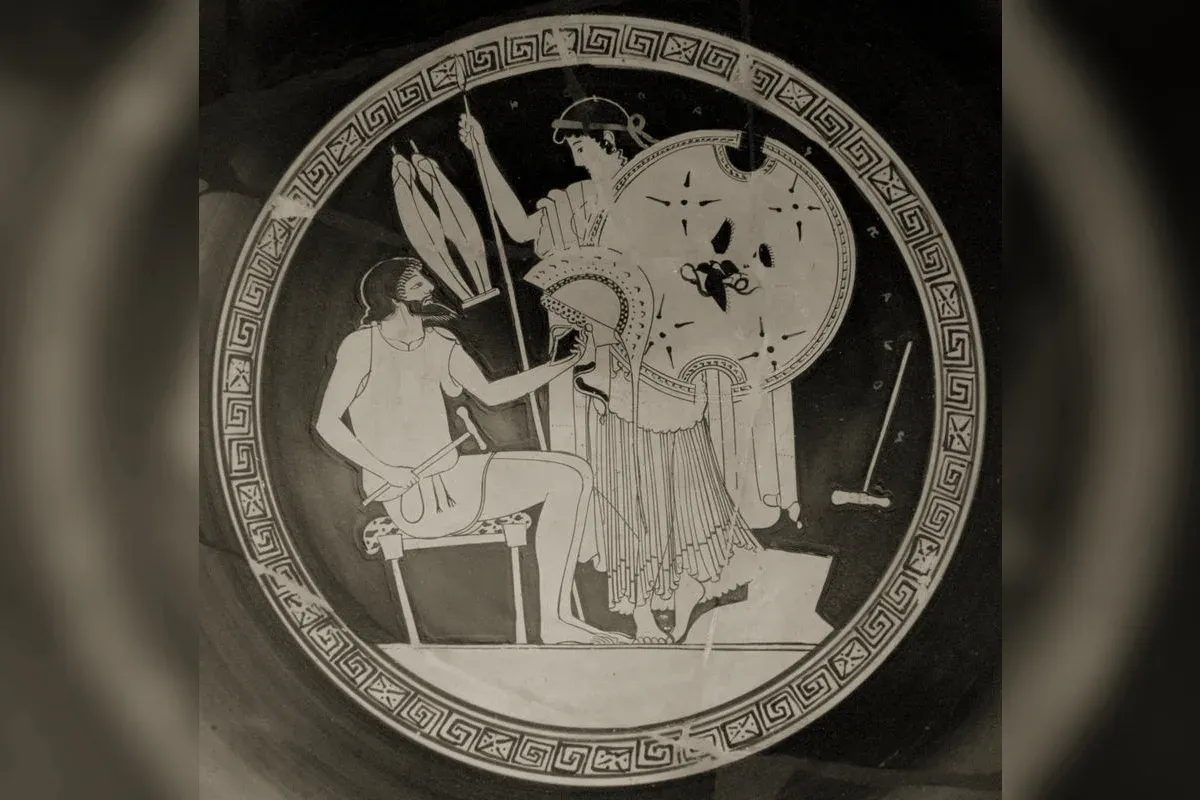
Hephaestus is the only Olympian who is ugly, lame, and works with his hands. In a pantheon of perfect beauty and abstract power, he is the craftsman, the engineer of the divine world — the one who gives material form to the ambitions of the gods. Behind his physical disgrace lie the most admirable masterworks of the Greek mythic universe.
A birth marked by rejection
The origin of Hephaestus is itself disputed. For Homer, he is the son of Zeus and Hera. For Hesiod — in a version that echoes the birth of Dionysus from Zeus alone — he is Hera’s son alone, conceived without a father to challenge Zeus.
In all traditions, his birth is followed by brutal rejection. Hera, horrified by the child’s ugliness or weakness, hurls him from Olympus. He falls for a full day before crashing into the sea or onto an island — Lemnos in the most widely known version. It is there, in contact with the island’s volcanic fire, that he learns his craft.
The fall and the revenge through art
Hephaestus does not roar with rage at his mother. He takes revenge through beauty. He forges for Hera a golden throne of unequaled splendor — equipped with invisible bonds. The moment she sits on it, she is imprisoned, unable to rise. No god can free Hera: only Hephaestus knows the mechanism.
According to one tradition, it is Dionysus who manages to get Hephaestus drunk and bring him back to Olympus, reconciling the smith with his divine family. In exchange, Hephaestus frees Hera and takes his seat among the Olympians.
The forge of the gods
On Olympus, Hephaestus is the architect and engineer of the divine universe. His creations are inexhaustible:
- The palaces of the gods on Olympus, built entirely by him.
- Zeus’s thunderbolt, first forged by the Cyclopes but perfected by Hephaestus.
- Poseidon’s trident and Hades’s cap of invisibility, weapons forged for the Titanomachy.
- Achilles’s armor, commissioned by Thetis and described at length in the Iliad — with a shield depicting the entire world.
- The invisible net that captures Ares and Aphrodite in flagrant adultery.
- Golden automata that serve as his workshop assistants — anticipating the idea of robots by two millennia.
Pandora and the creation of the first woman
The most ambitious work of Hephaestus — and the one with the heaviest consequences — is the creation of Pandora. At Zeus’s command, he shapes the first woman from clay, breathes life into her, and adorns her with beauty, charm, and curiosity. Each god bestows a gift — hence her name, “she who has all gifts.”
Pandora is given to Epimetheus, brother of Prometheus. She opens the jar entrusted to her, releasing all evils into the world. Hephaestus, by giving form to woman, inaugurates a new era for humanity.
Aphrodite and Olympian humiliation
The marriage of Hephaestus and Aphrodite is one of the cruelest ironies in Greek mythology: the ugliest god united with the most beautiful. Hera may have arranged the marriage to reward her son or to domesticate Aphrodite.
The union is unhappy. Aphrodite and Ares meet in secret. Hephaestus, informed by Helios, forges a microscopic, invisible net and spreads it over the marriage bed. The lovers are caught, exposed naked before the assembled gods. The scene is simultaneously comic and deeply humiliating.
The craftsman god, a philosophical figure
Hephaestus is the figure who reconciles intelligence with matter. His intelligence is a practical metis — similar to that of Hermes, but directed toward physical creation rather than speech and cunning. He mirrors the Greek artisans who were often socially marginal yet indispensable to the city.
For Plato, Hephaestus’s forge becomes a metaphor for the demiurge — the craftsman-god who gives shape to the world. In medieval Christian tradition, Vulcan (his Roman counterpart) would become the devil’s armorer, inverting the symbolic value of the creative fire.
Further reading
For the divine origins of Hephaestus and the context of his rejection, read the pages on Zeus and Hera. For his divine wife, see the page on Aphrodite. For the brother whose adultery the forge exposes, read the page on Ares. For the drunken reconciliation on Olympus, see the page on Dionysus.
Ancient sources
- Homer, Iliad, 1.571-600 and 18.368-617
- Homer, Odyssey, 8.266-366
- Hesiod, Theogony, lines 927-929
- Homeric Hymn to Hephaestus (no. 20)
- Apollodorus, Library, 1.3.5
See also
Frequently asked questions
Why is Hephaestus lame?
Two competing traditions exist. In one, Hera throws him from Olympus at birth, ashamed of his ugliness, and the fall breaks his legs. In the other, Zeus hurls him from the heavens during a quarrel, and he falls for a full day before crashing on the island of Lemnos.
What are the greatest works Hephaestus forged?
The most famous are: the palaces of the gods on Olympus, Achilles's armor and its cosmic shield, Zeus's thunderbolt, Poseidon's trident, Hades's cap of invisibility, Athena's aegis, golden automata that served as his workshop assistants, and the invisible net that caught Ares and Aphrodite together.
Who is Hephaestus married to?
According to Homer, Hephaestus is married to Aphrodite, goddess of love — one of the least harmonious unions on Olympus. Aphrodite regularly deceives him with Ares. Other sources give him Aglaea, one of the Graces.