Greek mythology · Creatures
The Lernaean Hydra, the many-headed serpent of Greek mythology
In brief
The Lernaean Hydra: a monstrous water serpent whose heads grow back when severed, the second labor of Heracles, its immortal venom, and its enduring symbolic legacy.
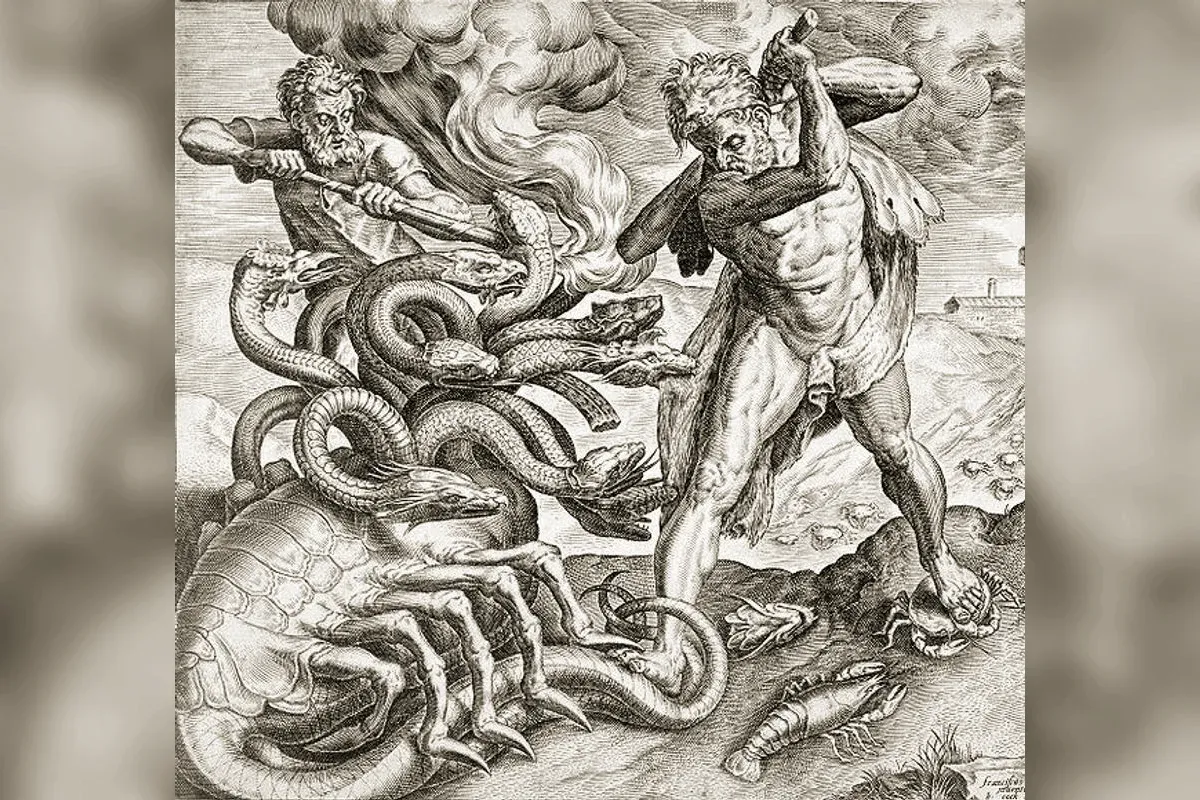
The Lernaean Hydra is one of the most formidable creatures in Greek mythology, and the second of the Twelve Labors that Heracles must complete to atone for his crime. A water monster whose severed heads grow back doubled, a venomous guardian of the springs of Lerna, she embodies a fundamental truth of heroic mythology: some adversaries can only be defeated by intelligence, not by brute force alone.
Description and origins
The Hydra is a colossal multi-headed serpent, born like so many Greek monsters from the union of Typhon and Echidna. She is therefore the sibling of Cerberus, the Nemean Lion, the Chimaera, and in some traditions, the Sphinx itself. This genealogy places the Hydra in the lineage of guardians — creatures who protect a location or threshold against any human intrusion.
Her habitat is the marshes of Lerna, in the Argolid. These wetlands, renowned in Antiquity for their springs and their unhealthy reputation, were considered an entrance to the underworld — the realm governed by Hades. The Hydra is both their guardian and their expression: a chthonic creature born from the depths, an embodiment of death through poison and infection.
According to Apollodorus, the Hydra possesses nine heads. The central one is immortal and cannot be destroyed by any ordinary means. The other eight have a terrifying property: each severed head grows back as two. This regeneration mechanism makes any frontal assault not merely useless but actively counterproductive.
Hera, who had despised Heracles since his birth, had personally reared the Hydra for the sole purpose of destroying him.
The second labor: the battle at Lerna
Heracles travels to Lerna with his nephew Iolaus as charioteer. He forces the Hydra out of her lair by shooting flaming arrows into the depths of the marsh. When the creature emerges, the fight begins.
The hero quickly discovers that cutting off heads makes matters worse: two grow back for every one severed. The battle seems unwinnable — and Hera, watching from Olympus, even sends a giant crab to bite Heracles’s feet and further disrupt the struggle. This intervention is characteristic of the goddess’s method: even when Zeus looks favorably on his son, Hera finds ways to sabotage each victory.
Heracles crushes the crab underfoot. Then he changes strategy: he calls on Iolaus to kindle a fire with torches or cut branches. After severing each head, Heracles immediately cauterizes the stump with flame, preventing regeneration. Head by head, he advances.
The final head — the immortal one — cannot be destroyed. Heracles severs it and buries it alive beneath a massive rock at the roadside, where it remains entombed for eternity, removed from danger but rendered harmless.
The immortal venom: a weapon and a curse
After his victory, Heracles makes a decisive choice: he dips his arrows in the blood and bile of the dead Hydra. This venom is absolutely lethal — a single arrow is enough to kill any mortal being, and even gods are not immune.
This decision transforms the defeated Hydra into a permanent threat, dispersed through all of the hero’s future adventures. The poisoned arrows play a crucial role in several later episodes:
- The death of the centaur Nessus, struck down by Heracles when the centaur tries to abduct Deianeira.
- The accidental death of the centaur Chiron, hit by stray during a brawl with other centaurs.
Above all, the death of Heracles himself. The dying Nessus tells Deianeira to preserve his blood as a supposed love charm. Years later, fearing she is losing Heracles’s affection, Deianeira soaks a robe in it. Heracles puts on the garment and the Hydra’s venom burns him from within, incurable. The Hydra defeated at Lerna eventually kills her own conqueror — a reversal that Greek mythology savors.
A labor invalidated by Eurystheus
King Eurystheus, who supervised Heracles’s labors, refused to count this victory among the ten required. His argument: Heracles had received help from Iolaus for the cauterizations, violating the rule of single combat. This ruling forced Heracles to complete two additional labors — bringing the total to twelve rather than ten.
This detail reveals an essential moral dimension of the heroic cycle: a victory achieved by cunning or with assistance is not fully recognized as meritorious by those who set the rules. Heracles wins, but pays for the method.
The Hydra as symbol
The symbolic power of the Hydra extends far beyond Greek mythology. Its regeneration property makes it the archetype of any problem that worsens the more you try to solve it: cut one head off the conflict, the evil, or the institutional hydra, and two will grow back.
In biology, the genus Hydra — freshwater polyps capable of regenerating any part of their body — takes its name from this mythological creature. Unlimited regeneration remains, in the scientific imagination, one of the most astonishing properties of living matter.
In political and philosophical vocabulary, “the hydra of…” has designated since Antiquity any phenomenon that resists eradication through its capacity for multiplication.
Further reading
For the hero who faced and defeated the Hydra, read the page on Heracles. For the goddess who reared the Hydra to destroy him, see the page on Hera. For the monstrous lineage to which the Hydra belongs, read the page on Cerberus and the Sphinx, all born of Typhon and Echidna. For the god of the underworld whose domain adjoins the chthonic springs of Lerna, see Hades. For the divine father of Heracles, whose power stands in contrast to his inability to shield his son from these trials, read the page on Zeus.
Ancient sources
- Hesiod, Theogony, lines 313-318
- Apollodorus, Library, 2.5.2
- Euripides, Heracles, lines 419-421
- Diodorus Siculus, Library of History, 4.11
See also
Frequently asked questions
How many heads did the Lernaean Hydra have?
Sources vary: Hesiod describes a monstrous creature without specifying a number, Apollodorus gives nine heads with one immortal at the center, Diodorus Siculus mentions a hundred, and other traditions cite five or seven. The nine-headed version, canonized by Apollodorus, is the most widely known in popular culture.
Why was the second labor declared invalid by Eurystheus?
Eurystheus refused to count the second labor among the ten mandatory tasks, on the grounds that Heracles had received help from his nephew Iolaus to cauterize the stumps. Having benefited from assistance, Heracles could not claim a solo victory under the terms of the oracle. He therefore had to complete two additional labors.
Why does the Hydra's venom matter after her death?
Heracles dipped his arrows in the Hydra's venomous blood, making them lethal to any living being they touched. Decades later, this same venom caused his own death: the centaur Nessus, mortally wounded by a poisoned arrow, told Deianeira to keep his blood as a supposed love charm. She soaked a robe in it. Heracles donned the robe and was burned alive from within — the Hydra he defeated at Lerna ultimately killed its own conqueror.