Greek mythology · Creatures
The Sphinx of Greek Mythology: the creature with the fatal riddle
In brief
The Greek Sphinx: hybrid monster sent by Hera to terrorize Thebes, its legendary riddle, Oedipus's answer, and what this creature reveals about knowledge and death.
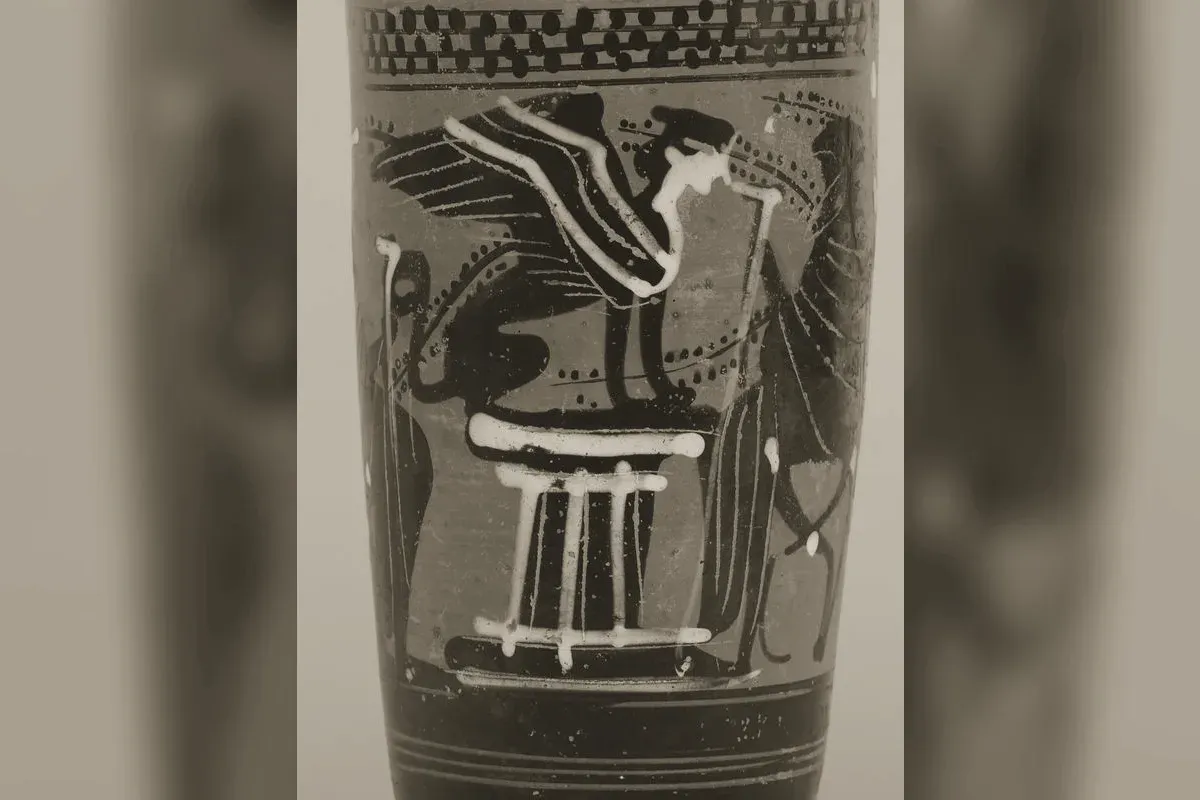
The Sphinx is one of the most intellectually singular monsters in all of Greek mythology. Perched on the rocky heights above the road to Thebes, it poses a question to every traveler — and those who fail to answer are devoured. Its reign of terror ends only when a man condemned by the gods, Oedipus, speaks the one answer that destroys it.
Portrait of a singular monster
The Greek Sphinx is a composite creature of three natures fused into one. Its body is that of a lioness — raw predatory power and untameable wilderness. Its wings are those of an eagle — dominion over height and sky, the capacity to see everything from above. Its face and chest are those of a woman — and this is what sets it apart from every purely animal monster in the Greek tradition: it thinks, it speaks, it composes riddles.
This triple nature — earth, air, and human reason — makes the Sphinx a creature of thresholds. It belongs fully to no single kingdom, and this liminal position is precisely what grants it its power as an implacable gatekeeper.
Ancient sources give the Sphinx Typhon and Echidna as parents, the two primordial figures of the monstrous in Greek mythology. Typhon is the ultimate adversary of Zeus himself — the one being that nearly overthrew Olympian order, the chaos against which the gods fought in the primordial wars described in the Titanomachy. Echidna is mother to nearly every great Greek monster: Cerberus, the Lernaean Hydra, the Chimera. The Sphinx therefore belongs to the highest lineage of the monstrous.
Some versions make it instead the child of Orthrus — the two-headed dog that guarded Geryon’s cattle — and Echidna, a genealogy that reinforces the Sphinx’s connection to guardians of passages and forbidden boundaries.
Sent by Hera to punish Thebes
The Sphinx is not a natural catastrophe. In the main tradition, it is Hera who sends the creature deliberately to Thebes. The reason lies in the crimes of the royal line: the city shelters the house of Laius, a king who had himself committed grave transgressions against divine hospitality (xenia), having violated Chrysippus, the son of Pelops. The curse on the Theban house flows from that act.
Hera, as guardian of marriage and moral order, is also a power of punishment. She uses the Sphinx as an instrument — much as she uses other divine agents to punish those who transgress fundamental laws. The pattern echoes her treatment of Heracles: the goddess rarely destroys directly; she creates the conditions for destruction.
Whatever the precise trigger, the Sphinx takes its post on a rock commanding the main road into Thebes. Every traveler who tries to enter or leave must answer the riddle. Those who fail — princes, warriors, scholars — are devoured or hurled into the abyss. The city is strangled. King Creon, regent after Laius’s death, promises the crown of Thebes and the hand of his sister Jocasta to whoever frees the city.
The riddle and what it stakes
The Sphinx’s riddle is among the most famous questions in all of ancient literature, and its fame is not accidental: it cuts to the definition of what it means to be human.
In its most widely attested form, the riddle runs:
What creature, with a single voice, walks on four legs in the morning, two legs at noon, and three legs in the evening?
The answer is the human being — the only creature to pass through three states of locomotion across a single lifetime. Morning stands for infancy (the crawling child), noon for adulthood (the person who walks upright), evening for old age (the elder who leans on a staff). The metaphor mapping a day onto the span of a life is exact, inevitable, and devastating in its simplicity.
What is most striking about this riddle is that it is not an erudite trap for philosophers. Its answer is universal, available to any person willing to reflect on their own condition. And yet dozens of challengers fail. Why? Because the answer requires a radical act of self-recognition: seeing oneself inside the question, accepting one’s own vulnerability and mortality. It is an act of humility that pride refuses.
Oedipus answers without hesitation. This act — immediate lucidity about the human condition — defines the hero’s character before his personal tragedy has even begun to unfold.
The encounter between Oedipus and the Sphinx
Oedipus arrives at Thebes as a stranger. He has fled Corinth to escape an oracle foretelling that he will kill his father and marry his mother. On the road, he has already — unknowingly — fulfilled the first part of the prophecy by killing Laius in a roadside quarrel. He now stands before the Sphinx.
He hears the riddle and answers: the human being.
The Sphinx, according to the various sources, then hurls itself from its rocky perch into the abyss, or dashes itself against the stones below, or simply disappears. Its death is almost mechanical: the riddle answered dissolves the condition of its existence.
Oedipus enters Thebes as its liberator. He receives the promised crown and marries Jocasta — his own mother, though neither knows it. The tragic irony is total: by defeating the Sphinx through wisdom, Oedipus fulfills precisely the fate he had fled. His victory over the riddle-keeper leads him directly to his own deepest riddle — his cursed identity.
The god who holds the threads of this story is Apollo, whose oracle at Delphi had delivered the original prophecy. The hidden truth behind the Sphinx’s riddle is only the prelude to the hidden truth behind Oedipus’s own nature. The Sphinx asks what a human being is; Apollo ensures that Oedipus will learn the answer in the most devastating way imaginable.
The Sphinx as symbol
The Sphinx concentrates several essential symbolic tensions in Greek thought.
The boundary between knowledge and death. The Sphinx does not kill for pleasure or hunger — it kills those who do not know. Knowledge here is literally a matter of survival. This is a radical vision: ignorance kills, and wisdom is the only protection. The motif anticipates the great preoccupation of Greek philosophy with self-knowledge (gnôthi seauton — know thyself) as the foundation of a well-lived life.
Monstrousness as cognitive test. In Greek mythology, monsters are typically physical trials that heroes must overcome. But the Sphinx does not fight with weapons: it challenges with thought. It is the only major Greek monster that functions more as a philosopher than a brute predator — closer, in a sense, to Hermes the god of riddles and hidden passages than to the raw violence of the Cyclops or the serpentine horror of Medusa.
Femininity and forbidden knowledge. The Sphinx bears a woman’s face — and in archaic Greek culture, hybrid creatures with female faces (Sirens, Harpies, Gorgons like Medusa) typically embody a form of seductive danger or unresolved mystery. The Sphinx continues this troubling association between the feminine and lethal, hidden knowledge.
Knowledge turned against its possessor. Oedipus defeats the Sphinx through knowledge — and it is precisely through knowledge (his investigation into Laius’s death, the revelation of his own identity) that his life is destroyed. There is a cruel logic here: the same weapon that saves Thebes will shatter its savior.
The Sphinx’s symbolic afterlife
The Sphinx does not truly die when it falls from its rock. It survives in the Western imagination as the emblem of unsolvable mystery, forbidden knowledge, the question whose answer costs everything. Sophocles makes it the pivot of Oedipus Rex, one of the most performed plays in the history of world theater. Jean Cocteau revisited the figure in the twentieth century in The Infernal Machine, where the Sphinx becomes a tragic, almost pitiable figure.
The creature also resonates beyond any single myth. When Heracles battles the children of Typhon and Echidna in his labors, he faces the same genealogical darkness the Sphinx embodies — a lineage that includes Cerberus, the Hydra, and the Chimera, each representing a different dimension of what lies beyond the ordered human world.
The Sphinx asks its question eternally because the question it poses has no final answer. Every age must answer it again for itself.
Further reading
To understand the divine context in which the punishment of Thebes unfolds, read the page on Hera. For the monstrous genealogy the Sphinx shares with its siblings, see the page on Cerberus. For the other great hybrid creature with a lethal gaze from the same monstrous generation, read the page on Medusa. For the god whose oracle governs all of Oedipus’s fate, read the page on Apollo. For the hero who also confronts the children of Typhon and Echidna through divine-imposed trials, see Heracles.
Ancient sources
- Hesiod, Theogony, lines 326-329
- Sophocles, Oedipus the King
- Apollodorus, Library, 3.5.8
- Euripides, Phoenician Women, lines 1019-1042
See also
Frequently asked questions
What is the riddle of the Sphinx in Greek mythology?
The classic riddle, as recorded by Sophocles and the ancient scholiasts, is: 'What creature, with a single voice, walks on four legs in the morning, two legs at noon, and three legs in the evening?' The answer is the human being: a person crawls in infancy, walks upright in adulthood, and leans on a staff in old age. The riddle is ultimately about mortality and the arc of human life.
Why does the Sphinx throw itself off the cliff after Oedipus answers?
The Sphinx was bound to its riddle by a divine oracle or magical condition: if someone answered correctly, it had to die. Its very existence was contingent on the perpetual failure of mortals. Oedipus's answer does not defeat the Sphinx by force — it annuls the condition that gave the creature its existence and its purpose.
How does the Greek Sphinx differ from the Egyptian Sphinx?
The Egyptian Sphinx, such as the Great Sphinx of Giza, has a man's head on a lion's body and serves as a royal guardian symbol tied to solar worship. The Greek Sphinx is female, winged, and above all a creature of language and riddle — a lethal interrogator rather than a silent monument. The two share only the composite form and the name, which may have traveled from Egypt to Greece.