Egyptian mythology · Gods & goddesses
Amun, the hidden god and king of the gods in Egyptian mythology
In brief
Amun, Egyptian god of Thebes: his hidden origin, fusion into Amun-Ra, the temple of Karnak, Akhenaten's reform, and his status as king of the gods under the New Kingdom.
- air and invisible breath
- divine kingship
- hidden creation
- protection of the empire
- +4
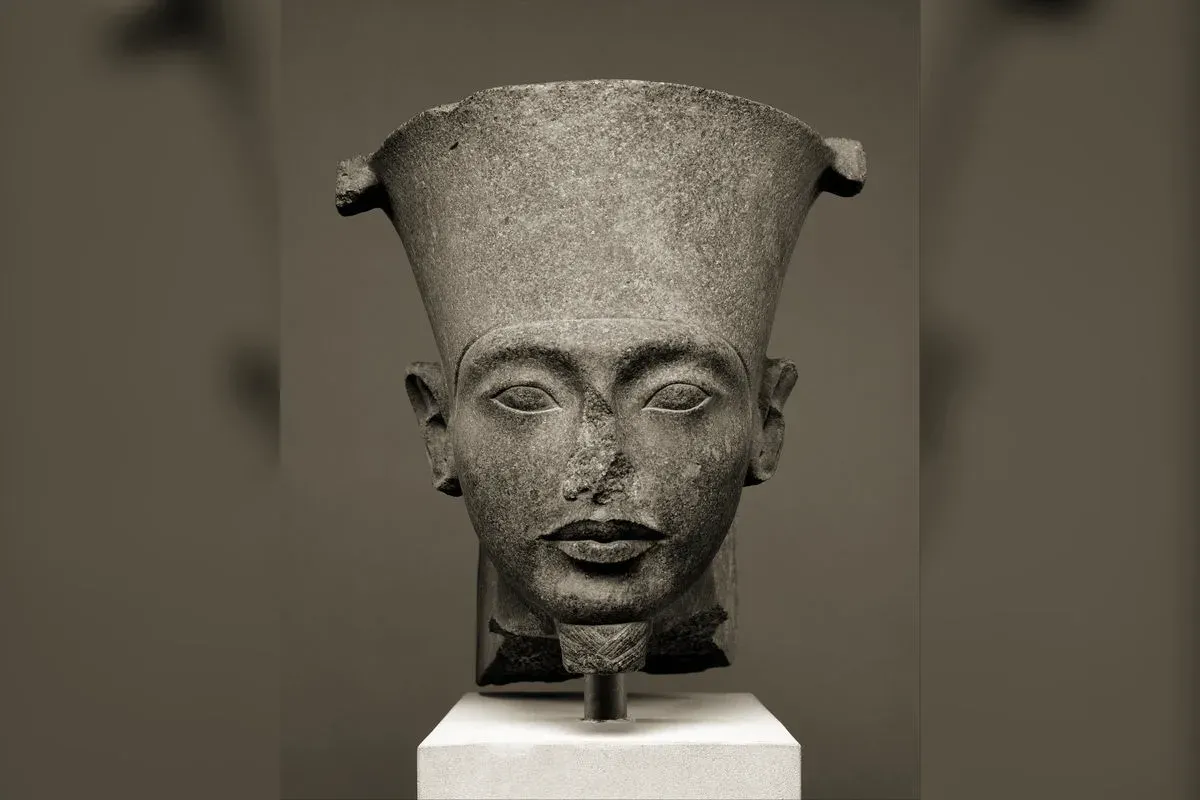
Who is Amun?
Amun is the Egyptian god of invisible breath and hidden kingship who, from the Middle Kingdom onward, became the supreme protector of Thebes and then the true king of the gods of imperial Egypt. His name, Jmn, “the Hidden One,” sums up his theological nature: unlike Ra, the direct embodiment of the visible sun disk, Amun is a power never seen directly — the air, the breath, the active principle behind every visible thing.
Role, nature, and Theban rise
Amun first appears as one of the eight primordial gods of the Hermopolitan Ogdoad, personifying with his consort Amaunet the principle of invisibility within primordial chaos. Originally a simple local god of Thebes, then a secondary city of Upper Egypt, his rise was spectacular: when Theban princes of the 11th and later 18th dynasties unified Egypt and founded the Middle and then New Kingdoms, they made Amun their dynastic god — and thus the national god.
The Amun-Ra fusion
Under the 18th dynasty, Theban theology fused Amun with Ra to produce Amun-Ra, a synthesis of hidden mystery and manifest solar power. Pharaohs such as Thutmose III and Ramesses II proclaimed themselves sons of Amun-Ra, claiming a legitimacy that was both solar and Theban. This fusion did not erase either god’s distinct identity: Amun continued to be worshipped alone at Karnak, while Ra retained his own Heliopolitan cult center and his own mythological cycle, notably his nightly battle against the serpent Apophis.
Karnak, the largest religious complex ever built
Amun’s cult center, the temple of Karnak, became under the New Kingdom the largest religious complex ever built in ancient Egypt, expanded over more than two thousand years by successive generations of pharaohs. Each year, the Opet festival saw Amun’s cult statue leave Karnak in a river procession to reach the temple of Luxor, symbolically renewing the fusion between royal power and hidden divine power.
The Theban triad
Amun forms, with his wife Mut (a protective vulture-headed goddess) and their son Khonsu (a lunar god), the Theban triad — the city’s tutelary divine family, celebrated together during major religious festivals and depicted on numerous reliefs at Karnak and Luxor.
The power of Amun’s priesthood and Akhenaten’s reform
The economic and political power of Amun’s priesthood grew, over the course of the New Kingdom, to nearly rival that of the pharaoh himself: land, workshops, and tribute flowed toward Karnak. This latent rivalry reached its peak under Akhenaten (c. 1353–1336 BC), who imposed exclusive worship of the sun disk Aten, had Amun’s name and image systematically chiseled off monuments, and moved the capital to Akhetaten (Tell el-Amarna). This attempt at solar monotheism did not survive his reign: his successor, Tutankhaten, restored the cult of Amun and changed his own name to Tutankhamun to solemnly affirm it.
What ancient sources say
The Great Hymn to Amun (Papyrus Boulaq 17, 18th dynasty, held at the Egyptian Museum in Cairo) celebrates Amun as a hidden, creative power preceding every visible form. The Leiden Papyrus (Leiden I 350, New Kingdom) develops a henotheistic theology in which Amun-Ra is presented as the single substrate behind the multiplicity of Egyptian gods. The monumental inscriptions of Karnak, accumulated over two millennia, document the god’s political and religious rise across successive dynasties.
Further reading
For the solar god whose fusion with Amun produces the supreme imperial divinity, see the page on Ra. For the god of living kingship the pharaoh embodies under Amun’s protection, see the page on Horus. For the divine scribe who shares with Amun the dimension of hidden knowledge, see the page on Thoth.
See also
Frequently asked questions
Are Amun and Ra the same god?
Originally, no: Amun is a local Theban god of invisible air, while Ra is the solar god of Heliopolis. Under the New Kingdom, their theological fusion into Amun-Ra combined the former's hidden mystery with the latter's visible solar power, producing the most powerful divinity of imperial Egypt — without erasing either god's distinct identity in other ritual contexts.
Why did Akhenaten try to erase the cult of Amun?
Pharaoh Akhenaten (c. 1353–1336 BC) imposed exclusive worship of the sun disk Aten, had Amun's name and image chiseled off monuments, and closed the Theban temples. The reform also targeted Amun's priesthood, which had grown so wealthy and powerful in Thebes that it rivaled pharaonic authority. After Akhenaten's death, his successor Tutankhaten restored the cult of Amun and changed his own name to Tutankhamun to prove it publicly.
What was the Theban triad?
The Theban triad brought together Amun, his wife Mut (a protective vulture goddess), and their son Khonsu (a lunar god), forming the tutelary divine family of Thebes. This family unit, celebrated each year during the Opet festival — when statues of the three deities processed between the temples of Karnak and Luxor — shaped Theban theology and religious calendar under the New Kingdom.