Amun, the hidden god and king of the gods in Egyptian mythology
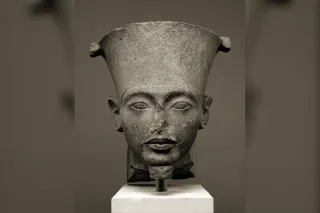
Amun, Egyptian god of Thebes: his hidden origin, fusion into Amun-Ra, the temple of Karnak, Akhenaten's reform, and his status as king of the gods under the New Kingdom.
Northeast Africa — Nile Valley
A complete guide to Egyptian mythology: pantheon overview, cosmogony, Osirian cycle, major myths, ancient sources and religious traditions of ancient Egypt.
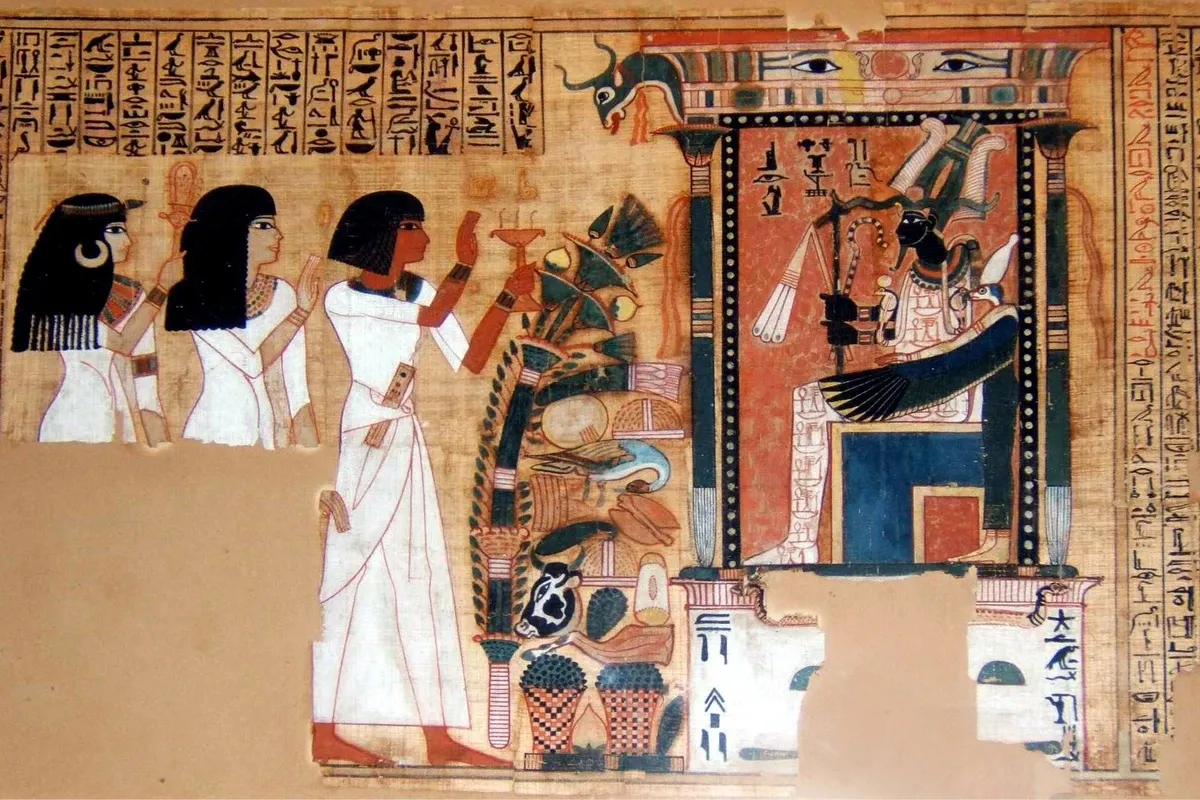
Amun, Egyptian god of Thebes: his hidden origin, fusion into Amun-Ra, the temple of Karnak, Akhenaten's reform, and his status as king of the gods under the New Kingdom.
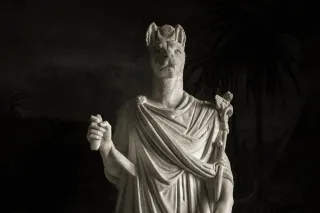
Anubis, the jackal-headed god of ancient Egypt: guardian of the dead, divine embalmer, guide of souls, and overseer of the weighing of the heart.
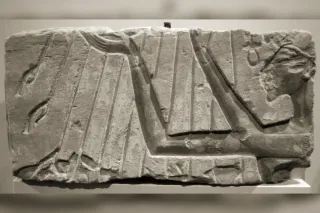
The Aten, the sun disk raised to sole god by Akhenaten: no human image, no myth, a name in royal cartouches, the Great Hymn at Amarna, and its erasure.
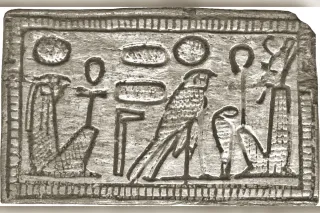
Atum, creator god of Heliopolis: the self-created demiurge who rose from Nun, begot Shu and Tefnut, founded the Ennead and embodies the setting sun, father of the gods.
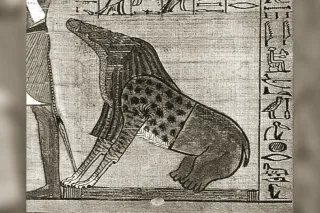
Ammit, the Egyptian creature with a crocodile's head, a lion's chest, and a hippopotamus's hindquarters: her devouring of the impure heart and the second death.
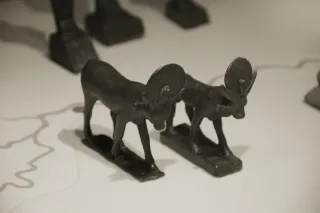
Apis, the sacred bull of Memphis: recognised by his markings, living herald of Ptah, mummified in the Serapeum of Saqqara and reborn as Osiris-Apis, ancestor of Serapis.
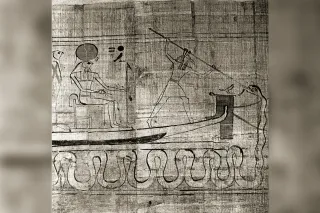
Apophis (Apep), the giant serpent of chaos in Egyptian mythology: sworn enemy of Ra whom he attacks each night in the Duat, and the rites of annihilation used to defeat him.
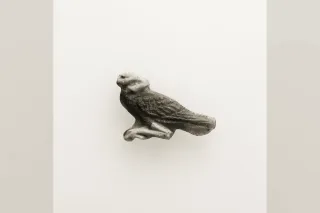
The Bennu, sacred heron of Heliopolis: a self-created bird perched on the benben stone, ba of Ra and Osiris, and the Egyptian original behind the Greek phoenix.
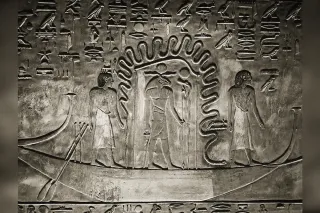
The Duat, the Egyptian underworld: nocturnal realm crossed by the sun, place of Osiris's judgment and the twelve hours of the night mapped by the funerary books.
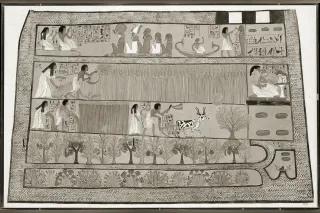
The Field of Reeds (Sekhet-Iaru), the Egyptian afterlife paradise: an idealised Egypt where the justified dead plough, harvest, and send shabtis to do the work.
Creation myths
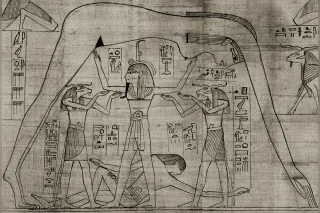
The Egyptian creation myth: from the primordial Nun to Atum, the birth of the Heliopolitan Ennead and the order of the world against the chaos of Apophis.
Death and afterlife
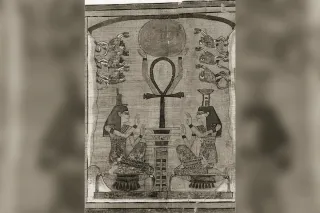
The Egyptian Judgment of the Dead: the Hall of Two Truths, the Negative Confession before forty-two divine assessors, and Anubis weighing the heart against Maat's feather.
Death and afterlife
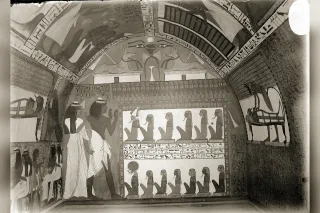
The complete Osiris myth: murder by Seth, Isis's quest, dismemberment, reassembly and resurrection — the founding narrative of ancient Egyptian funerary theology.
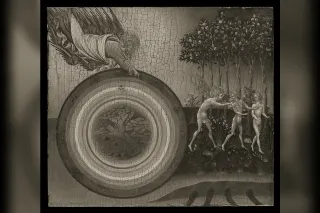
Creation myths compared: Greek Chaos, Egyptian Nun, Norse Ginnungagap and Mesopotamian combat. How each tradition wrests an ordered world from chaos.
A comparison of death deities and underworld rulers in Greek, Egyptian, Norse, Roman, Japanese, Hindu, Aztec, and Celtic mythologies.
A comparison of love deities in Greek, Roman, Norse and Egyptian mythology: Aphrodite, Venus, Freya, Hathor, Eros and Cupid compared across traditions.
Egyptian mythology is one of the oldest and most thoroughly documented religious systems in human history. Developed over more than three thousand years along the Nile, it features a pantheon of several hundred deities organised into cosmogonic cycles, royal myths, and eschatological narratives where death is never an ending but a transformation.
Ancient Egypt never possessed a single unified theological canon. Each major city had its own creation myth and tutelary deities; these local cycles coexisted, merged, and were periodically reinterpreted:
Heliopolis’s creation myth, the most influential of all, places Ra (in the form of Atum) at the origin of everything: emerging from Nun, the primordial ocean, he creates Shu (air) and Tefnut (moisture) through his own breath. They beget Geb (earth) and Nut (sky), whose children are Osiris, Isis, Seth, and Nephthys. This genealogy forms the Great Ennead, the nine founding deities of world order (Maat).
At the heart of Egyptian mythology lies the cycle of Osiris: his murder at the hands of his brother Seth, Isis’s quest to reassemble his dismembered body, his resurrection as the first embalmed deity, and the birth of Horus, who will avenge his father and reclaim the throne of Egypt.
This cycle underpins both funerary theology — every dead person hopes to “become Osiris” — and royal theology: every living pharaoh is Horus; every dead pharaoh becomes Osiris. This equation between earthly kingship and funerary kingship runs unbroken through three millennia of Egyptian civilisation.
Egyptian funerary cosmology describes the Duat, the underworld through which the sun travels each night: Ra battles the cosmic serpent Apophis — embodiment of chaos —, attends the judgment of souls presided over by Osiris, and is reborn on the horizon at dawn. The Book of the Dead and the Amduat detail the stages of this nocturnal journey and the magical spells that allow the dead to pass through it safely.
Ancient Egyptian religion outlasted Alexander the Great (330 BCE) and the Roman conquest (30 BCE). The Ptolemies adopted the Egyptian pantheon, and the cult of Isis spread throughout the Roman Empire. The last sanctuaries — notably the temple of Philae, dedicated to Isis — did not close until the fifth century CE under Christian pressure. Hieroglyphic writing fell into disuse around 396 CE, making the sacred texts inaccessible for fourteen centuries until Champollion’s decipherment of the Rosetta Stone in 1822.
To compare Osiris — judge of the dead in ancient Egypt — with death deities from other civilisations (Hades, Hel, Yama…), read the comparison Gods of death across 8 world mythologies.