Gods of Love in World Mythologies
In brief
A comparison of love deities in Greek, Roman, Norse and Egyptian mythology: Aphrodite, Venus, Freya, Hathor, Eros and Cupid compared across traditions.
- Greek mythology
- Roman mythology
- Norse mythology
- Egyptian mythology
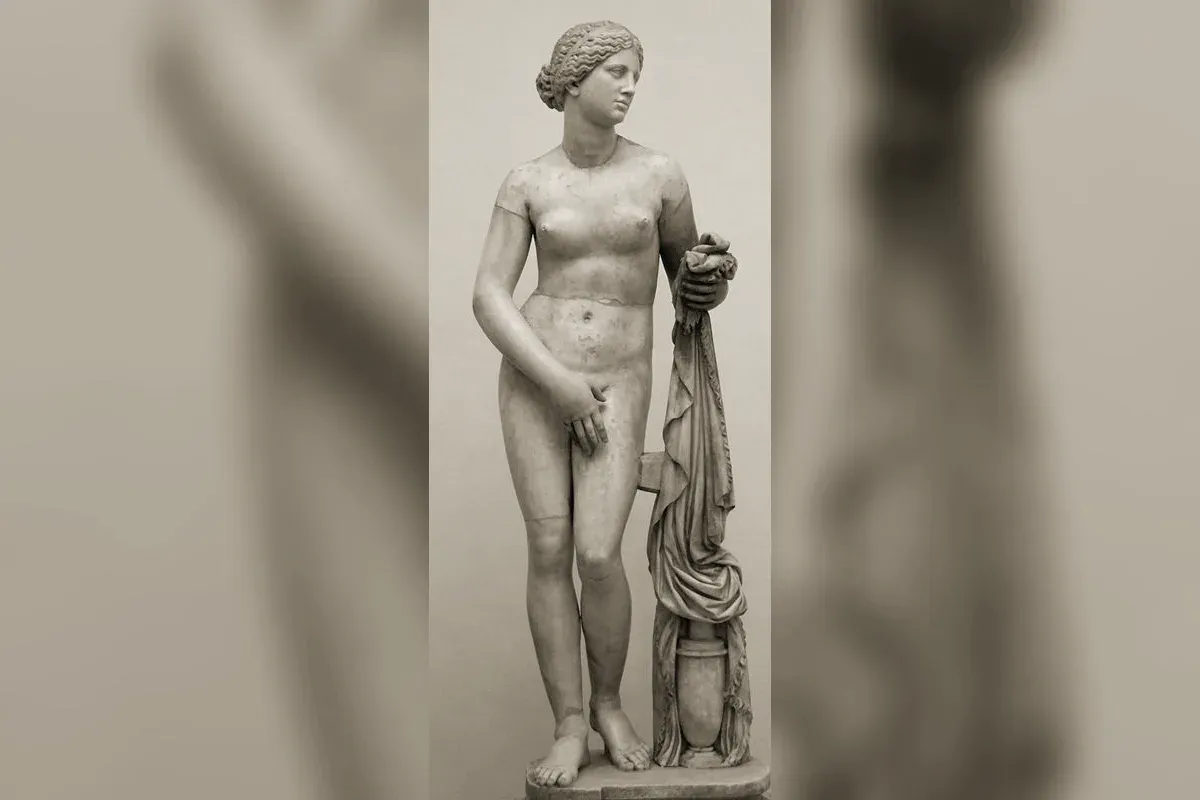
Love’s divine face is never just one figure. Every great mythological tradition placed at the heart of the cosmos one or more powers governing desire, beauty, union, and fertility. But these love figures reveal radically different conceptions: desire as a cosmic force or personal emotion, love linked to war and death or kept apart from them, a single goddess or a male/female pair. A survey across four traditions.
1. Aphrodite and Eros — Greece: love as force and as trap
In the Greek pantheon, love is governed by two complementary figures.
Aphrodite is the goddess of love, beauty, and desire. Her birth is singular: according to Hesiod (Theogony), she arose from the sea-foam where the severed genitals of Ouranos fell after Cronus’s blow. She embodies the desire that draws beings toward one another — and that can destroy them. Her role in the Judgement of Paris, promising him the love of Helen, triggered the Trojan War.
Eros is her son (or an independent cosmic power, depending on the author). In Hesiod’s Theogony, he is one of the first forces to emerge from Chaos, before even the gods. He personifies the power of desire that unites beings and generates life. In Hellenistic poetry, he becomes a mischievous infant armed with golden arrows (which cause love) and lead ones (which cause rejection).
The Greek conception of love is therefore double: a primordial cosmic force (Eros) and a personal, narrative goddess (Aphrodite), whose interventions in human affairs are as often a source of disorder as of beauty.
2. Venus and Cupid — Rome: love deified and nationalized
Rome inherited the Greek pair but gave it a particular political dimension.
Venus is the interpretatio romana of Aphrodite. While she shares her Greek counterpart’s attributes — beauty, desire, the sea, the shell — she enjoys a civic importance that Greece never accorded her: mother of Aeneas, legendary ancestor of the Romans and the gens Julia, she is also the founding protectress of Rome. Julius Caesar devoted a particular cult to her and claimed descent from her.
Cupid (Cupido, from Latin cupiditas, desire), son of Venus and Mars (or Mercury in some versions), inherits the form of the Hellenistic Eros — the winged child with arrows — and becomes the visual icon of romantic love throughout the Western tradition. In Apuleius (The Golden Ass), he takes a central narrative role in the tale of Cupid and Psyche, one of antiquity’s most influential love stories.
3. Freya — Scandinavia: love and death intertwined
Freya (Freyja in Old Norse, “the Lady”) is the great Norse goddess of love, beauty, fertility, and desire. Belonging to the Vanir — the divine family associated with fertility and magic — she joined the Aesir after the Aesir-Vanir War. She possesses the necklace Brísingamen (symbol of her power), a falcon-feather cloak, and a chariot drawn by two cats.
What distinguishes Freya radically from Aphrodite is her funereal and martial dimension: she commands the Valkyries and receives half of the warriors fallen in battle in her domain Fólkvangr (the other half go to Odin in Valhalla). Love, death, and warriors’ fates are inseparable in her — a conception with no equivalent in the Greek world.
She also masters seiðr, a form of shamanic magic associated with knowledge of the future and manipulation of fate.
4. Hathor — Egypt: love, music, and the cosmos
Hathor (Hwt-Hr, “House of Horus”) is one of the great goddesses of the Egyptian pantheon. Her domain encompasses love, beauty, music, joy, fertility, and motherhood — but also death, in her manifestation as Goddess of the Necropolises.
She is represented as a cow, a woman with cow’s ears, or a woman wearing cow horns framing a solar disc. Her connection to the sun (daughter of Ra according to some texts) gives her a cosmic dimension that the Greek and Roman goddesses lack.
Isis, sometimes conflated with Hathor, shares some of her attributes (notably the solar-disc headdress). But Isis is distinguished by her role in the myth of Osiris’s death and resurrection, and by her aspect of magic and maternal protection — she is above all a faithful mother and wife. Hathor is more closely associated with joy, dance, music, and pure erotic desire.
Synthesis: four ways of loving in mythology
These four traditions reveal several fundamental polarities:
Cosmic or personal love: archaic Eros is a force that precedes the gods and generates life. Aphrodite, Venus, and Freya are divine personalities with histories, desires, and vengeances. Hathor oscillates between the two: cosmic force and divine personality.
Love and death: only Freya explicitly unites the two domains. For Aphrodite and Venus, love can lead to death (Helen, Troy) but it is not their own domain. Hathor can take on a deadly aspect, but that is not her core.
Love and political power: Venus alone carries a national political dimension (mother of Aeneas, ancestor of Rome). Aphrodite, Freya, and Hathor are universal forces without a comparable national anchor.
Male or female love: Greece is the only tradition to have developed a structured pair (Aphrodite/Eros) articulating the goddess and the son/the force. The other traditions concentrate love in a primary female figure.
Editorial debt: the pages on Venus (Roman) and Hathor (Egyptian) are not yet published in the English cluster. Links to those pages will be activated upon their publication.
Further reading
For the great Greek goddess of love, read the page on Aphrodite. For the Greek god of desire who accompanies Aphrodite, see Eros. For the Norse goddess of love and war, read the page on Freya. For the Egyptian goddess whose attributes overlap with Hathor’s, see the page on Isis.
See also
Frequently asked questions
What is the difference between Eros and Cupid?
Eros and Cupid are the Greek and Roman equivalents of the god of love, but their representations differ. In archaic Greece, Eros is a primordial cosmic force, born of Chaos. In Plato and Hellenistic poetry, he becomes the son of Aphrodite and takes on childlike features. Cupid (Cupido) inherits this Roman image: the winged child with bow and arrows who will remain in Western iconography to this day.
Do Freya and Aphrodite share the same powers?
They share the domain of love, beauty, and desire, but Freya is distinguished by her martial and funereal dimension: as commander of the Valkyries, she receives half of the warriors fallen in battle at Fólkvangr, her domain. Aphrodite is exclusively devoted to desire, beauty, and bonds between beings — she is rarely associated with death or war, unlike Ares, whom she sometimes accompanies.
Is Hathor really a goddess of love?
Hathor is a multidimensional Egyptian goddess: love, music, joy, fertility, motherhood, and even death all fall within her domain. She is often depicted as a cow or a woman wearing cow horns framing a solar disc. Her 'love and beauty' aspect is the closest to the Greek and Roman goddesses, but she cannot be reduced to this single function.