Greek mythology · Gods & goddesses
Eros, Greek god of love and desire
In brief
Eros, Greek god of desire: primordial force in Hesiod or son of Aphrodite in later tradition, golden arrows, and the foundational myth of Psyche.
- desire
- love
- attraction
- fertility
- +6
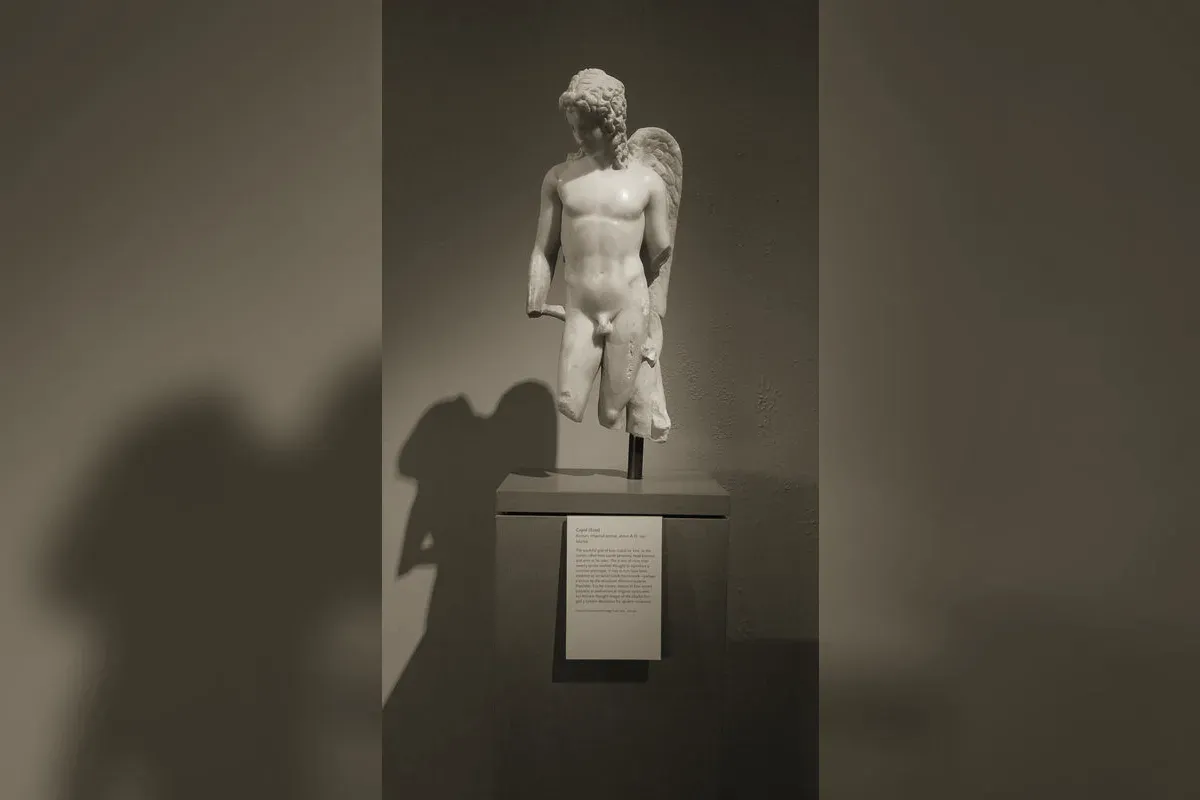
Eros is the god of erotic desire in Greek mythology — not of tender, reasonable affection, but of an irresistible force that seizes gods and mortals alike, overturns destinies, and acknowledges no hierarchy. His very nature has been disputed since antiquity: a primordial force predating the Olympians, or the mischievous son of Aphrodite? Both traditions coexist, and this duality says something essential about how the Greeks conceived of desire.
Two versions of Eros, one power
Hesiod’s primordial Eros
In the Theogony (line 120), Hesiod makes Eros one of the original cosmic forces, born alongside Gaia (the Earth) and Tartarus at the moment Chaos emerges. This Eros is not a human-faced deity: he is the principle of attraction that binds elements together and allows creation to take shape. He is Protogonos (the First-Born), without whom nothing can combine — the fundamental bond between all things.
This cosmogonic version is amplified in the Orphic tradition (6th–4th century BCE), where Eros-Phanes, hatched from a cosmic egg, is the primordial light that makes the world visible and gives it vital impetus.
The son of Aphrodite
This is the version that dominated iconography and literature from the classical period onward: Eros as son of Aphrodite and Ares (or Hermes in other traditions). This second Eros is a winged child, mischievous and capricious, armed with bow and arrows. He shoots at random — or with calculation — and whoever is struck falls helplessly in love.
Plato, in the Symposium, reconciles both by distinguishing Aphrodite Ourania (heavenly) and her corresponding Eros, noble and philosophical, from Aphrodite Pandemos (common) and her corresponding Eros, carnal and ordinary. This distinction anticipates the medieval and Renaissance debate on courtly love and amor vulgaris.
The bow and arrows: the violence of desire
The most widespread image of Eros — bow, arrows, wings — conveys a central idea: desire strikes without warning and cannot be defended against. Even the most powerful gods fall victim. Zeus himself succumbs to ill-advised passions, Apollo pursues Daphne, Poseidon chases nymphs — all situations the Greeks often attributed to Eros’s intervention.
According to Ovid (Metamorphoses, I, 453–471), the mechanism is explicit: Eros carries two types of arrows. The gold-tipped arrow causes a blazing, irrepressible desire. The lead-tipped arrow (or blunt horn in other versions) produces the opposite — flight, disgust, indifference. In this episode, Eros strikes Apollo with gold and Daphne with lead: the result is a pursuit that can only end in disaster.
The blindfold — mainly a feature of Hellenistic and Roman imagery — conveys the same idea: Eros (or Cupid) strikes blind, seeing neither whom he hits nor the consequences.
Eros and Psyche: the myth of hidden love
The most famous narrative in which Eros is the protagonist is the myth of Eros and Psyche, preserved in Apuleius’s The Golden Ass (2nd century CE) — a late Latin source, but rooted in a much older Greek narrative tradition (fragmentary earlier versions appear in Hellenistic authors).
Psyche is a mortal of such extraordinary beauty that Aphrodite, consumed by jealousy, orders Eros to condemn her to love a hideous creature. But as Eros looks at Psyche to carry out the order, he falls in love himself. He brings her to an enchanted palace and marries her in secret, visiting each night — but never revealing himself. His identity must remain unknown.
Urged on by jealous sisters, Psyche transgresses the prohibition: she lights a lamp to see her husband. A drop of burning oil falls on Eros’s shoulder. He wakes and flies away, wounded both by the physical pain and by the betrayal of trust. “Love cannot live where there is suspicion,” he declares as he leaves.
Psyche must then complete impossible tasks set by Aphrodite: sorting an enormous heap of seeds, retrieving golden wool from wild rams, fetching a vial of water from the Styx, then descending into the underworld to ask Persephone for a vial of beauty. She succeeds — with discreet, mysterious help. But on the return journey, curiosity overtakes her: she opens the vial. A death-like sleep strikes her down.
Eros, healed of his wound and unable to stop loving Psyche, wakes her by brushing the sleep from her face. He pleads with Zeus, who grants Psyche immortality. Aphrodite is reconciled. Eros and Psyche marry on Olympus. Their union produces a child named Voluptas (Pleasure).
This story is far more than a love tale: it is an allegory. Psyche (“Soul” in Greek) must traverse death to be worthy of divine love. Eros (Desire) cannot be fulfilled until the Soul has proved its worth. The Neoplatonist philosopher Plotinus later read it as the human soul’s quest toward the divine.
Eros in Greek art
The representation of Eros evolves considerably across the centuries. In 5th-century BCE vase paintings, he appears as a winged young man — handsome and athletic, a grave figure associated with the beauty of the beloved. This is the Eros of funerary epigrams mourning young men who died: desire and death stand close.
In the Hellenistic period, he gradually becomes a chubby, mischievous child — the putto that would inspire medieval and Renaissance depictions of love. Multiple Erotes (plural) crowd festival scenes and garden settings.
The sculpture of the Sleeping Eros (Rhodes Museum) and other winged figures of the period testify to the importance of the winged form in Hellenistic art as a symbol of immediacy and transcendence.
Ancient sources
Hesiod (Theogony, lines 120–122): Eros as primordial cosmic force. Plato (Symposium, speeches of Phaedrus, Agathon, Aristophanes, and Socrates): philosophical readings of desire. Apollonius of Rhodes (Argonautica, III): Eros helps Medea fall in love with Jason. Ovid (Metamorphoses, I): Eros and his two arrows. Apuleius (The Golden Ass, IV–VI): the myth of Eros and Psyche.
Further reading
For the goddess who is Eros’s mother in the Olympian tradition, read the page on Aphrodite. For the war god often cited as his father, see the page on Ares. For the ruler of Olympus who grants Psyche immortality, see the page on Zeus.
Ancient sources
- Hesiod, Theogony, lines 116-122
- Plato, Symposium
- Apollonius of Rhodes, Argonautica, 3
- Ovid, Metamorphoses, 1
- Apuleius, The Golden Ass, 4-6
See also
Frequently asked questions
Is Eros the son of Aphrodite?
According to the tradition dominant from the classical period onward, yes: Eros is the son of Aphrodite and Ares (or Hermes in some sources). But in Hesiod's Theogony, the far older account, Eros is a primordial force born alongside Gaia and Chaos — without parents, predating the Olympian gods. These two versions of Eros coexist throughout Greek tradition.
What is the difference between Eros's golden and lead arrows?
According to Ovid (Metamorphoses, Book I), Eros carries two kinds of arrows: a gold-tipped arrow provokes intense, irresistible desire in whoever it strikes; a lead-tipped arrow (or one tipped with blunt horn in other versions) produces the opposite effect — flight, repulsion, indifference. This duality illustrates the arbitrary violence of desire, which strikes without logic or merit.
What is the myth of Eros and Psyche?
The story of a mortal girl so extraordinarily beautiful that Aphrodite, out of jealousy, sends her son Eros to curse her. But Eros falls in love with Psyche himself. He marries her in secret, forbidding her ever to look at him. Psyche, urged on by her sisters, breaks the prohibition. Eros flees. After trials imposed by Aphrodite, Zeus grants Psyche immortality. The myth is told in Apuleius's The Golden Ass (2nd century CE) and remains one of antiquity's most celebrated love stories.