Egyptian mythology · Creatures
Ammit, the devourer of unjust souls in Egyptian mythology
In brief
Ammit, the Egyptian creature with a crocodile's head, a lion's chest, and a hippopotamus's hindquarters: her devouring of the impure heart and the second death.
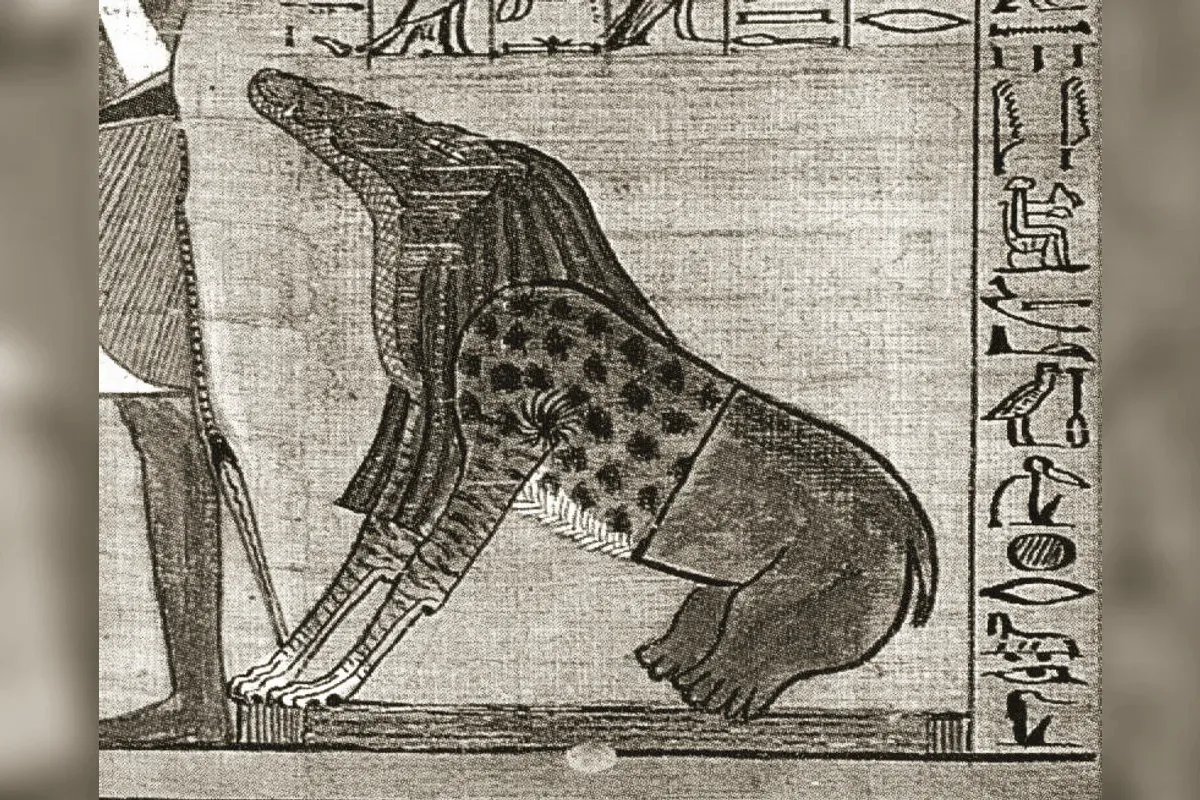
Who is Ammit?
Ammit is the most feared creature in the Egyptian judgment of the dead — not a worshipped deity, but the living instrument of the ultimate sanction. She waits permanently beside the scale where Anubis weighs the hearts of the deceased, ready to act if the verdict falls against them. Unlike Osiris or Anubis, Ammit has no genealogy, no birth myth, and no sanctuary of her own: she exists for a single role, but that role is absolute finality.
A composite creature: the three predators of the Nile
Egyptian funerary iconography depicts Ammit as a precise assembly of three animals, each carrying a specific threat within the Nilotic imagination:
- a crocodile’s head, predator of the Nile’s waters, associated with drowning and mutilation;
- a lion’s chest and forelegs, symbol of raw strength and relentless hunting;
- a hippopotamus’s hindquarters, an animal whose real danger to riverside Egyptians exceeded, in both ancient and modern records, that of the crocodile and the lion combined.
This combination is not decorative: it condenses into a single body the three forms of violent death most feared along the Nile valley, representing a threat that surpasses any natural predation.
The central role in the weighing of the heart
Ammit appears in the most famous scene of Egyptian funerary theology: the judgment of the dead, which takes place in the Hall of Two Truths, deep within the Duat. After the Negative Confession spoken before forty-two divine assessors, the deceased’s heart (ib) is placed on one pan of the scale held by Anubis, balanced against the feather of Maat, goddess of truth and cosmic order.
Thoth, the scribe god, watches the weighing and stands ready to record the verdict. Ammit waits, motionless, at the foot of the scale — a recurring vignette in papyri of the Book of the Dead, where she is almost always shown crouching, jaws slightly open, awaiting the signal.
If the heart balances evenly with the feather, the deceased is declared maa-kheru (“true of voice”), and Ammit never intervenes: she poses no threat to the living or to the virtuous dead, only to those whose lives were judged unjust.
The second death: annihilation with no return
If the heart is heavier than the feather — weighed down by wrongdoing, lies, and injustices committed during life — Ammit devours the heart on the spot. This act constitutes what Egyptian texts call the second death (mwt mwt): not the end of the body, which has already occurred, but the complete annihilation of the soul itself, of the ba and the ka, of every trace of personality and memory.
Nowhere in the whole of Egyptian eschatology does a magic spell, an offering, or a resurrection rite exist that can undo this fate. It is precisely this irreversibility that sets Ammit’s devouring apart from every other funerary threat in Egyptian belief — including physical death itself, which was treated as a mere passage. This perspective explains why funerary papyri insist so heavily on the moral and ritual preparation of the deceased: fear of Ammit was the principal lever of the entire Egyptian funerary ethic.
A guardian of morality rather than a gratuitous monster
Unlike figures such as Apophis, the serpent of chaos who threatens cosmic order itself, Ammit is never portrayed as an enemy of the gods. She does not rebel, does not seek to overturn Maat: she carries out a judgment already rendered by the weighing. This functional passivity makes her a unique figure in the Egyptian bestiary — a threat entirely subordinate to divine justice, never to her own impulses.
This conception sharply distinguishes Egyptian mythology from other traditions where guardians of the afterlife act out of cruelty or caprice: Ammit instead embodies the mechanical, impersonal consequence of a life poorly lived, reinforcing the central idea of Egyptian funerary theology — that individual morality has exact, verifiable cosmic consequences.
What the ancient sources say
Chapter 125 of the Book of the Dead (New Kingdom, c. 1550-50 BCE), devoted to the weighing of the heart, is the main textual source on Ammit. The Papyrus of Ani (Dynasty XIX, c. 1275 BCE, held at the British Museum) offers one of the most detailed and widely reproduced vignettes of the creature, crouched beside the scale. The Coffin Texts (Middle Kingdom) already mention anonymous funerary “devourers,” of which Ammit represents the most fully developed iconographic synthesis of the New Kingdom.
Further reading
For the god who holds the scale and oversees the weighing beside Ammit, read the page on Anubis. For the ruler of the dead who presides over the tribunal where the creature waits, see the page on Osiris. For the scribe god who records the verdict before Ammit’s possible intervention, read the page on Thoth. For the goddess whose feather determines whether Ammit must act, see the page on Maat. For the full account of the judgment ceremony, read The Judgment of the Dead.
See also
Stories featuring this entity
Frequently asked questions
Is Ammit a goddess or a demon in Egyptian mythology?
Neither, exactly. Ammit does not belong to the circle of great deities who received a cult, but she is also not a chaotic force hostile to the gods like Apep. She is a functional creature, defined entirely by a single role: carrying out the verdict of Osiris's tribunal when a deceased's heart is judged impure. Egyptians built her no temple and made her no offerings — she exists only within the scene of judgment.
Why does Ammit combine a crocodile, a lion, and a hippopotamus?
For the ancient Egyptians, these three animals were the most dangerous predators of the Nile and its banks: the crocodile for drowning and mutilation, the lion for raw strength and hunting, the hippopotamus for its unpredictable danger to humans. By combining the three most feared threats into a single body, funerary iconography gives the second death as terrifying a form as possible — a composite designed to embody absolute annihilation.
What happens to a soul devoured by Ammit?
Nothing survives. Unlike physical death, which is merely a passage into life in the Duat, being devoured by Ammit constitutes the 'second death' (mwt mwt): the complete annihilation of the ba, the ka, and every trace of the deceased's identity and memory. No magical spell, no funerary rite in the entire corpus of Egyptian belief could reverse this fate. It is the only truly final ending in all of Egyptian eschatology, which explains the terror Ammit inspired.