Egyptian mythology · Mythical places
The Duat: the underworld of the dead in Egyptian mythology
In brief
The Duat, the Egyptian underworld: nocturnal realm crossed by the sun, place of Osiris's judgment and the twelve hours of the night mapped by the funerary books.
- underworld of the dead
- nocturnal course of the sun
- place of the judgment of souls
- space of regeneration and rebirth
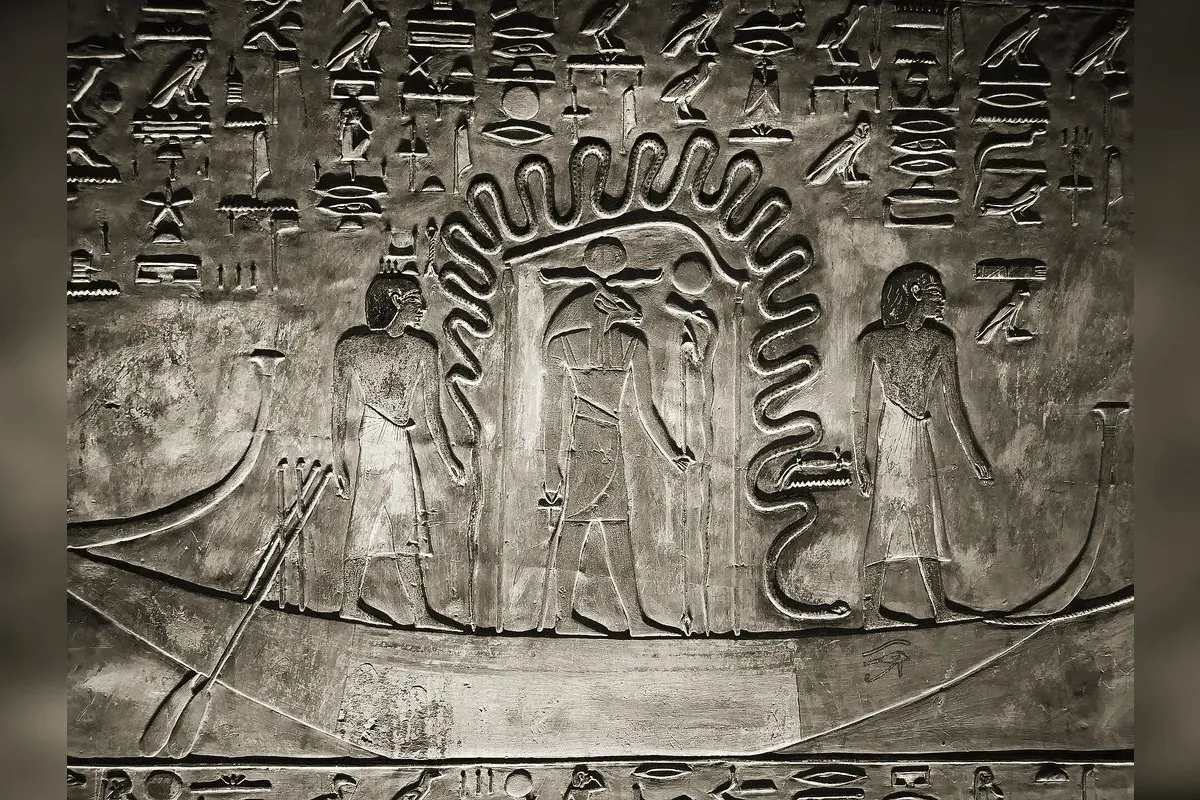
What is the Duat?
The Duat is the underworld of Egyptian mythology: the nocturnal realm into which the dead descend, but also the territory the sun crosses each night before being reborn at dawn. Far from a mere “hell,” it is a complex space, at once geographical and cosmic, whose function is not to punish but to allow passage — from death to rebirth, from dusk to dawn. To understand the Duat is to grasp how the Egyptians conceived of death: not as an ending, but as a perilous, codified crossing.
A twofold place: night sky and underground
The word dwꜣt is often written with the sign of the star within a circle, betraying a celestial origin: the Duat is first the region of the sky where the sun sinks in the evening and from which it re-emerges in the morning. But it is also conceived as an underground realm, a kingdom beneath the earth and the western horizon. This ambivalence is no contradiction for Egyptian thought: the Duat is the reverse of the visible world, the nocturnal space through which all rebirth must necessarily pass.
It is entered through the West (Amenti), where the sun sets; this is why the necropolises were built on the western bank of the Nile, on the side of the dead.
The realm of Osiris and the judgment of the dead
At the heart of the Duat sits Osiris, sovereign of the dead and supreme judge. It is here that the decisive scene of Egyptian funerary theology unfolds: the weighing of the heart, described in the judgment of the dead. The deceased appears in the Hall of the Two Truths, where the heart is weighed against the feather of Maat under the watch of Anubis, while Thoth records the verdict.
The danger here is not eternal torture but annihilation: if the heart is judged impure, it is devoured by Ammit, the “Great Devourer,” inflicting on the deceased the “second death,” a total and irreversible disappearance. For the righteous, by contrast, the Duat opens onto eternal life in the Field of Reeds, beside Osiris. This is the whole meaning of the Osiris myth, the first god to have crossed death and been reborn.
The nocturnal journey of the sun
The Duat is not only the abode of the dead: it is also the night road of the sun. Each evening the barque of Ra enters it for a journey divided into twelve hours, corresponding to twelve regions or halls separated by guarded gates. At each hour the solar god faces ordeals, briefly illuminates the dead who acclaim him, and above all must defeat Apophis, the serpent of chaos that seeks to dry up the waters and swallow the barque.
At the midpoint, in the depth of the night, Ra momentarily unites with Osiris: this encounter between the sun and the god of the dead generates the regenerative energy that allows one to be reborn at morning and the other to remain alive in his realm. The Duat is thus the place where, night after night, the renewal of the cosmos is accomplished.
A geography mapped by the funerary books
The Egyptians charted the Duat with remarkable precision in a series of funerary books painted on the walls of the royal tombs. The Amduat (“Book of What Is in the Underworld”) describes its twelve hours, region by region, with their deities, dangers and the formulas needed to pass them. The Book of Gates stresses the guarded gates that both the deceased and the sun must open by pronouncing the exact name of their keepers. The Book of Caverns explores the dark grottoes where the enemies of order are punished.
This detailed topography is anything but idle: to know the Duat, its passages and its words of power was to equip oneself to cross it victoriously. The Book of the Dead papyri placed in the tombs functioned as genuine travel guides to the afterlife.
What the ancient sources say
The Duat appears as early as the Pyramid Texts (c. 2400 BCE) and the Coffin Texts (Middle Kingdom), which prepare the deceased for the journey. But it is in the New Kingdom that its geography unfolds in full, in the great books of the afterlife — Amduat, Book of Gates, Book of Caverns — carved in the tombs of the Valley of the Kings. Chapter 125 of the Book of the Dead sets the judgment scene in the Hall of the Two Truths, the moral core of the Duat.
Further reading
For the sovereign who rules the Duat and judges the dead, read the page on Osiris. For the solar god who crosses it each night, see the page on Ra. For the serpent of chaos that threatens the barque there, see the page on Apophis. For the creature that devours unjust souls, read the page on Ammit. For the full account of the ceremony, see the judgment of the dead.
Ancient sources
- Pyramid Texts
- Coffin Texts
- Amduat
- Book of Gates
- Book of Caverns
- Book of the Dead, chapter 125
See also
Frequently asked questions
What is the Duat in Egyptian mythology?
The Duat is the underworld of the dead in Egyptian mythology: a nocturnal realm that is both the path of the sun through the twelve hours of the night and the abode of the deceased. It is not a hell of punishment but a space of passage and regeneration, structured into regions, gates and ordeals that both the soul and the sun must cross in order to be reborn.
Is the Duat a hell like the Christian hell?
No. The Duat is not a place of eternal damnation but a realm of passage. The real danger there is not torture but the 'second death': the final annihilation of the soul judged unjust, devoured by Ammit. For the righteous, the Duat is instead the road to rebirth and eternal life beside Osiris and Ra.
Which god rules the Duat?
Osiris rules the Duat as sovereign of the dead and supreme judge of the weighing-of-the-heart tribunal. Anubis guides and embalms the deceased there, while Ra crosses it each night in his barque. The Duat is thus a shared space between the solar god who travels through it and the god of the dead who presides over it.