Egyptian mythology · Gods & goddesses
Maat, Egyptian goddess of truth and cosmic order
In brief
Maat, Egyptian goddess of truth and justice: her role in the weighing of the heart, her bond with the pharaoh, her opposition to Isfet, and ancient wisdom teachings.
- truth
- justice
- cosmic order
- balance
- +3
Who is Maat?
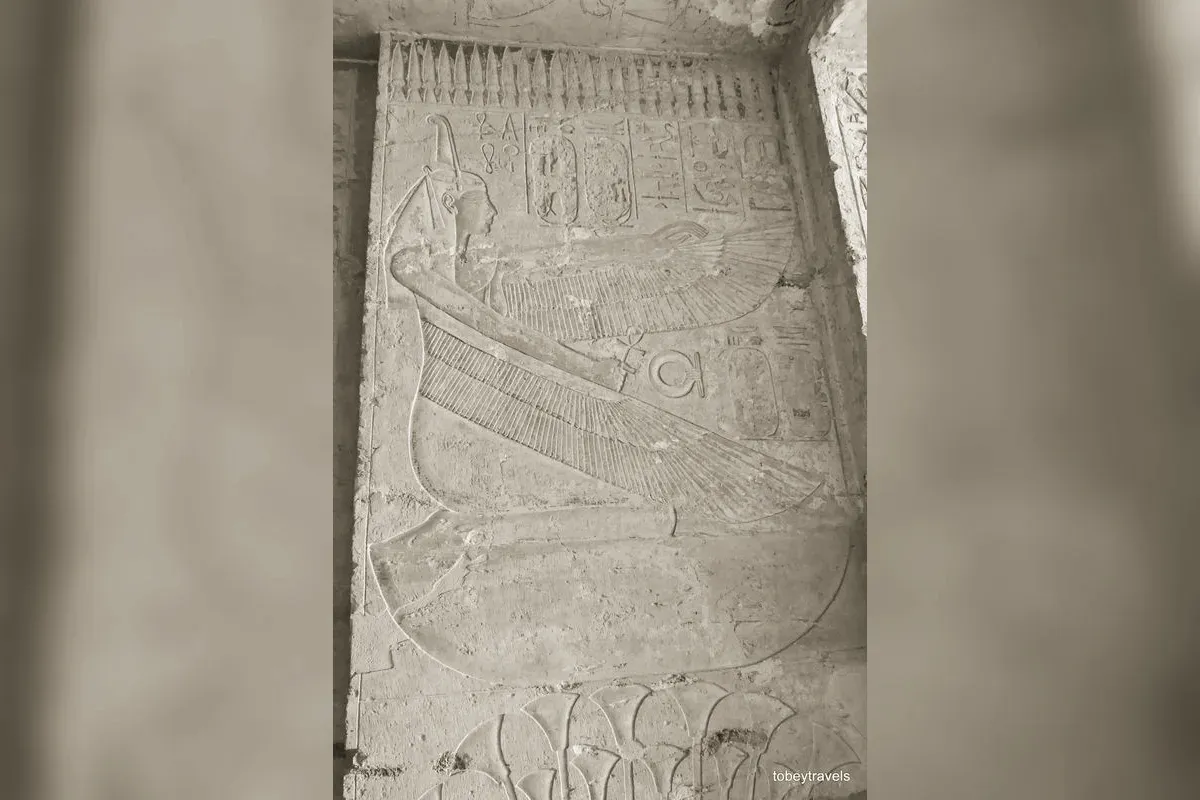
Maat is the Egyptian goddess of truth, justice, and cosmic order — the principle that keeps the universe, society, and individual conscience in just balance. Daughter of Ra according to Heliopolitan theology, she is depicted seated, an ostrich feather rising from her head, sometimes with arms spread as protective wings. Unlike most Egyptian deities, Maat has almost no narrative myth of her own: she is a personified principle rather than a heroine of divine adventures.
Role, nature, and domain
Maat denotes three interwoven realities at once: the goddess herself, the moral virtue of truth-justice each individual must embody, and the cosmic order that keeps the sun on its course, the Nile in its regular flood, and Egyptian society in its stable hierarchy. Her conceptual opposite is Isfet, chaos, falsehood, and injustice — a force every pharaoh, every judge, and every ordinary person had to combat daily.
This dual nature — divine person and abstract principle — explains why Maat is rarely at the center of a narrative myth, yet omnipresent in ritual formulas, wisdom texts, and funerary inscriptions.
Maat and the pharaoh
The Egyptian sovereign held the title “Lord of Maat” (Neb Maat), affirming that his essential function was to uphold the cosmic order she embodies. Offering a small statuette of Maat to the gods — a rite depicted on numerous temple reliefs — symbolized the royal commitment to rule according to truth and justice. A pharaoh who failed to uphold Maat, in Egyptian theology, endangered not only his own reign but the balance of the entire cosmos.
Maat and the judgment of the dead
Maat’s best-known role unfolds during the judgment of the dead, in the Hall of the Two Truths. Anubis places the deceased’s heart on one pan of his scale, and Maat’s feather on the other. If the two pans balance — if the heart is not weighed down by faults committed — the deceased is declared maa-kheru, “true of voice,” and may enter the Field of Reeds. Thoth then records the verdict, guaranteeing the absolute objectivity of this symbolic weighing.
The Two Maats and the political dimension
Some depictions show two Maat goddesses seated side by side, associated with Upper and Lower Egypt: this duality recalls that the cosmic balance Maat guarantees also covers the political balance of the unified kingdom. Egyptian law courts were often called “Halls of Maat,” and their judges bore the title “priests of Maat,” underscoring that human justice was conceived as a direct extension of divine order.
What ancient sources say
The Pyramid Texts (c. 2400 BC) already mention Maat as a cosmic principle tied to the maintenance of royal order. Chapter 125 of the Book of the Dead, devoted to the Negative Confession and the weighing of the heart, makes her the central instrument of funerary judgment. The Instructions of Ptahhotep (Middle Kingdom), a wisdom text meant to train senior officials, presents Maat as the foundation of good governance and personal conduct — proof that her role extended far beyond the funerary realm to structure Egyptian civic ethics during one’s lifetime.
Further reading
For the full account of the judgment where Maat’s feather decides each deceased’s fate, read The Judgment of the Dead. For the god who presides over this tribunal, see the page on Osiris. For the god who watches the scale alongside Maat, see the page on Anubis. For the creature who devours the heart of those whose lives failed to honor Maat, see the page on Ammit.
See also
Related entries
Stories featuring this entity
Frequently asked questions
Is Maat a goddess or just a concept?
Both at once, and that is precisely what makes Maat unique in the Egyptian pantheon. She is personified as a seated goddess, sometimes winged, daughter of Ra — but her name also directly denotes the virtue of truth-justice and cosmic order itself, without a distinct narrative myth attached to her. Egyptians invoked Maat both as a divine person and as an abstract principle governing the universe.
What is the connection between Maat and the pharaoh?
The pharaoh held the title 'Lord of Maat,' and his fundamental role was to maintain the cosmic order she embodies against chaos (Isfet). Offering figurines of Maat to the gods, dispensing fair justice, and ruling according to truth made the sovereign the earthly guarantor of universal balance — a failure of Maat threatened, in Egyptian theology, the stability of the entire cosmos, not just the kingdom.
Why is Maat's feather used in the weighing of the heart?
During the judgment of the dead, the deceased's heart is placed on one pan of Anubis's scale, balanced by Maat's feather on the other. If the heart is as light as the feather — that is, not weighed down by faults and injustices committed — the deceased is declared righteous and admitted into the afterlife. The feather thus symbolizes the exact measure of the moral truth of an entire life.