Greek mythology · Creatures
Scylla, the six-headed sea monster of the strait
In brief
Scylla in Greek mythology: a nymph turned into a six-headed monster, the terror of the strait opposite Charybdis, devourer of sailors in Homer's Odyssey.
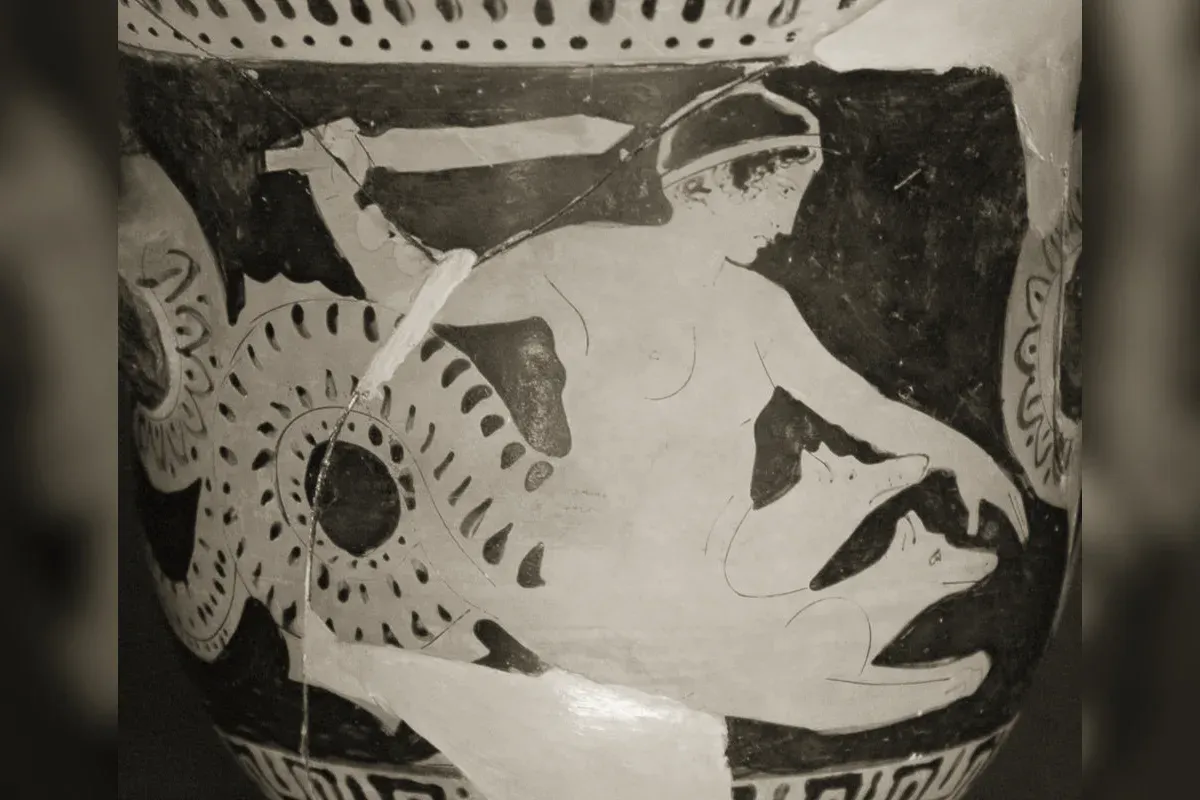
Scylla is, in Greek mythology, one of the two twin scourges of the strait — the other being the whirlpool of Charybdis. A six-headed sea monster lurking high on a cliff, she snatches sailors from ships that pass within reach. Immortalized by the Odyssey, she gave Western culture the very image of the no-win dilemma: the one in which fleeing a peril means throwing oneself into another.
A monster of the narrow passage
Scylla’s function is geographic as much as narrative: she guards a narrow strait, an unavoidable passage that navigators cannot go around. Homer places her in a spray-battered cave, high on a wall so smooth and so tall that no one could climb it. Facing her, within bowshot, opens the whirlpool of Charybdis, which three times a day sucks down and spews out the sea. Between the two lies a channel so narrow that no ship can escape one without grazing the other.
This topography of the trap makes Scylla a creature of the threshold, like so many Greek monsters posted at points of passage. But where other guardians protect a place, Scylla defends nothing: she is pure danger, the unavoidable toll of the crossing.
Six heads, twelve feet: the Homeric description
In Book XII of the Odyssey, the sorceress Circe describes Scylla to Odysseus with a dreadful precision. The creature has twelve misshapen feet and six long necks, each topped by a horrible head lined with a triple row of close-set teeth. From the waist down she stays sunk in the hollow of the rock, but she thrusts her heads out of the chasm to fish for dolphins, seals, and sailors. Her voice, shrill, is that of a litter of newborn pups — a detail that fed the etymology linking her name to skýlax, the puppy.
Circe is categorical: Scylla is not mortal, she cannot be fought. Against her there is no possible heroic victory, only a loss to be accepted.
The passage of Odysseus
The Scylla episode is one of the peaks of the Odyssey. Warned by Circe, Odysseus must choose between two evils: to hug Charybdis, risking the loss of the whole crew and ship at once, or to keep close to Scylla’s cliff, knowing the monster will seize a few men. Circe recommends the second — sacrifice six sailors rather than lose everything.
Odysseus follows the advice but cannot bring himself to be passive: he arms himself and watches for the monster. In vain. While the terrified crew stares at Charybdis, Scylla plunges her six heads and carries off six companions, who call their captain by name as she devours them at the mouth of her lair. Homer has Odysseus say it was the most pitiable sight of all his trials at sea. The lesson is bitter: even the craftiest of men can only limit the disaster, not avoid it.
Other navigators before the strait
Scylla haunts more than the Odyssey. Jason’s Argonauts cross the same strait, but the goddess Thetis and the Nereids guide their ship through the passage, sparing them both scourges. Later, the Roman tradition warns Aeneas away from the route of Scylla and Charybdis, which he avoids by sailing around Sicily.
These interlocking accounts anchor Scylla in a precise mythic geography: antiquity places the strait between Italy and Sicily — the present-day Strait of Messina — renowned for its opposing currents and dangerous eddies. The monster is thus the mythological dress of a real maritime peril.
From nymph to monster: the metamorphosis
Scylla’s origins vary by author. Homer names only her mother, Crataeis. Apollonius of Rhodes identifies Crataeis with Hecate and makes Phorcys her father; other traditions call her a daughter of Typhon and Echidna. The site’s tree follows Apollonius’s variant without presenting it as the only ancient genealogy.
Later poets also invent a tragic past for her. In Ovid’s Metamorphoses, Scylla was a beautiful nymph courted by the sea god Glaucus — not to be confused with Glaucus of Corinth, the son of Sisyphus. Rejected, he implores the sorceress Circe, who falls in love with him in turn. Jealous of a rival, Circe poisons the cove where Scylla comes to bathe: the moment she enters the water, heads of howling dogs erupt from her flanks. Horrified by her own body, she freezes on her rock and becomes the scourge of sailors.
Other versions attribute the transformation to Amphitrite, wife of Poseidon, jealous of the god’s attention to the nymph. In every case the motif is the same: a coveted beauty, punished for a fault she did not commit, turned into a monster by a deity’s jealousy. Scylla is as much a victim as a threat.
“Between Scylla and Charybdis”
Scylla’s most enduring legacy is proverbial. To be “between Scylla and Charybdis” is to be caught between two dangers, one of which can only be escaped by facing the other — the ancient equivalent of “between a rock and a hard place.” The phrase, in use since antiquity, runs through the whole of European literature.
The Scylla–Charybdis pairing thus sums up a tragic truth dear to the Greeks: some situations offer no good way out, only the choice of the lesser evil. The six-headed monster remains, to this day, the emblem of the dilemma with no escape.
Ancient sources
- Homer, Odyssey, XII, 73–126 and 234–259
- Ovid, Metamorphoses, XIII–XIV
- Apollonius of Rhodes, Argonautica, 4.828-829
- Virgil, Aeneid, III
See also
Related entries
Stories featuring this entity
Frequently asked questions
Who is Scylla in Greek mythology?
Scylla is a six-headed sea monster that haunts a narrow strait, facing the whirlpool of Charybdis. In later traditions she was originally a beautiful nymph, transformed out of jealousy into a hideous creature. She is best known for devouring six of Odysseus's companions as his ship passes through the strait in the Odyssey.
What does 'between Scylla and Charybdis' mean?
It describes a situation in which one danger can only be avoided by exposing oneself to another, equally grave one. In the Odyssey the strait is flanked by two perils: Scylla, who snatches sailors, and Charybdis, who swallows whole ships. Circe advises Odysseus to hug Scylla's side and sacrifice six men rather than lose everything to Charybdis.
How did Scylla become a monster?
The most famous version, in Ovid, makes Scylla a nymph loved by the sea god Glaucus. The sorceress Circe, jealous, poisons the water where Scylla bathes: heads of howling dogs erupt from her body. Other traditions attribute the transformation to Amphitrite, wife of Poseidon. Punished beauty becomes the horror of the strait.