Greek mythology · Gods & goddesses
Helios, the sun god of Greek mythology
In brief
Helios, the Greek sun god who crosses the sky in his chariot: his Titan genealogy, the myth of Phaethon, the cattle of the Sun, and the cult of Rhodes.
- the sun
- daylight
- sight and oaths
- the passing of time
- +3
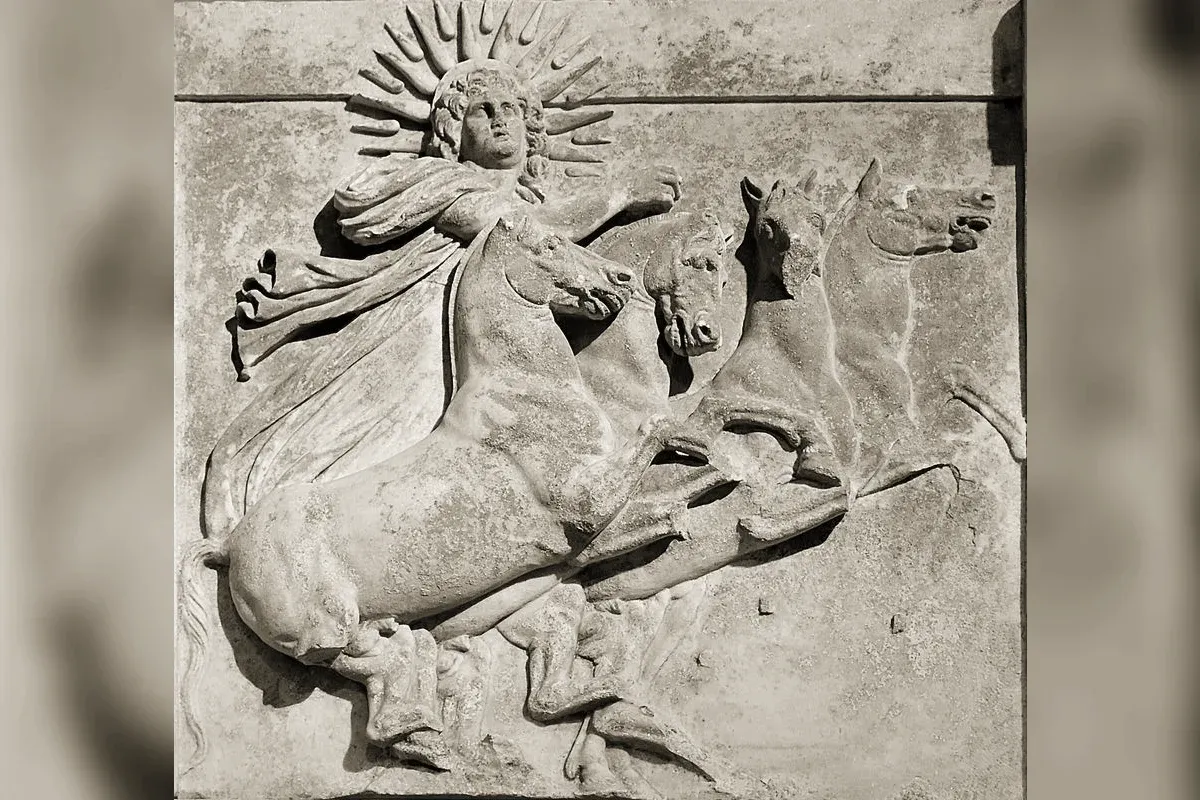
In Greek mythology, Helios is the Sun itself, personified as a god who crosses the sky each day on a chariot of fire. A deity of pitiless clarity, he sees all and forgets nothing: nothing that happens in the light escapes him. Neither an Olympian nor a shadowy figure, he is the eye of the world, the universal witness — and this all-seeing gaze makes him, in several myths, the one who denounces, warns, or demands justice.
A Titan of light
Helios belongs to the second generation of Titans. He is the son of Hyperion (“the one who walks above”) and the Titaness Theia. His two sisters complete the trio of celestial luminaries: Selene, the Moon, and Eos, the rosy-fingered Dawn. Together they set the rhythm of the sky — day, night, dawn.
Each morning, Helios sets out from the east, mounted on a chariot drawn by four winged horses that breathe fire. He climbs the vault of heaven to its zenith, then descends toward the west, where he plunges into the Ocean. At night, according to a vivid tradition, he returns to his eastern palace by sailing in a giant golden cup carried over the waves. This daily journey makes him a deity of passing time, a living measure of the days.
The god who sees everything
Because he rules the world from on high, Helios “sees all and hears all.” This all-seeing gaze gives him a recurring role as witness. It is he who, in the story of the abduction of Persephone, reveals to Demeter the identity of her daughter’s abductor: from the sky he has seen Hades carry the young goddess into the underworld. Without his testimony, the grieving mother would never have known where to search.
It is Helios, too, who catches the secret love affair of Ares and Aphrodite, and who warns the betrayed husband, Hephaestus. This role as informer makes him the guarantor of oaths: to swear by the Sun is to call as witness the one from whom nothing is hidden.
Phaethon: pride and the fall
The most famous myth attached to Helios is that of his son Phaethon. Doubting his divine parentage, the young man travels to the palace of the Sun and begs his father for a proof: to drive the solar chariot for a single day. Helios, bound by a rash oath, cannot refuse.
But Phaethon has neither the strength nor the skill to master the horses of fire. The chariot swerves from its course, climbs too high — freezing the earth — then dips too low, scorching the countryside, drying the rivers, and, it was said, forever darkening the skin of the peoples of Ethiopia. To save the world from being consumed, Zeus strikes Phaethon with a thunderbolt, and the boy falls into the river Eridanus. His sisters, the Heliades, weep for him until they are transformed into poplars shedding tears of amber. Told masterfully by Ovid, this myth is a lesson on excess and on the weight of a father’s gifts.
The cattle of the Sun in the Odyssey
Helios plays a decisive role in the Odyssey. On the island of Thrinacia graze his sacred herds: seven herds of cattle and as many flocks of sheep, immortal and unchanging, watched over by his daughters. Odysseus, warned by the prophecy of Tiresias, strictly forbids his companions to touch them.
But, held back by contrary winds and gnawed by hunger, the sailors finally slaughter and devour the sacred beasts. Outraged, Helios climbs to Olympus and demands satisfaction: if the guilty are not punished, he threatens, he will go down to shine among the dead and deprive the living of his light. Zeus then blasts the ship on the open sea. All the companions perish; only Odysseus, who had not touched the cattle, survives. The episode seals the central theme of the poem: transgression must be paid for, and the recklessness of men condemns them.
A numerous progeny
Helios is the father of a line rich in unsettling figures. From him are born:
- Circe, the enchantress of the Odyssey who turns men into swine;
- Pasiphae, wife of Minos and mother of the Minotaur;
- Aeëtes, king of Colchis and keeper of the Golden Fleece coveted by Jason;
- Phaethon and the Heliades.
This progeny ties Helios to the great myths of magic and excess: his children inherit a dangerous brilliance, a power that borders on the forbidden. The blood of the Sun burns those who carry it.
Cult and the Colossus of Rhodes
The cult of Helios was especially strong on Rhodes, an island consecrated to him and said by one tradition to have been born of his union with the nymph Rhode. Each year the Rhodians offered him a chariot and horses cast into the sea. There stood the Colossus of Rhodes, a giant statue of the god counted among the Seven Wonders of the ancient world. Elsewhere in Greece his cult remained modest beside the Olympians, but at Rome, under the name Sol Invictus, the Sun became a major imperial deity of late antiquity.
What the ancient sources say
- Homer, Odyssey (Book XII): the episode of the cattle of the Sun and the wrath of Helios.
- Homeric Hymn to Helios: the portrait of the radiate god driving his chariot.
- Hesiod, Theogony: his Titan genealogy alongside Selene and Eos.
- Ovid, Metamorphoses (Book II): the full account of Phaethon’s fall.
Further reading
For the Olympian god of light with whom Helios was gradually merged, see the page on Apollo. For the story in which his sacred cattle seal the sailors’ fate, read the Odyssey. For the hero who alone survives that shipwreck, see the page on Odysseus. For the myth in which his testimony revives the goddess’s search, read the abduction of Persephone. For the mother to whom he reveals the abductor, see the page on Demeter.
Ancient sources
- Homer, Odyssey, 12
- Homeric Hymn to Helios (no. 31)
- Hesiod, Theogony, lines 371-374
- Ovid, Metamorphoses, 2
See also
Related entries
Stories featuring this entity
Frequently asked questions
Who is Helios in Greek mythology?
Helios is the sun god, a second-generation Titan, son of Hyperion and Theia. Each day he crosses the sky from east to west on a chariot of fire drawn by four winged horses, bringing light to the world. Because he sees everything from on high, he is also the witness of oaths and hidden deeds.
Are Helios and Apollo the same god?
Originally, no: Helios is the personified Sun-star, a Titan, while Apollo is an Olympian linked to light, prophecy, and music. But from the classical period a gradual assimilation turned Apollo into a solar god, so that the two figures are often merged in later poetry.
What is the myth of the cattle of the Sun?
In the Odyssey, Odysseus's starving companions slaughter the sacred cattle of Helios on the island of Thrinacia, despite a strict prohibition. Enraged, Helios threatens to stop lighting the world unless Zeus punishes them. Zeus then blasts the ship: all the companions die, and Odysseus alone survives.