Greek mythology · Heroes & mortals
Ixion, ancestor of the Centaurs in Greek mythology
In brief
Ixion: the first kinsman-killer in Greek myth, the first man Zeus purified, the father of the Centaurs by a cloud, and the wheel that never stops.
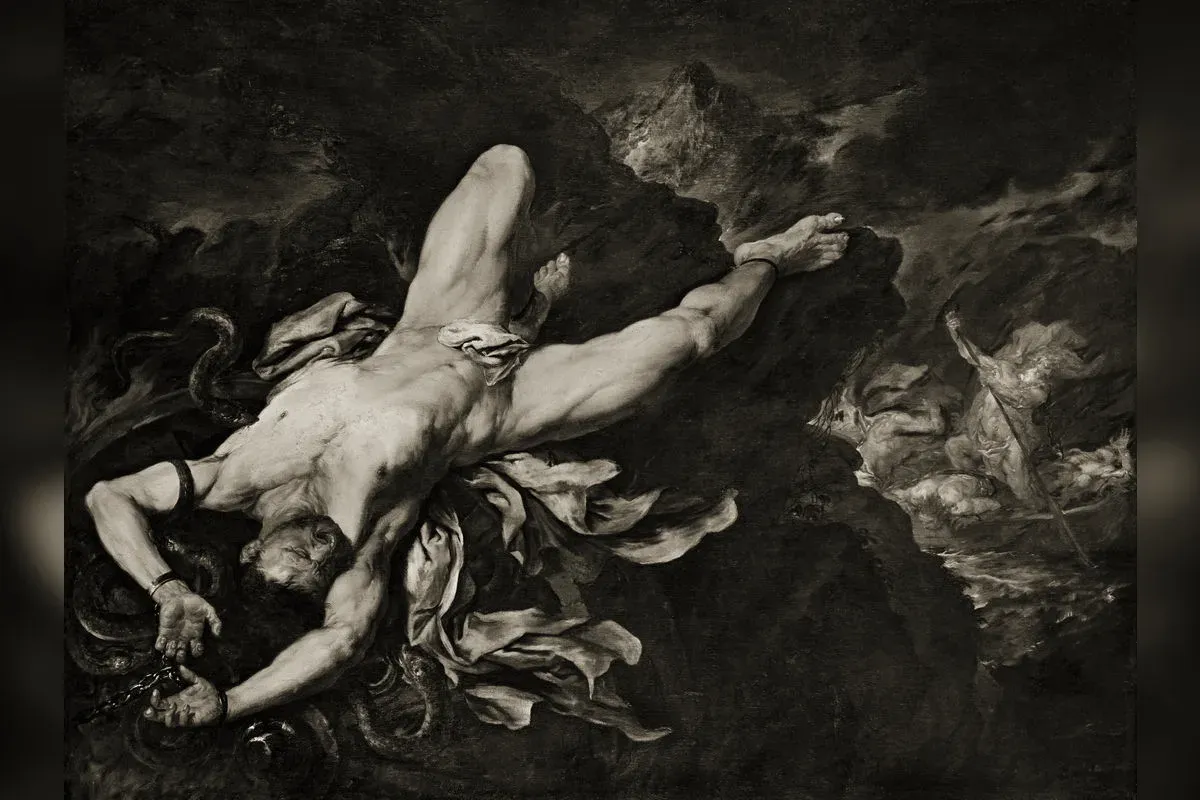
Ixion is the first man in Greek myth to murder a relative, the first to be purified of blood-guilt, and the first to abuse the hospitality of the gods. He ends bound to a burning wheel that turns forever. Pindar tells his story as a warning, and the sequence of his offences is more interesting than the punishment everyone remembers.
The first kin-murderer
Ixion, king of the Lapiths in Thessaly, promises a bride-price to Deioneus for his daughter Dia and then refuses to pay. When Deioneus seizes some of his horses as security, Ixion invites him to a feast and has him fall into a pit of live coals concealed in the floor.
Greek tradition treats this as a first. Killing a kinsman — Deioneus is his father-in-law — carried a pollution no ordinary ritual could remove, and no procedure yet existed for handling it. Nobody, mortal or divine, would purify him. He wandered, driven mad, shunned by everyone.
The first purification
Then Zeus takes pity, purifies him personally, and invites him to dine on Olympus.
This is the most consequential act in the story, and it is easy to miss under what follows. The institution of ritual purification — the mechanism by which a killer can be readmitted to human society — is founded here, on Ixion, by the god who guards suppliants. Every later purification in Greek myth, including those of Peleus and Heracles, runs on the precedent Zeus set for a man who had roasted his father-in-law.
The cloud
At the table of the gods, Ixion looks at Hera and decides to pursue her.
Zeus, testing rather than immediately punishing, shapes a cloud into her likeness. Ixion lies with the phantom, and boasts about it afterwards — which is what removes any remaining doubt. The cloud, Nephele, conceives and gives birth to Centaurus, from whom the Centaurs descend: creatures half man and half horse, the standard Greek image of appetite without restraint. His offence is made to generate its own emblem.
Pindar’s summary is severe and exact: Ixion, he says, was carried away into outrageous folly, and soon received a distinguished suffering — a man who had received extraordinary favour and could not recognise the limits attached to it.
The wheel
Zeus binds him to a winged, fiery wheel and sets it spinning through the air, later fixed in Tartarus. In some versions he must repeat aloud, forever, that benefactors should be honoured.
The punishment is legible. Ixion turned a guest-table into a trap, then turned a host’s table into an opportunity; the wheel is a table with no seat, motion without progress, an eternal return to the same position — which is what a man who cannot learn deserves in a system that punishes by analogy.
He is also, structurally, the mortal counterpart to the great sinners Sisyphus and Tantalus, and the three are regularly named together. Orpheus’s music is said to have stopped all three at once — the wheel halting is how the poets measure how good the singing was.
Ancient sources
- Pindar, Pythian, 2.21-48
- Apollodorus, Epitome, 1.20
- Diodorus Siculus, 4.69
- Aeschylus' lost Ixion
- Virgil, Georgics, 4.484
- Pindar, Pythian Ode 2
- Diodorus Siculus, Library of History, Book 4
See also
Related entries
Frequently asked questions
What did Zeus invent for Ixion?
Ritual purification itself. No one, mortal or divine, would cleanse the first kin-murderer, so Zeus took pity, purified him personally and invited him to dine on Olympus. That act founds the mechanism by which a killer can be readmitted to human society — every later purification in Greek myth, including those of Peleus and Heracles, runs on the precedent set for a man who had roasted his father-in-law.
How did Ixion father the Centaurs?
Through a forgery. At the table of the gods he decided to pursue Hera, and Zeus — testing rather than immediately punishing — shaped a cloud into her likeness. Ixion lay with the phantom and then boasted about it, which removed any remaining doubt. The cloud, Nephele, conceived and produced the line of the Centaurs: his offence was made to generate its own emblem.