Norse mythology · Creatures
The Valkyries, warrior maidens who choose the slain in battle
In brief
The Valkyries in Norse mythology: Odin's servants who mark the fallen warriors, lead them to Valhalla, and weave the fate of battles according to the Eddas.
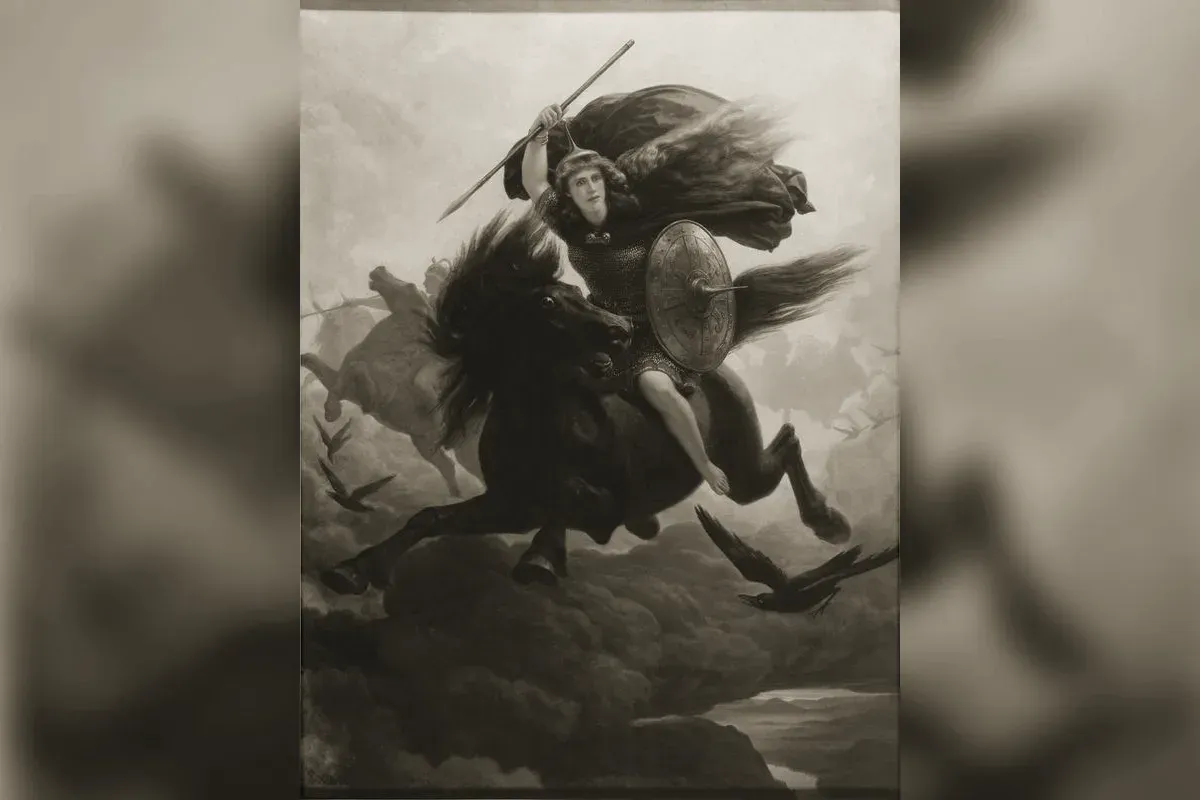
Who are the Valkyries?
The Valkyries (valkyrjur, ‘choosers of the slain’) are the warrior maidens of Norse mythology, servants and messengers of Odin. Their function is as precise as it is fearsome: on every battlefield they decide which warriors will fall, then escort the worthiest to Valhalla, the hall of the glorious dead. They are neither major goddesses nor mere spirits: they are the instrument through which Odin recruits, death by death, the army he gathers for the final battle.
Role and nature: to elect, not to kill
The Valkyries’ name states their whole office. They do not cause death — they mark it. Hovering unseen above the armies, they choose which fighters are ripe for death and which of those dead deserve to enter Valhalla. The choice is not moral: Odin does not want the most just men, but the most formidable warriors, for he destines them to fight at his side at Ragnarök.
Once the battle is over, the Valkyries accompany the chosen — the Einherjar — to Odin’s hall. There their role changes: they become cup-bearers, serving the inexhaustible mead to the warriors who feast each evening after slaughtering one another each day. The Valkyrie is thus both the reaper and the hostess, the one who chooses death and the one who honours it.
A sharing with Freya
Valhalla is not the only destination of the battle-slain. The Eddas specify that Freya, the great Vanir goddess, receives half of the fallen in her own domain of Fólkvangr; Odin takes the other half. Some readings even make Freya the foremost of the Valkyries, or at least their divine model. This division reminds us that warrior death, in ancient Scandinavia, belongs to no single god: it is a prize contested among the powers.
The named Valkyries
The texts do not present the Valkyries as an anonymous mass: several bear names that are so many programmes. The Grímnismál lists those who serve in Valhalla — Hrist, Mist, Skeggjöld, Göndul, Skögul, Hildr, Þrúðr (Thor’s daughter), Herfjötur (‘host-fetter’), Geirölul. The skaldic poem Hákonarmál shows Göndul and Skögul riding to receive King Hákon among the Einherjar.
These names denote functions: Hildr means ‘battle’, Herfjötur names the power to paralyse a warrior in combat, Geirölul evokes the spear. The Valkyrie is an abstraction of war become a person.
Swan-maidens and heroes’ brides
Alongside these cosmic figures, the heroic poems present more human Valkyries, caught in mortal loves. The Völundarkviða tells how three Valkyries — Hlaðguðr, Hervör and Ölrún — alight by a lakeshore, having laid aside their swan-cloaks, and marry mortals: this is the ‘swan-maiden’ motif, common to many traditions.
The most famous is Brynhildr. A Valkyrie who disobeyed Odin by giving victory to the wrong side, she is punished: put to sleep within a ring of fire on a mountain, she can be woken only by a hero who knows no fear. That hero is Sigurd, the slayer of the dragon Fáfnir. Their meeting links the supernatural world of the Valkyries to the great tragic cycle of the Völsungs — one of the summits of Norse literature.
The weavers of fate
The most chilling image of the Valkyries comes from Njáll’s saga (Njáls saga), in the poem Darraðarljóð. A man glimpses twelve Valkyries in a hut, working at a gruesome loom: the warp is made of human entrails, the weights are severed heads, the shuttle an arrow, the reeds swords. They sing as they weave — for what they weave is the outcome of the Battle of Clontarf (1014). Here the Valkyrie is no longer merely the one who chooses the slain: she is the one who decides the battle, sister to the Norns who spin fate.
Symbolic significance
The Valkyries condense the Norse vision of war and death. To die in battle is no curse there but an election: to be chosen by a Valkyrie is to be judged worthy of Odin’s cause. This warrior theology gives meaning to violent death in a society where it was ever-present. It also explains why the ideal warrior of the sagas preferred to fall sword in hand rather than die in bed — for only the first death opened the doors of Valhalla.
What the ancient sources say
The Valkyries appear as early as the Poetic Edda: the Völuspá shows them ready to ride, the Grímnismál names them, the Helgakviða stages them beside heroes. The Prose Edda of Snorri Sturluson (Gylfaginning, c. 1220) synthesises their role as cup-bearers and messengers of Odin. Skaldic poetry — Eyvindr’s Hákonarmál, the Eiríksmál — has them welcome dead kings. Finally, the Darraðarljóð of Njáls saga gives the darkest vision, that of the weavers of carnage. This diversity of sources explains the contradictory richness of the figure: servant, warrior, lover and goddess of fate all at once.
Further reading
For the master whose will the Valkyries carry out, read the page on Odin. For the hall to which they lead the chosen warriors, see the page on Valhalla. For the goddess who receives the other half of the battle-slain, consult the page on Freya. For the hero who wakes the Valkyrie Brynhildr asleep in the flames, read the page on Sigurd. Finally, for the final battle for which the Valkyries prepare the army of the Einherjar, see the tale of Ragnarök.
See also
Stories featuring this entity
Frequently asked questions
What is the role of the Valkyries in Norse mythology?
The Valkyries are Odin's servants. On every battlefield they decide which warriors will die, then lead half of the glorious dead to Valhalla — the other half going to Freya. In Valhalla, they serve mead to the Einherjar. Their name means 'those who choose the slain in battle'.
Are the Valkyries goddesses or mortals?
Both, depending on the text. In the cosmological myths they are semi-divine beings in Odin's service. In the heroic poems, several Valkyries — such as Brynhildr, Sváva or Sigrún — appear as high-born women bound in love to mortal heroes, sometimes punished by Odin for disobeying.
Who is Brynhildr, the most famous Valkyrie?
Brynhildr is a Valkyrie who disobeys Odin by granting victory to the wrong king. To punish her, Odin puts her to sleep within a ring of fire on a mountain, until a fearless hero wakes her: that hero is Sigurd. Her story links the world of the Valkyries to the great heroic cycle of the Völsungs.