Norse mythology · Gods & goddesses
Baldr, Norse god of light and beauty
In brief
Baldr, son of Odin and Frigg, Norse god of light and beauty: his invulnerability, death by mistletoe orchestrated by Loki, and the promised resurrection after Ragnarök.
- light
- beauty
- peace
- purity
- +5
Who is Baldr?
Baldr is the most beloved and luminous figure in the Norse pantheon. Son of Odin and Frigg, he embodies beauty, purity, light, and peace — qualities the Aesir cherish all the more because they are fragile in a cosmos doomed to Ragnarök. His death, engineered by Loki, is the pivotal moment of Norse mythology: from that point forward, the end of the world becomes inevitable.
Role, nature and domains
In the Norse texts, Baldr is presented as the most beautiful and gracious of the Aesir: every judgment he renders is accepted without dispute, his body radiates its own light, and all living creatures love him instinctively. His hall in Asgard is called Breidablik (“broad gleaming”), described in the Prose Edda as the purest place in all the worlds — no unclean thing or falsehood can enter it.
This absolute purity makes Baldr an almost Christ-like figure: innocent, radiant, fated to die through treachery, promised resurrection after the end of time. The parallels are not direct; they reflect deep mythological structures shared across several Indo-European traditions.
Genealogy and birth
Baldr is the son of Odin, the Allfather, and Frigg, queen of the Aesir and goddess of foreknowledge. His brother is Höðr, the blind god, with whom he shares a tragic fate: Höðr becomes the unwitting instrument of his death.
Baldr is also the father of Forseti, god of justice and arbitration, one of the most respected Aesir for his fairness.
The invulnerability: Frigg’s oath
When Baldr begins having prophetic nightmares, Odin understands that his son’s death has been foretold. Frigg, terrified, acts first: she travels through the nine worlds and obtains oaths from every thing — trees, stones, metals, poisons, diseases, fire, water, animals — never to harm Baldr.
Reassured, the gods turn Baldr into a target for sport: they hurl arrows, stones, swords and spears at him — all bounce away harmlessly. Baldr laughs, the gods laugh. This game becomes the occasion of his death.
The fatal exception: mistletoe. Frigg had judged it too young and too insignificant to require an oath. Loki, suspecting a gap, disguises himself as an old woman and extracts the truth from Frigg. He cuts a mistletoe branch and goes to the assembly of the gods.
The death of Baldr
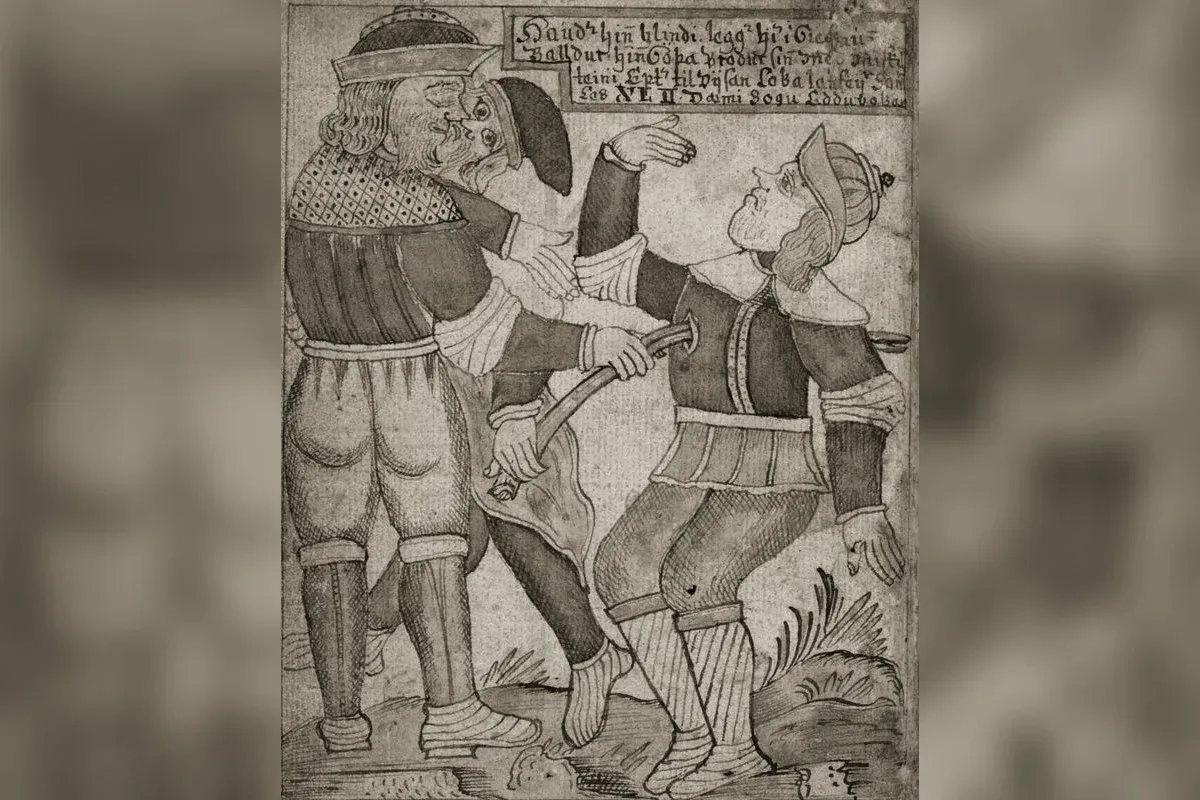
Höðr, Baldr’s blind brother, takes no part in the game — unable to aim, he stands to one side. Loki approaches him, places the mistletoe branch in his hand and guides his throw. The mistletoe flies, pierces Baldr, and the god of light falls dead.
The silence that descends on the assembly is absolute. No one can take vengeance on the spot, as the place is sacred (no blood may be spilled there). The Aesir mourn as they have never mourned — for they know this death is without reversal, and that it changes everything.
The attempt to retrieve Baldr: Hermóðr in Hel
Odin sends his son Hermóðr on the horse Sleipnir to the realm of the dead to beg Hel — the ruler of the dead — to release Baldr. Hel sets one condition: every thing in the world, alive and dead, must weep for Baldr. If even one refuses, he stays with her.
Messengers travel the worlds and everything weeps — men, gods, animals, stones, trees. Everything, except a giantess named Þökk — who refuses: “Baldr means nothing to me; let him stay with Hel.” This giantess is Loki in disguise. His hatred alone is enough to condemn Baldr to the realm of the dead forever.
Baldr and Ragnarök
Baldr is one of the central figures in the final prophecy. The Völuspá — the key poem of the Poetic Edda — names his death as one of the events that trigger the chain of consequences leading to Ragnarök: the punishment of Loki, the breaking free of Fenrir and the Midgard Serpent, and the fall of the gods.
But the Völuspá also carries the promise: after Ragnarök, when the world has been destroyed and reborn, Baldr will return from Hel together with his brother Höðr. They will rule over a world at peace, where the old fields of Asgard will grow green again and surviving humans will live in goodness.
What the ancient sources say
The fullest account of Baldr is the Gylfaginning of Snorri Sturluson (Prose Edda, c. 1220), which describes in detail the death, the attempted rescue, and the condemnation of Loki. The Völuspá (Poetic Edda) evokes Baldr’s death, Odin’s vengeance, and Baldr’s return after the world’s end in terse but pivotal stanzas. Baldrs draumar (“Baldr’s Dreams”) is a short eddic poem in which Odin awakens a dead seeress to interpret his son’s nightmares.
Saxo Grammaticus (Gesta Danorum, c. 1200) offers a very different version: Balderus appears as a human warrior in rivalry with Hothurus (Höðr) for a woman’s love. This euhemerised version is considered a historicising reading, less close to the Norse religious tradition.
Further reading
For the architect of his death and the ambiguous figure whose act tips Norse mythology into catastrophe, read the page on Loki. For the Allfather who gathers armies for the end of the world, see the page on Odin. For the blind brother whose hand throws the mistletoe, consult the page on Hodr. For the mother whose oath-taking missed the one plant that never swore, read Frigg, and for the queen who refuses to give him back, Hel. For the monstrous wolf who devours Odin at the Ragnarök his death set in motion, see Fenrir. The full account of the killing and its consequences is told in The Death of Baldr.
See also
Related entries
Stories featuring this entity
Frequently asked questions
Why is Baldr invulnerable in Norse mythology?
Frigg, Baldr's mother, obtained an oath from every thing in existence — plants, animals, stones, diseases, poisons — never to harm her son. Only mistletoe was omitted, deemed too young and insignificant to swear. This single exception proved fatal: Loki discovered it and used it to cause Baldr's death.
How does Baldr die?
Loki, having learned of the mistletoe exception, guides the hand of the blind god Höðr to throw a mistletoe branch at Baldr during a game among the gods. The projectile pierces Baldr, who falls dead. It is the gravest act committed in the nine worlds before Ragnarök.
Does Baldr return after Ragnarök?
Yes. The Völuspá describes a renewed world after Ragnarök where Baldr rises from Hel to rule alongside his brother Höðr in a new age of peace. His resurrection embodies the promise of cosmic renewal after the final destruction.