Norse mythology · Death and afterlife
The death of Baldr: the darkest myth of Norse mythology
In brief
The death of Baldr: Frigg's oath, the fatal mistletoe guided by Loki, Hel's refusal to release him, and Loki's punishment — the inevitable herald of Ragnarök.
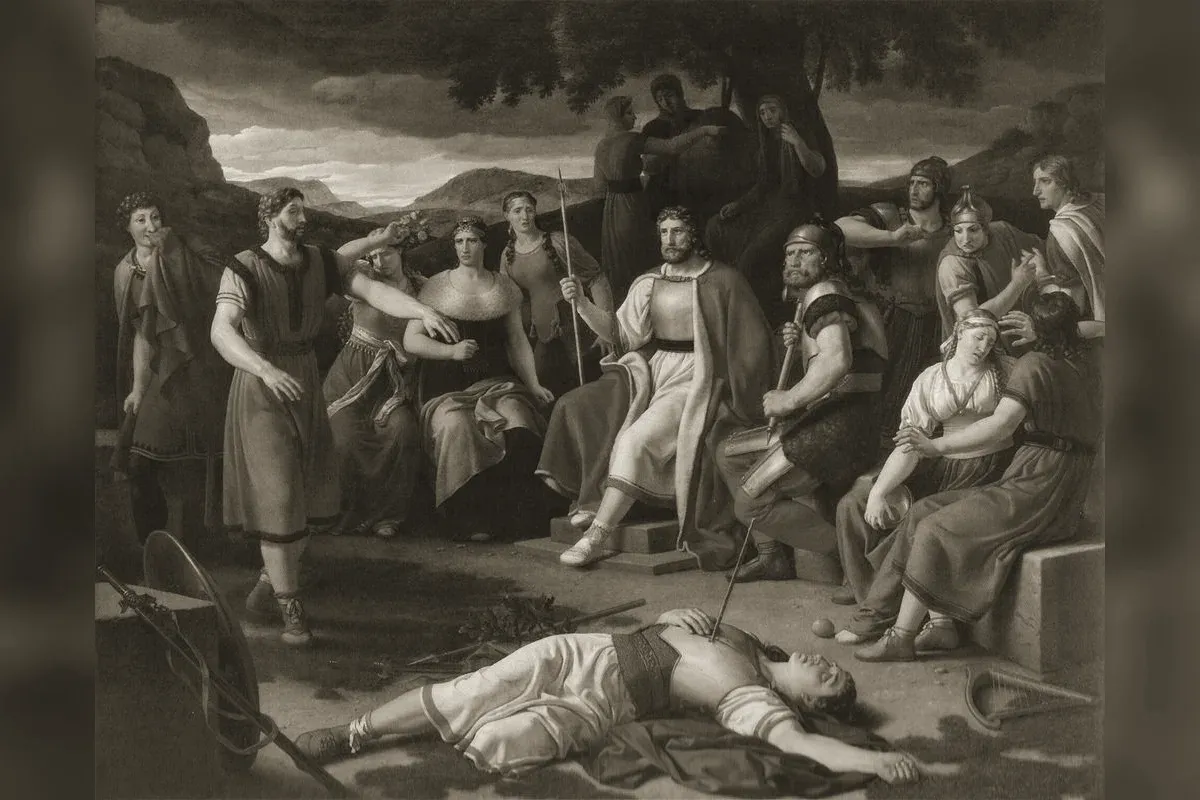
Before the death: Baldr’s dreams
It begins with dreams. Baldr, Asgard’s most beloved son, begins having nightmares that foretell his imminent death. This premonition carries absolute gravity in Norse cosmology, where dreams are direct channels to the destinies woven by the Norns.
Odin, alarmed, seeks answers. The Völuspá and Baldrs draumar (“Baldr’s Dreams”) tell how Odin rides Sleipnir eastward, awakens a dead seeress’s grave and questions her about his son’s fate. The prophetess reveals that Baldr will be killed — by mistletoe, by the blind hand of Höðr.
Frigg’s oath
Frigg, Baldr’s mother and queen of the Aesir, decides to take his fate into her own hands. She travels through the nine worlds and asks every thing — trees, stones, fires, diseases, poisons, animals, minerals — to swear never to harm Baldr.
All swear. The gods, relieved, invent a game: they throw arrows, swords, axes and stones at Baldr. Everything bounces away harmlessly. Baldr laughs. The gods laugh. Innocence appears to be protected.
The gap: mistletoe
Loki watches the scene. He suspects a gap in the oath — something was omitted. He disguises himself as an old woman and visits Frigg, who, in the confidence of conversation, reveals that mistletoe, too young to swear, was not approached.
Loki immediately goes to cut a mistletoe branch. He fashions it, hardens it, turns it into a throwing weapon. Then he makes his way to the assembly of the gods where Baldr’s game is in play.
Off to one side stands Höðr — Baldr’s blind brother — taking no part. He cannot aim, cannot see. Loki approaches him with false concern: “Why aren’t you joining in? Here is something to throw — I’ll guide your arm.”
Höðr agrees. Loki guides the arm. The mistletoe flies.
The death
The projectile passes through Baldr entirely. The god of light falls dead before he reaches the ground.
The silence that descends on the assembly of the gods is total and unprecedented. No one can raise a hand against the killer — the place is sacred, no blood may be shed there. The Aesir stand rooted to the spot, voiceless. The gods weep. They have never wept before.
Baldr’s body is carried in procession to the sea. His horse is led onto the funeral pyre with him. His wife Nanna dies of grief and is laid at his side. The funeral ship — the greatest of all ships — is set alight and pushed out to sea. Odin whispers a final secret in his son’s ear that no one else can hear.
Hermóðr’s quest
Odin sends his son Hermóðr on the horse Sleipnir to the underworld to plead Baldr’s case before Hel, ruler of the dead.
Hermóðr rides nine nights through darkness and ravines, crosses the bridge Gjallarbru, and enters Hel’s realm. He finds Baldr seated in the place of honour, pale but intact. He begs Hel to let him go.
Hel sets one condition: every thing in the world, alive and dead, must weep for Baldr. If even one refuses to weep, he remains with her forever.
The refusal of Þökk
Messengers travel the worlds. Everywhere they collect tears — men weep, gods weep, stones weep, trees weep. Everything weeps for Baldr.
Except one giantess named Þökk, who replies with absolute coldness: “Baldr never did anything for me. Let him stay with Hel. Whatever Hel keeps, she keeps.”
Þökk is Loki in disguise. His hatred alone is enough to condemn Baldr to the realm of the dead forever. Hel’s condition goes unmet. Baldr stays in the land of the dead.
The punishment of Loki
The gods understand that Loki is responsible — for Baldr’s death, for the refusal of Þökk, and therefore for the impossibility of his resurrection. After he further compromises himself at the banquet of the Lokasenna — where he insults each of the assembled gods in turn — they capture him.
The punishment matches the crime:
- His sons Vali and Narfi are summoned. Vali is transformed into a wolf who devours Narfi.
- Narfi’s entrails are used to bind Loki across three stone slabs.
- A serpent is placed above him, dripping venom onto his face.
- His wife Sigyn holds a bowl to catch the poison — but when she turns away to empty it, the drops fall and Loki convulses in agony. His convulsions are, in Norse tradition, the cause of earthquakes.
Loki will remain chained until Ragnarök, when he breaks free to lead Fenrir and the forces of chaos against Asgard.
Symbolic significance
The death of Baldr is far more than a narrative episode. It is the theological turning point of Norse mythology:
- It transforms Loki definitively into an enemy of the gods — from equivocal companion, he becomes a force of absolute destruction.
- It proves that even absolute beauty and pure innocence cannot escape destiny.
- It triggers the chain of events leading to Ragnarök — for Loki’s punishment only sharpens his revenge, and his final release will mark the beginning of the end.
What the ancient sources say
The Völuspá (Poetic Edda) evokes Baldr’s death and Loki’s punishment in a handful of stanzas of extraordinary density. Baldrs draumar is devoted entirely to the prophetic dreams and Odin’s consultation of a dead seeress. Snorri Sturluson’s Gylfaginning provides the fullest narrative of the myth, including details of the mistletoe, the three attempts at universal mourning, and Loki’s punishment. The Lokasenna recounts Loki’s insults to the gods at the feast, immediately before his capture.
Further reading
To understand Baldr, the victim at the heart of the myth, read the page on Baldr. For the mother whose oath was not enough, see the page on Frigg. For the trickster who engineers the murder, see the page on Loki. For the bereaved father who prepares his vengeance from Valhalla, see the page on Odin. For the monstrous creature that this death will ultimately free at Ragnarök, read the page on Fenrir. For the account of the inevitable end that Baldr’s death sets in motion, see Ragnarök.
Story beats
- 01Baldr's prophetic nightmares
- 02Frigg's oath from every thing in the world
- 03Loki discovers the exception
- 04Baldr killed by the mistletoe branch guided by Höðr
- 05Hermóðr's quest to Hel to reclaim Baldr
- 06The refusal of Þökk (Loki in disguise) to weep
- 07The capture and punishment of Loki
Ancient sources
- Völuspá (Poetic Edda)
- Baldrs draumar (Poetic Edda)
- Gylfaginning (Prose Edda, Snorri Sturluson, c. 1220)
- Lokasenna (Poetic Edda)
See also
Frequently asked questions
Why does Loki want to kill Baldr?
The Norse sources do not spell out Loki's motive explicitly. Some scholars read jealousy toward the being most beloved by all; others see the nature of a trickster that inevitably drives toward chaos. In the narrative logic of the Eddas, Baldr's death seems less driven by personal grudge than by cosmic necessity — Loki is the agent of a fate that nothing can prevent.
Is Höðr guilty of Baldr's death?
His responsibility depends on the source and interpretation. In Snorri’s account, Hodr knows that he is joining the game against Baldr, but, being blind, does not know that the mistletoe supplied by Loki can kill him; Loki chooses the weapon and directs the throw. The older Eddic poems name Hodr’s fatal stroke without relating this manipulation. Vali subsequently kills Hodr to avenge Baldr.
What happens to Loki after the death of Baldr?
Loki is captured by the gods after insulting each of them in turn at the banquet of the Lokasenna. He is chained in an underground cave, his own sons used as instruments of his punishment — a serpent drips venom onto his face. He remains there until Ragnarök, when he breaks his chains to lead the forces of chaos against the gods.