Norse mythology · Gods & goddesses
Sif, Norse goddess of golden hair and wife of Thor
In brief
Sif is the Aesir goddess married to Thor, famous for her hair of gold and mother of the archer-god Ullr. When Loki shears her head while she sleeps, Thor's demand for compensation sets off the forging of the gods' greatest treasures, Mjolnir included. Her name is the Old Norse word for kinship by marriage.
- marriage bond and kinship
- household honour and fidelity
- fertility of ploughed land (modern reading)
- long golden hair forged by dwarves
- +1
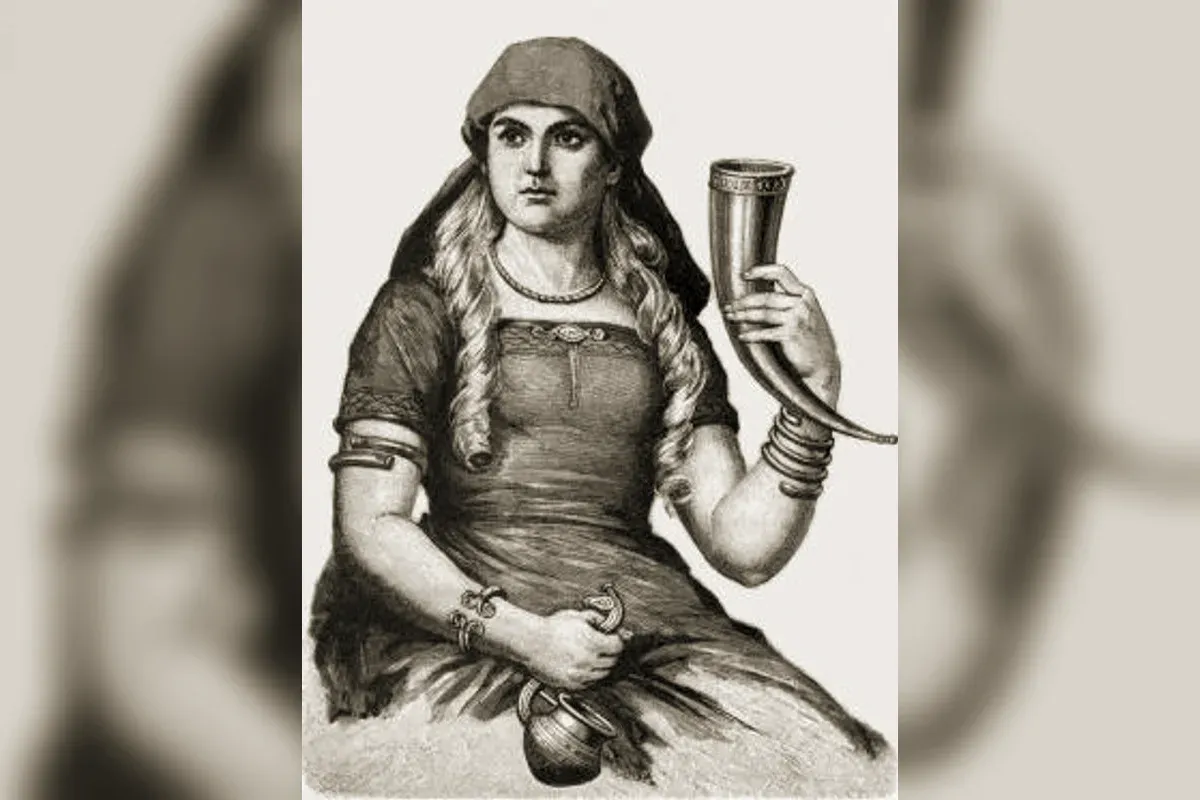
Who is Sif?
Sif is the Aesir goddess married to Thor, known above all for her hair of gold. Snorri Sturluson counts her among the goddesses of Asgard and characterises her above all by her golden hair.
She speaks barely a handful of lines in the Norse corpus, and yet one of its most important mechanisms starts with her. When Loki shears her head while she sleeps, the compensation Thor extorts from him sends the dwarves to their forges — and out of those forges come the objects on which the power of the gods rests, Mjolnir first among them.
Role, nature and domain
Sif governs no element. Her domain is abstract and it is written into her name: Old Norse sif, plural sifjar, means kinship by marriage — the tie a wedding creates between two lines. The same root gives German Sippe and English sibling.
That etymology invites an association with marital alliance, but no surviving text explicitly calls Sif a goddess of marriage. The sources present her above all as Thor’s wife; the two assaults directed at her concern her body, when her hair is cut, and her reputation, when Loki accuses her of adultery before the assembled gods.
Nineteenth-century mythographers, Jacob Grimm among them, read her golden hair as ripe grain and made her a goddess of the cultivated earth, the natural consort of a thunder god who brings rain. The reading is attractive and often repeated, but it should be labelled for what it is: no Norse source says so. It is a modern reconstruction, not Eddic data.
Genealogy: wife of Thor, mother of Ullr
Sif has no recorded ancestry. No text gives her a father, a mother or a giant origin; she enters the pantheon solely by marriage, which fits a goddess named after marriage.
She is Thor’s wife, and Skáldskaparmál knows a daughter of Thor named Þrúðr (“strength”), whose mother is never explicitly named but is generally taken to be Sif.
More importantly, Sif is the mother of Ullr, the archer and ski-god. Gylfaginning is unambiguous: Ullr is “the son of Sif, the stepson of Thor”. Sif therefore bore a son by a father the sources leave in shadow, before her union with Thor. The silence is worth noting — Norse genealogies do not aim at a tidy family tree but preserve local traditions side by side, gaps included.
The stolen hair and the forging of the treasures
This is Sif’s great myth, told in chapter 35 of Skáldskaparmál, and it works like a chain reaction.
Loki, out of sheer malice, cuts off Sif’s hair. Thor finds out, seizes him, and promises to break every bone in his body. Loki bargains: he will bring back from Svartalfheim hair of gold that will grow like hair of flesh.
He goes first to the sons of Ivaldi, who make three things: the golden hair, the ship Skidbladnir that folds up into a pouch, and Gungnir, the spear of Odin that never misses.
Unable to stop there, Loki wagers his own head with the dwarf Brokkr and his brother Eitri (Sindri in part of the manuscript tradition) that they cannot do better. To win, the brothers forge the boar Gullinbursti, the ring Draupnir, and the hammer Mjolnir. Loki, in the shape of a fly, stings Brokkr on the eyelid to sabotage the work: the bellows falter for a moment, and that is why Mjolnir’s handle is too short. The gods judge the hammer the greatest of all the treasures anyway.
Read the ledger of that episode as a whole: the weapon that defends Asgard from the giants, the spear that decides battles and the ring that breeds gold all exist because Loki cut a goddess’s hair. Few passages show so plainly how Norse myth works, with the trickster producing as much as he ruins.
Suspicion: Lokasenna and Hárbarðsljóð
Two Eddic poems target Sif, and both on the same ground — her fidelity.
In Lokasenna, Sif steps forward to hand Loki a cup of mead and ask for peace. Loki drains it and answers that she would be beyond reproach but for one exception: himself, whom he names as her lover. The method is the method of the whole poem, which hits every deity where it hurts most. For the goddess whose name means “marriage tie”, an accusation of adultery is the worst available wound.
Hárbarðsljóð turns the same weapon on Thor rather than on Sif: the ferryman Hárbarðr — Odin in disguise — taunts the thunder god that Sif has a lover waiting at home and that he should hurry back. Thor treats it as provocation, but the jibe shows the motif was in circulation.
Neither passage should be read as a tradition establishing that Sif was unfaithful. They show the opposite: her honour was a sensitive enough point that it was the thing to aim at when the target was Thor.
The theft of Mjolnir tells a later adventure of the weapon whose forging Sif unwittingly set in motion.
What the ancient sources say
Almost everything comes from Snorri Sturluson (c. 1220). Gylfaginning names her among the goddesses and records her motherhood of Ullr; Skáldskaparmál tells the story of the hair and doubles as a catalogue of kennings, where gold is called Sifjar haddr, “Sif’s hair” — proof that the episode was common knowledge for any skaldic audience.
The Prologue to the same Edda offers a quite different, euhemerised account. Snorri, a Christian, explains the Norse gods as deified men and women out of Asia; there Sif becomes Sibil, a prophetess married to “Tror” (Thor) and an ancestress of the royal lines of the North. This is not religious tradition but a learned attempt to fit paganism into world history — valuable less as myth than as evidence of how the thirteenth century handled its own heathen inheritance.
In the Poetic Edda Sif appears in Lokasenna and Hárbarðsljóð, never for more than a few stanzas. No source gives her a story of her own: her deepest mark on the tradition is a kenning for gold and a chain of events she never chose.
Further reading
For the husband she is inseparable from in every source, read the page on Thor. For the god who shears her hair and then slanders her in Lokasenna, see Loki. For the hammer that came out of that settlement, consult Mjolnir, and for the spear forged on the same errand, Gungnir. To continue with the pantheon’s principal goddesses, read Freya and Frigg.
Ancient sources
- Snorri Sturluson, Prose Edda — Gylfaginning, 31
- Snorri Sturluson, Prose Edda — Skáldskaparmál, 35 (the shorn hair and the forging of the treasures)
- Snorri Sturluson, Prose Edda — Prologue, 3-4 (Sibil)
- Poetic Edda — Lokasenna, 53-54
- Poetic Edda — Hárbarðsljóð, 48
See also
Related entries
Stories featuring this entity
Frequently asked questions
Who is Sif in Norse mythology?
Sif is an Aesir goddess, the wife of Thor and the mother of Ullr. Snorri identifies her above all by her hair of gold. She says almost nothing in the surviving texts, yet one of the most consequential chains of events in the mythology begins with her: Loki's theft of her hair is what forces the dwarves to forge the treasures of the gods.
Why did Loki cut off Sif's hair?
Skáldskaparmál gives no motive beyond malice. The consequence is what matters. Thor seizes Loki and swears to break every bone in his body; Loki buys his life by promising to bring back hair of gold from the dark elves that will grow like real hair. Keeping that promise is what also produces Gungnir, Skidbladnir, Gullinbursti, Draupnir and Mjolnir.
What does the name Sif mean?
Old Norse *sif* / *sifjar* means kinship by marriage — the tie that a wedding creates between two families. Sif is therefore named after the relationship she embodies, which explains how little she does in the myths: she is not a goddess of deeds but the divine guarantee of a bond. That is also why the two attacks she suffers strike at her body and at her reputation rather than at her power.