Norse mythology · Gods & goddesses
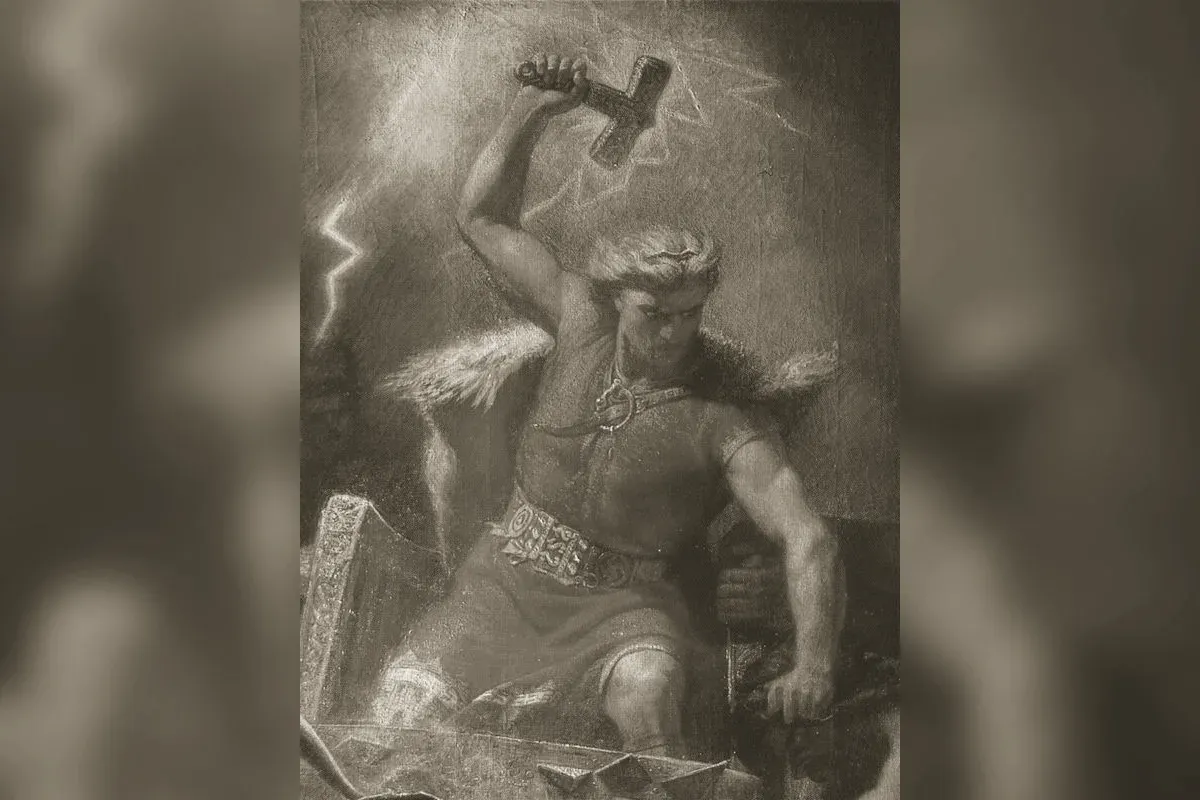
Thor, god of thunder and protector of mankind in Norse mythology
In brief
Thor, the Norse god of thunder: his hammer Mjöllnir, his battles against giants, his fishing for Jörmungandr, and his fateful duel at Ragnarök.
- thunder
- lightning
- storms
- strength
- +8
Who is Thor?
Thor is the god of thunder in Norse mythology and one of the most widely venerated deities among the Norse and Germanic peoples. Son of Odin and the earth goddess Jörð, he is the protector of Midgard — the world of humans — and the tireless fighter against the Giants (Jötnar), embodiments of the chaotic forces threatening cosmic order. Unlike his father Odin — intellectual, shamanic, and often deceptive — Thor is direct, courageous, and loyal: he fights with his strength and hammer, not through cunning.
Role, nature, and domains
Thor is above all the god of storms and thunder: when the sky roared and lightning split the clouds, the Norse heard his steel-wheeled chariot crossing the heavens, pulled by his two sacred goats (Tanngnjóstr and Tanngrísnir). These goats have the remarkable property of dying and reviving each day — Thor can eat them in the evening, and if their bones are intact by morning, they live again.
But Thor is not only a warrior deity: his domain also encompasses agriculture and fertility. Norse farmers invoked him for good harvests, because the rain and thunder that fertilise the fields come from him. His cult was thus popular and accessible — closer to the common people than the aristocratic and esoteric worship of Odin.
Mjöllnir: the sacred hammer
Mjöllnir (the “crusher” or “grinder”) is Thor’s most emblematic attribute and the most powerful magical object in Norse mythology. Forged by the dwarves Brokkr and Sindri at Odin’s commission, it has one flaw: its handle is too short, because Loki (in the form of a fly) stung Brokkr to disrupt the forging. Despite this flaw, Mjöllnir is considered the dwarves’ greatest creation because:
- it always returns to Thor’s hand after each throw
- it can reduce a mountain to dust
- it can bless and consecrate (weddings, funerals, newborns)
- the giants fear it above all else
Mjöllnir amulets are the most widespread jewellery of the Viking Age — the functional counterpart of Christian crosses, worn as divine protection.
Battles against the Giants
Thor is the giant-slayer par excellence. The majority of Norse narratives featuring him show him in combat with Jötnar:
The journey to Útgarðaloki: Thor and Loki visit the castle of the Giant Útgarðaloki, where they face impossible trials. Thor tries to drain a drinking horn whose far end plunges into the ocean, to lift a cat that is in fact the disguised Jörmungandr, and to wrestle an old woman who represents Old Age itself. Thor fails all these contests — magical illusions — but the slight progress he makes so frightens Útgarðaloki that the giant dissolves his castle.
The fishing for Jörmungandr (Hymir and Thor): Thor sails with the giant Hymir and uses an ox head as bait, hauling the World Serpent (Jörmungandr) up to the boat’s edge — but Hymir, seized with fear, cuts the fishing line. Thor and Jörmungandr are fated to kill each other at Ragnarök.
The theft of Mjöllnir (Þrymskviða): Þrym, king of the giants, steals Mjöllnir and demands Freyja in marriage in exchange. Loki suggests Thor disguise himself as the bride. Thor — in a wedding dress — recovers his hammer at the ceremony and slaughters the giants.
Family and Odin’s circle
Thor is the son of Odin and Jörð (the Earth, personified as a goddess), making him a deity who is simultaneously celestial (his thunder) and terrestrial (his links to fertility). His mother is not Frigg — Odin’s official wife — but a primordial earth goddess, which gives him a nature closer to the world of men than to the aristocratic intrigues of Asgard.
He resides in Thrudheim (“the realm of strength”), his own domain in the Asgardian universe, distinct from his father’s hall.
Ragnarök: Thor’s death
At Ragnarök, Thor’s fate is recorded in the Völuspá with dramatic clarity:
- Thor faces Jörmungandr, the World Serpent, his eternal cosmic adversary.
- Thor slays the serpent with his hammer.
- But he staggers back nine steps before dying from Jörmungandr’s venom.
Nine steps — the cosmic number in Norse mythology. Thor dies a victor, but a victor who will not survive his own victory. This tragic fate illustrates the Norse conception of heroism: it is not survival that matters but courage to the very end.
Cult and legacy
Thor’s worship was among the most widespread in Scandinavia. Temples were dedicated to him at sites such as Uppsala (Sweden), where a colossal statue of Thor stood at the centre. Oaths were sworn on his sacred ring. Thursday bears his name in English (and its Germanic equivalents).
During the Viking Age, the spread of Christianity provoked an identity reaction centred on Thor: Mjöllnir amulets multiplied as an ostentatious counterweight to the cross. Thor represented the resistance of Norse culture against Christianisation.
What the ancient sources say
The Poetic Edda contains several lays centred directly on Thor: Þrymskviða (the theft of Mjöllnir), Hymiskviða (the fishing for Jörmungandr), Hárbarðsljóð (a quarrel between Thor and the disguised Odin). Snorri Sturluson’s Prose Edda devotes extensive passages to his adventures, including the journey to Útgarðaloki. Adam of Bremen (Gesta Hammaburgensis ecclesiae pontificum, 11th c.) describes the statue of Thor at Uppsala and his cult as the first deity of the calendar. Saxo Grammaticus dedicates several chapters to his exploits in the Gesta Danorum.
Further reading
For the Allfather of whom Thor is the mightiest son, read the page on Odin, father of the gods. For the trickster who helps him recover his hammer and accompanies him on adventures, see the page on Loki. For the Vanir goddess whose hand in marriage a giant once demanded in exchange for the stolen Mjöllnir, consult the page on Freya. For the World Serpent he battles several times and who is his cosmic nemesis, see the page on Jörmungandr. For the full story of his sacred hammer, read the page on Mjolnir. For the story of his disguise as a bride to recover his stolen weapon, see The Theft of Mjolnir. For the account of the final battle between Thor and the cosmic serpent, see Ragnarök. For his wife, whose shorn hair set the forging of Mjolnir in motion, read the page on Sif.
See also
Frequently asked questions
Why does Thor need gloves to wield Mjöllnir?
The iron gloves *Járngreipr* are necessary to grip the hammer without injury: Mjöllnir was forged by the dwarves Brokkr and Sindri, but its handle is too short because Loki — in the form of a fly — stung Brokkr during the forging. This flaw makes the hammer difficult to wield for anyone lacking the appropriate strength and equipment. The gloves and the belt of strength *Megingjörð* double Thor's power and are his inseparable attributes.
How is Thor connected to the days of the week?
Thursday is named after Thor in Germanic languages: *Thursday* in English, *Donnerstag* in German ('thunder day'). The French *jeudi* comes from *Jovis dies* (day of Jupiter) — the Roman equivalent of Zeus, who was himself identified with Thor in the *interpretatio romana*. This trace in our calendar testifies to the depth of Norse and Germanic-Roman gods' imprint on Western culture.
Does Thor fight Loki?
Thor and Loki have an ambivalent relationship: they frequently travel together in the myths (the journey to Útgarðaloki, the stay among the giants), and Loki sometimes helps Thor recover his hammer (*Þrymskviða*). But Loki is also the indirect cause of many evils — including Baldr's death. At Ragnarök they do not fight directly: Thor battles Jörmungandr (Loki's son), while Loki leads the forces of chaos against the Aesir. Their relationship illustrates the complexity of the relationship between order and chaos in Norse mythology.