Norse mythology · Creatures
Jörmungandr, the World Serpent of Norse mythology
In brief
Jörmungandr, the World Serpent of Norse myth: Loki's son encircling Midgard, his three confrontations with Thor, and their mutual death at Ragnarök.
What is Jörmungandr?
Jörmungandr is the cosmic serpent of Norse mythology, one of the three monstrous creatures fathered by Loki with the giantess Angrboða. Its siblings are Fenrir, the wolf, and Hel, sovereign of the dead. Cast into the ocean surrounding Midgard by Odin, it grew large enough to encircle the entire world and bite its own tail. Its absolute enemy is Thor, whose prophetic counterpart it is: they will kill each other at Ragnarök.
Birth and exile in the ocean
Jörmungandr is born in the forest of Járnviðr (the Iron Wood), from the union of Loki with the giantess Angrboða. When Odin learns of the three children of this union, he understands from prophecy that each constitutes a cosmic threat.
He makes different decisions for each:
- Hel is sent to Niflheim, of which she becomes sovereign.
- Fenrir is brought to Asgard and raised by the gods, until his binding.
- Jörmungandr is cast into the ocean surrounding Midgard.
This proves to be a fundamental cosmic miscalculation: the ocean is not a prison. Jörmungandr grows freely in the depths, nourished by the unfathomable sea, until its body encircles all of Midgard. In those bottomless waters it bites its own tail — forming a cosmic ring which, so long as it closes upon itself, maintains the boundary between order and chaos. Its release at Ragnarök will dissolve that boundary.
Three confrontations with Thor
Jörmungandr and Thor have three encounters in the Norse texts, each more intense than the last.
1. The illusion of Útgarða-Loki
In the tale of Útgarðar (Gylfaginning), Thor visits the giant Útgarða-Loki, who challenges him to a series of seemingly trivial feats. One involves lifting a cat. Thor tries with all his strength and manages only to lift one paw. The giants of Útgarðar laugh.
At the end of the stay, Útgarða-Loki reveals the truth: the cat was Jörmungandr in magical disguise. The fact that Thor managed to raise even one paw of the World Serpent had terrified every giant present — no being but Thor could have touched it at all.
2. The fishing trip with Hymir
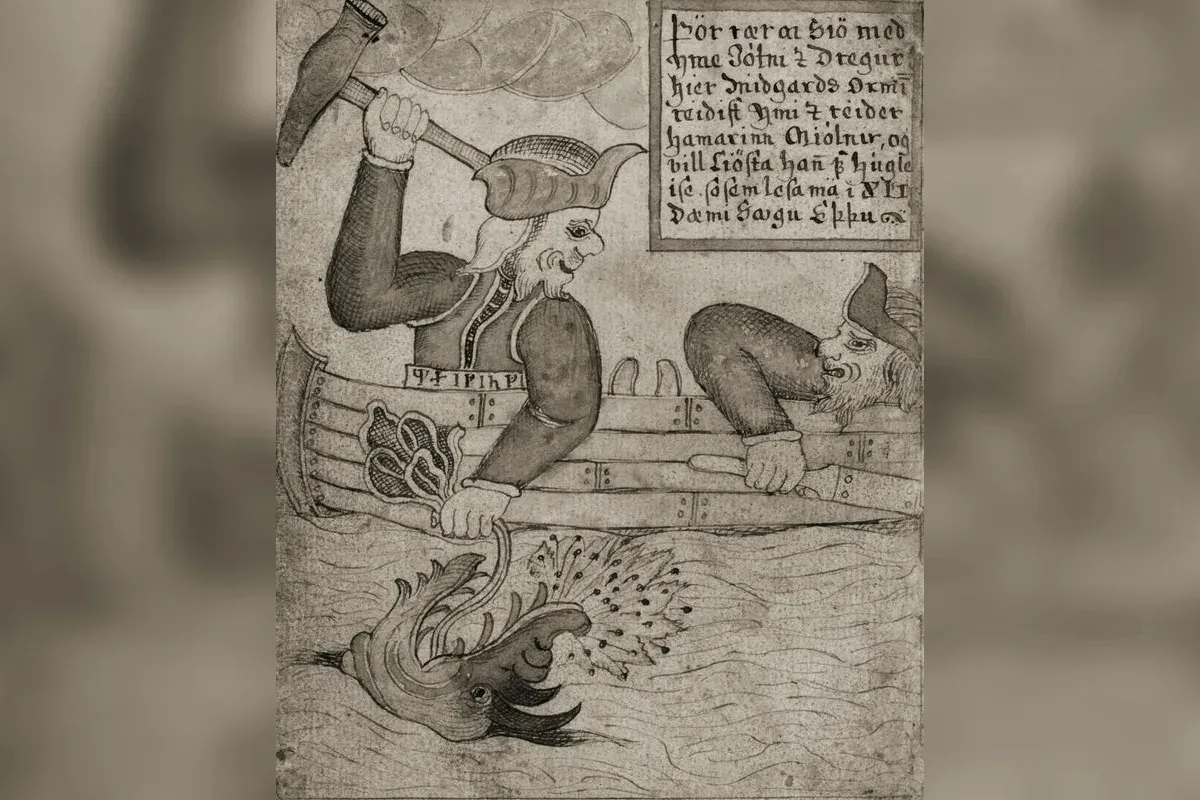
In the Hymiskviða, Thor sets out fishing with the giant Hymir. Against the giant’s advice, he rows far beyond the usual fishing grounds, into the deep water. He uses an ox’s head as bait.
Jörmungandr bites. The catch is titanic. Thor hauls the serpent out of the water and comes face to face with it — a confrontation of cosmic intensity, eye to eye, Mjolnir raised.
But Hymir, seized with panic, cuts the fishing line. Jörmungandr plunges back into the depths. Thor, furious, strikes Hymir and returns empty-handed — knowing their final meeting has been deferred, not cancelled.
3. Ragnarök: the fatal duel
At Ragnarök, Jörmungandr rises from the ocean, dissolving the ring around Midgard. It spews its venom into the air and over the land, poisoning the world. Thor goes out to meet it, Mjolnir in hand.
They fight. Thor kills Jörmungandr with a blow of Mjolnir that crushes its skull. But the serpent’s venom has permeated the god of thunder with every step. Thor takes nine steps after Jörmungandr’s death — then collapses, carried off by the poison.
The Völuspá summarises this duel in a few strophes of tragic economy: nine steps, and it is over.
Jörmungandr in the cosmic network
Jörmungandr occupies a precise place in the Norse cosmological map. Its body encircling Midgard makes it a cosmic boundary as much as a threat: as long as it bites its tail in the ocean depths, it delimits the human world from outer chaos. This image evokes the ouroboros (the serpent biting its own tail) found in other traditions — Egyptian, alchemical — as a symbol of cyclicality, eternity, and self-containment.
Its siblings Fenrir and Hel form with it the infernal triad sprung from Loki — three threats for three cosmic domains:
- Fenrir for the land and sky of Asgard (will devour Odin)
- Jörmungandr for the ocean and Midgard (will kill Thor)
- Hel for the realm of the dead
This monstrous triad is the negative counterpart of the divine triad, generated by Loki’s own body — as if the trickster carried within himself the seeds of the world’s end.
What the ancient sources say
The Völuspá (Poetic Edda, 11th–12th century) foretells Jörmungandr’s emergence from the ocean at Ragnarök and its mutual death with Thor. The Gylfaginning (Prose Edda, Snorri Sturluson, c. 1220) narrates its birth, its exile in the ocean, and the principal stories concerning it. The Hymiskviða (Poetic Edda) recounts the fishing trip with Thor and Hymir. Skaldic kenningar regularly employ Jörmungandr as an image of cosmic vastness and ultimate menace.
Further reading
For its father, the trickster whose monstrous offspring shapes the world’s end, read the page on Loki. For its absolute enemy, whose fate it will share at Ragnarök, see the page on Thor. For its brother, the other bound cosmic threat spawned by Loki, read the page on Fenrir. For the weapon that ends its days, see the page on Mjolnir. For the final battle that brings all these fates together, read the story of Ragnarök.
See also
Related entries
Stories featuring this entity
Frequently asked questions
Why is Jörmungandr Thor's enemy?
The Eddas give no explicit causal reason: their antagonism seems written into the cosmic order itself. Thor is the protector of Midgard and mankind; Jörmungandr is the force that encircles and threatens that world. Their crossed fate — killing each other at Ragnarök — is one of the most clearly stated prophecies in Norse mythology, as if two complementary forces were condemned to annihilate one another.
What happens when Jörmungandr releases its tail at Ragnarök?
As long as Jörmungandr bites its own tail in the ocean depths, it forms a ring that delimits Midgard — a cosmic boundary between the world of humans and the outer chaos. When it releases at Ragnarök, that boundary dissolves: the ocean floods the land, monsters break free, and the world tumbles into destruction. The serpent's release is simultaneously a liberation and the collapse of cosmic order.
Does Thor really die from Jörmungandr's venom?
Yes. The Völuspá and the Gylfaginning are explicit: Thor kills Jörmungandr with Mjolnir, but then succumbs to its venom after taking nine steps — he collapses after nine strides. This crossed fate, in which both protagonists destroy each other, is one of the most distinctive features of Norse mythology: victory here is never without death.