Norse mythology · Creation myths
The Norse Creation Myth: Ymir and the Ginnungagap
In brief
The Norse creation myth: from the yawning void of Ginnungagap to the body of the giant Ymir, how Odin and his brothers shape the world and the first humans.
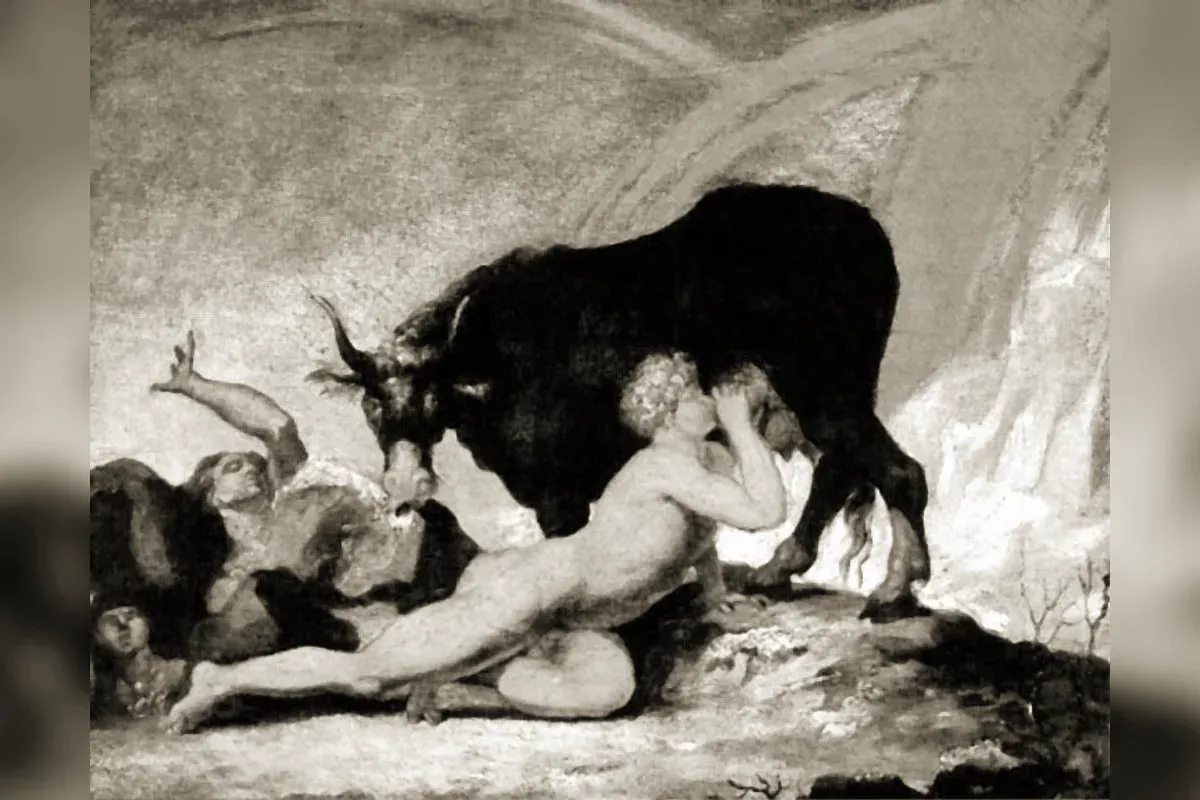
The Norse creation myth begins not with a creating word or a benevolent god, but with a void and a murder. The Viking world is born from the meeting of frost and fire, then from the dismembered body of a primordial giant. Reconstructed chiefly from Snorri Sturluson’s Prose Edda and the poem Völuspá, this story says from the outset what the Norse cosmos is: recycled matter, wrested from chaos, and doomed from the very start to collapse one day in the fire of Ragnarok.
Ginnungagap: the yawning void of the beginning
Before the worlds there stretched Ginnungagap, an empty abyss, without form or life. It is not absolute nothingness but an interval, a waiting space. At its two ends stand two opposing primordial realms:
- to the north, Niflheim, the world of ice, mist, and cold, from which the spring Hvergelmir flows;
- to the south, Muspelheim, the world of fire and flame, guarded by the giant Surt and his blazing sword.
The frozen rivers of Niflheim, called the Élivágar, flow southward. Where their frost meets the heat of Muspelheim, the ice melts, and from those drops quickened by warmth the first life is born.
Ymir and Audhumla: the first creatures
From this meeting of frost and fire arises Ymir, the primordial giant, first living being of the cosmos. As he sleeps, the sweat of his armpits begets a pair of giants, and one of his legs conceives a son with the other: thus is born the race of frost giants (the Jötnar), of whom Ymir is the ancestor.
From the melting frost also comes Audhumla, a primordial cow whose four rivers of milk feed Ymir. Audhumla nourishes herself by licking the salty blocks of ice. From that ice, over three days, she frees a man: Buri, fair and mighty, ancestor of the gods. From the very beginning, the Norse world sets two rival lineages face to face: the giants descended from Ymir, and the gods descended from Buri.
The killing of Ymir: a world born from a body
Buri begets Bor, who marries the giantess Bestla. From their union are born three gods: Odin, Vili, and Ve. These three brothers rise against Ymir and kill him. The blood that pours from the giant is so vast that it nearly drowns all the frost giants; only Bergelmir escapes with his wife, perpetuating the lineage that will later oppose the gods.
Odin and his brothers then drag Ymir’s corpse to the center of Ginnungagap and shape the world from his remains. The Norse cosmogony is here brutally precise:
- his flesh becomes the earth;
- his blood becomes the seas and lakes;
- his bones become the mountains;
- his teeth and bone fragments become the rocks and stones;
- his skull becomes the vault of the sky, held at its four corners by four dwarves (North, South, East, West);
- his scattered brains become the clouds;
- his eyelashes or brows are used to build Midgard, the fortified enclosure meant for humankind.
Finally, the gods capture sparks flying out of Muspelheim and fix them in the sky: these become the stars, the sun, and the moon, each assigned an ordered course.
Ask and Embla: the birth of humanity
The world is made, but it remains to be peopled. Walking along a shore, Odin and his brothers find two tree trunks washed up. From them they make the first humans: Ask (the ash) and Embla (the elm, or perhaps the vine).
Each god offers a gift: Odin gives breath and life; the second gives intelligence and movement; the third gives appearance, speech, hearing, and sight. Thus animated, Ask and Embla become the ancestors of all humankind, settled within the protective enclosure of Midgard.
Yggdrasil and the nine worlds
The cosmos thus created is ordered around Yggdrasil, the immense ash tree whose branches and roots connect the nine worlds. Among them: Asgard, the citadel of the Aesir gods; Midgard, the world of humans; Jötunheim, the land of the giants; Niflheim and Muspelheim, the primordial realms; and Helheim, the abode of the ordinary dead.
The world-tree binds and nourishes this cosmos, but it already suffers: an eagle sits atop it, the serpent Nídhögg gnaws at its roots, and the squirrel Ratatosk carries insults from one to the other. From its very birth, the Norse world bears the signs of its wear and its end.
What the ancient sources change
The fullest account comes from the Gylfaginning, first part of the Prose Edda composed around 1220 by the Icelandic Christian Snorri Sturluson. Snorri systematizes and narrates older traditions, but his learned Christian perspective may rationalize certain details.
The older poems of the Poetic Edda offer sometimes divergent versions. The Völuspá (“Prophecy of the Seeress”) stresses the primordial void and already foretells the end of the world. The Vafþrúðnismál stages a dialogue between Odin and a wise giant about origins, and explicitly attributes the formation of the world to Ymir’s body. The Grímnismál details the correspondence between the giant’s parts and the elements of the cosmos. These sources do not always agree: Norse mythology reaches us in fragments, reconstructed after the Christianization of Iceland.
The meaning of the myth
The Norse cosmogony is perhaps the darkest of the great creation myths. The world here is not given: it is wrested, carved from the corpse of a giant, built upon a founding murder. The gods are not all-powerful creators but craftsmen recycling a hostile raw material. And this world, from the very instant of its birth, knows that it will perish: Ragnarok is already written into the order of things. This awareness of the end gives Viking myth its unique gravity.
Further reading
For the god-craftsman who shapes the world and gives breath to humankind, read the page on Odin. For the world-tree that structures the cosmos born from Ymir, see the page on Yggdrasil. For the citadel of the gods at the heart of the nine worlds, consult the page on Asgard. For the foretold destruction of this created world, read the Ragnarok narrative.
Story beats
- 01The yawning void of Ginnungagap between Niflheim and Muspelheim
- 02Frost meeting fire gives birth to the giant Ymir
- 03The cow Audhumla and the emergence of Buri, ancestor of the gods
- 04Odin and his brothers slay Ymir and shape the world from his body
- 05The creation of the first humans, Ask and Embla
- 06The ordering of the nine worlds around Yggdrasil
Ancient sources
- Snorri Sturluson, Prose Edda (Gylfaginning)
- Völuspá (Poetic Edda)
- Grímnismál (Poetic Edda)
- Vafþrúðnismál (Poetic Edda)
See also
Frequently asked questions
How was the world created in Norse mythology?
In the beginning there was Ginnungagap, a yawning void bordered by the icy realm of Niflheim and the fiery realm of Muspelheim. Where the frost melted against the heat, the first giant, Ymir, was born. Later, Odin and his brothers slew Ymir and shaped the world from his body: his flesh became the earth, his blood the seas, his bones the mountains, and his skull the vault of the sky.
Who is Ymir in Norse mythology?
Ymir is the first living being, a primordial giant born from the frost of Ginnungagap. From his sleeping body the first giants are born. He is killed by Odin, Vili, and Ve, who use his remains as the raw material of the world. Ymir is thus both the ancestor of the giants and the very substance of the cosmos.
Who were the first humans in Norse mythology?
Ask and Embla, a man and a woman shaped by the gods from two tree trunks found on the shore. Odin gives them breath and life, his brothers grant them intelligence, speech, hearing, sight, and the color of life. They become the ancestors of all humankind.