Norse mythology · Mythical places
Asgard, the celestial city of the Aesir gods in Norse mythology
In brief
Asgard in Norse mythology: the fortress of the Aesir linked to Midgard by the Bifröst bridge, its great halls, its walls, and its fall at Ragnarök according to the Eddas.
What is Asgard?
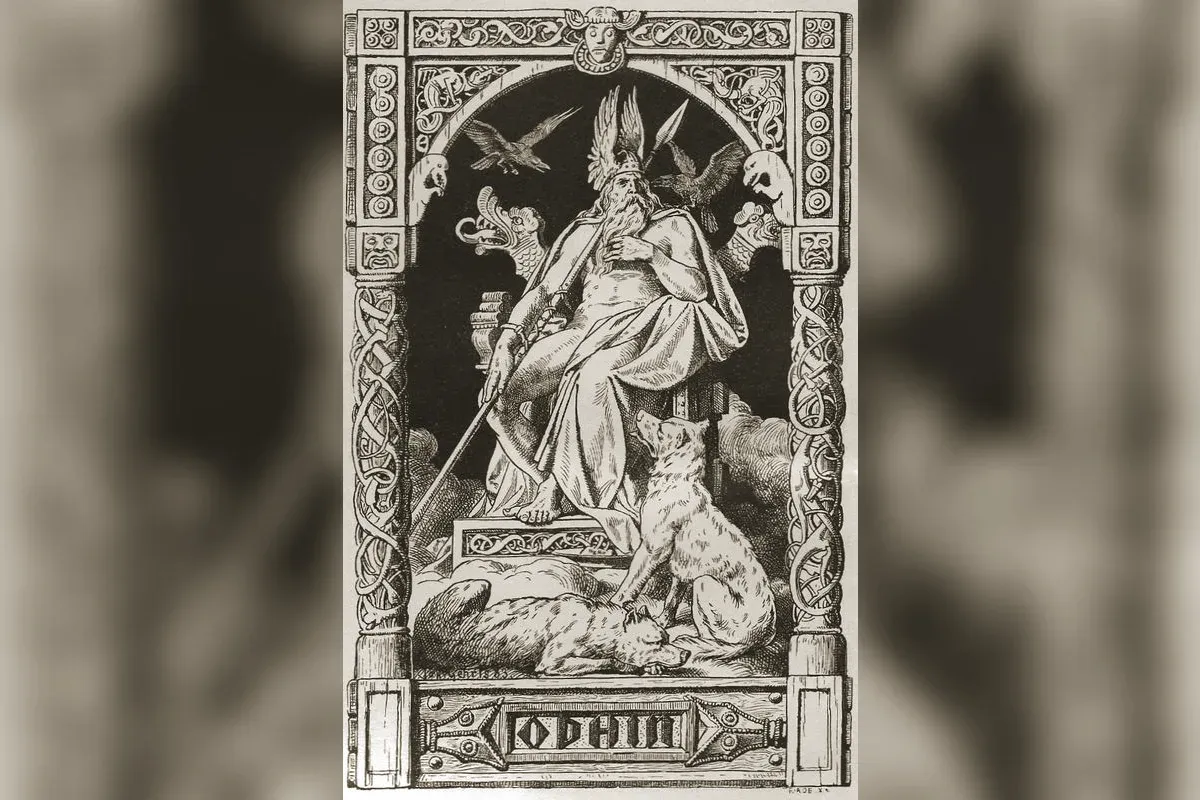
Asgard (Ásgarðr, ‘the enclosure of the Aesir’) is the city of the gods in Norse mythology — the celestial fortress where the Aesir, the chief of the two divine families, dwell. It is there that Odin sits enthroned, there that Thor returns from his expeditions against the giants, there that Valhalla rises, where the warrior dead train. Asgard is not merely a place: it is the heart of the Norse cosmic order, the enclosed and defended space that holds the chaos of the Jötnar at bay.
An enclosure against chaos
The very name of Asgard states its function. A garðr is an enclosure, a precinct: Asgard is the protected domain of the gods, opposed to Útgarðr, the wild ‘outside’ where the giants rule. All of Norse geography rests on this tension between the ordered inside and the threatening outside. Asgard is the centre; around it stretches Midgard, the fenced world of humans; beyond, in the margins, the hostile powers prowl.
Within the structure of the nine worlds hung from the world-tree Yggdrasil, Asgard occupies the heights. It communicates with Midgard by a single passage: the Bifröst, the fiery rainbow bridge, guarded without rest by the god Heimdall, whose hearing catches the grass growing and who will sound the horn Gjallarhorn when the end comes.
The great halls of Asgard
Asgard is not a single city but a cluster of divine dwellings. The Grímnismál (Poetic Edda) draws up its catalogue:
- Valhalla, Odin’s hall with its 540 doors, where the Einherjar feast.
- Valaskjálf, Odin’s dwelling housing Hliðskjálf, the throne from which the god surveys the nine worlds.
- Fensalir, the hall of Frigg, Odin’s wife.
- Breiðablik, the luminous dwelling of Baldr, ‘where nothing impure may be found’.
- Bilskírnir, in the realm of Þrúðheimr, Thor’s vast palace.
- Fólkvangr, the domain of Freya, where she receives half of the battle-slain.
This plurality makes Asgard a true divine city, structured like a royal capital in which each power holds its own court.
The building of the walls
One of Asgard’s founding myths is that of its walls. After the war between the Aesir and the Vanir, the city’s fortifications lie in ruin. A builder — a giant in disguise — appears and offers to rebuild the walls in a single winter, on condition of receiving as his wage the goddess Freya, along with the sun and the moon.
The gods accept, certain the task is impossible within the deadline — but the giant, aided by his prodigious stallion Svaðilfari, advances too fast. In a panic, the Aesir order Loki to find a way out. The trickster turns into a mare and lures the stallion away for a whole night; the work falls behind, the giant rages, reveals his nature — and Thor kills him with a blow of his hammer. From that trick will later be born Sleipnir, Odin’s eight-legged horse, brought forth by Loki himself. This tale illustrates a Norse constant: the security of the gods rests as much on fraud as on force.
The fall of Asgard at Ragnarök
Asgard is built to last, but the gods know it is doomed. At Ragnarök, the forces of chaos converge upon it. The sons of Muspell, led by Surt and his sword of fire, ride to the assault; under their weight, the Bifröst shatters. Heimdall at last sounds the Gjallarhorn; the gods and the Einherjar march out in arms from Valhalla to fight the final battle on the plain of Vígríðr.
Most of them fall. The old world collapses and sinks into flames. But Norse cosmology is not nihilistic: after the catastrophe, a new earth emerges, and the surviving sons of the gods gather at Iðavöllr, the site of the old Asgard, to build a renewed world. The city of the gods is therefore both a point of departure and a point of return.
Variants: Snorri’s ‘historical’ Asgard
One particular reading deserves mention. In the prologue to his Prose Edda, Snorri Sturluson offers a euhemerist explanation: the Norse gods were originally illustrious men who came from Asia, and Asgard is but a legendary transformation of Troy (Ásgarðr linked to Asia). This learned theory, typical of medieval Christianity seeking to rationalise paganism, does not belong to the living mythology — but it testifies to the way a Christian scholar of the 13th century tried to save the pagan heritage by disguising it as ancient history.
What the ancient sources say
The description of Asgard rests on the Poetic Edda and the Prose Edda. The Grímnismál lists the divine dwellings and their masters. The Gylfaginning of Snorri Sturluson (c. 1220) gathers the topography of Asgard, the tale of the building of the walls, and the city’s place in the cosmology of the nine worlds. The Völuspá (Poetic Edda) evokes the founding of Asgard, the golden age of the gods, then its destruction at Ragnarök and its rebirth at Iðavöllr. The concrete descriptions — number of doors, materials, layout — come mainly from Snorri, who systematises a more fragmentary oral tradition.
Further reading
For the sovereign of Asgard and master of its throne Hliðskjálf, read the page on Odin. For the defender of the city against the giants, see the page on Thor. For the burning rainbow bridge that is the city’s only approach, read the page on Bifröst, and for its tireless guardian, consult the page on Heimdall. For the most famous of Asgard’s halls, read the page on Valhalla, and for the tree that bears the nine worlds, the page on Yggdrasil. Finally, for the battle in which Asgard collapses before its rebirth, see the tale of Ragnarök.
See also
Stories featuring this entity
Frequently asked questions
What is Asgard in Norse mythology?
Asgard (Ásgarðr, 'the enclosure of the Aesir') is the fortified city of the Aesir gods, one of the nine worlds of Norse cosmology. Set in the heights, it houses the great halls of the gods — including Odin's Valhalla — and connects to the world of humans, Midgard, by the rainbow bridge Bifröst, guarded by Heimdall.
How is Asgard connected to Midgard?
Asgard is linked to Midgard, the world of humans, by the Bifröst: a blazing rainbow-shaped bridge, guarded day and night by the god Heimdall. This bridge will shatter at Ragnarök under the weight of the sons of Muspell riding to assault the gods.
Who built the walls of Asgard?
An anonymous giant builder offered to fortify Asgard in exchange for the goddess Freya, the sun and the moon. To avoid paying that price, the gods forced Loki to sabotage the work: transformed into a mare, he lured away the builder's stallion Svaðilfari. The giant was killed by Thor, and Loki later gave birth to Sleipnir, Odin's horse.