Greek mythology · Journeys & quests
The Twelve Labors of Heracles: the cycle of impossible trials
In brief
The Twelve Labors of Heracles: the origin of the cycle, the twelve impossible tasks imposed by Eurystheus, and the meaning of this founding heroic journey.
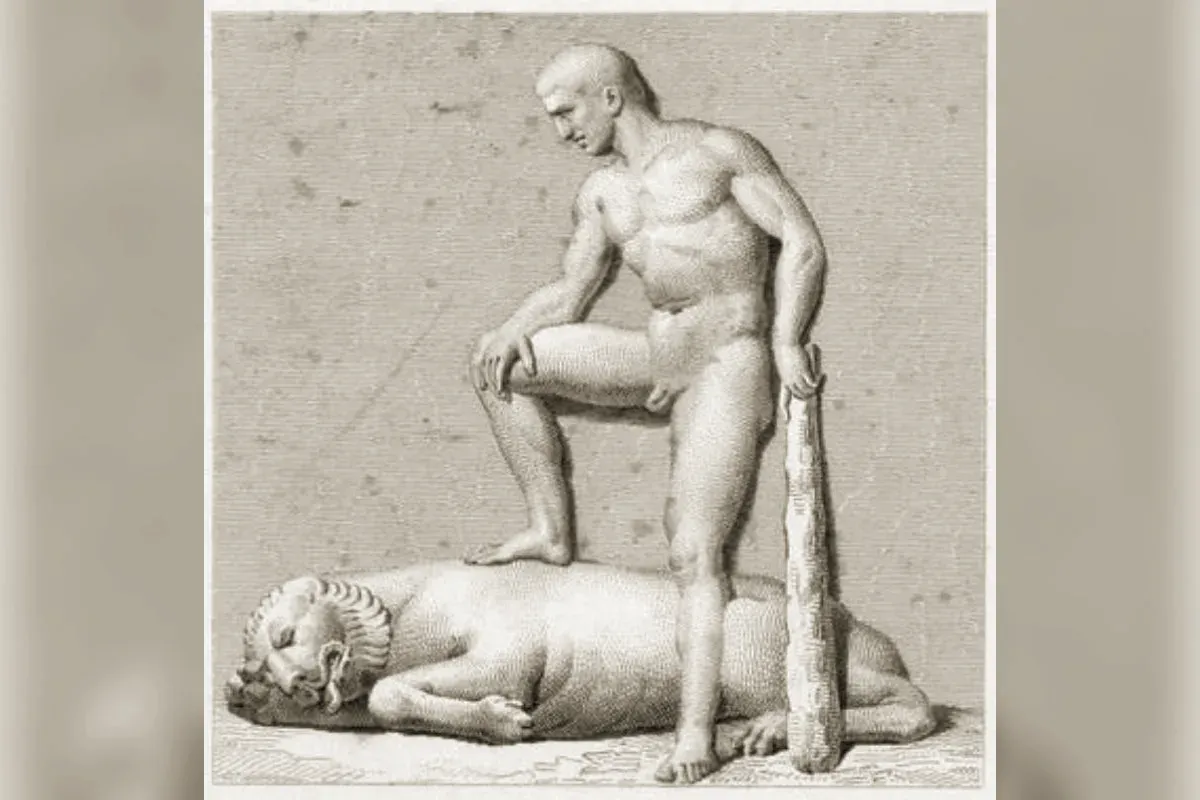
The Twelve Labors of Heracles are the most celebrated heroic cycle in all of Greek mythology. They are not merely a catalogue of feats. They constitute a narrative of redemption — a journey that carries the hero from the depths of madness to the threshold of immortality, through twelve trials designed, one after another, to be impossible to survive. More than two and a half millennia after they were first told, they remain one of the most immediately recognized story structures in Western culture.
The origin: crime, oracle, and sentence
Everything begins with catastrophe. Hera, who has hated Heracles since birth — he is the living proof of Zeus’s infidelity — sends a fit of divine madness upon him. In his delirium, Heracles no longer recognizes the people around him. He slaughters his wife Megara and their children, believing himself to be fighting enemies.
When the madness lifts and Heracles sees what he has done, he is shattered. He seeks guidance from the oracle at Delphi, the sanctuary of Apollo. The answer is unequivocal: he must go to Tiryns and place himself in the service of King Eurystheus for twelve years, completing whatever trials the king imposes. Only on that condition will purification — and eventually immortality — be granted.
The founding irony is embedded in the hero’s very name: Heracles means in Greek “he who owes his glory to Hera.” The goddess whose hatred drives the punishment is paradoxically the engine of the hero’s greatness.
The first six labors: Greece purified
1. The Nemean Lion
The opening labor: kill the Nemean Lion, a monstrous beast whose hide is impenetrable to every weapon. Heracles fires arrows and strikes with his club — without effect. He drives the lion into its cave by blocking one of the exits, then strangles it with his bare hands. Using the lion’s own claws to strip the invulnerable skin, he fashions the armor that becomes his most iconic attribute.
2. The Lernaean Hydra
The Hydra is a nine-headed serpent living in the marshes of Lerna. Each head severed grows back as two. Heracles quickly grasps that the stumps must be cauterized before the heads regenerate. With his nephew Iolaus wielding the torch, he defeats the creature one neck at a time. He dips his arrows in the Hydra’s venom, a weapon that will serve him in every major battle to come. Eurystheus refuses to count this labor because Heracles did not act alone.
3. The Ceryneian Hind
The Ceryneian Hind is sacred: she belongs to Artemis, goddess of the hunt, and her hooves are gold, her antlers bronze. Killing her is forbidden. Heracles must capture her alive. The pursuit lasts a full year, through all of Greece and as far as the land of the Hyperboreans. He finally pins her between the hooves with an arrow — without drawing blood — and carries her back to Eurystheus.
4. The Erymanthian Boar
The fourth labor is the live capture of the Erymanthian Boar, a colossal beast ravaging the lands of Arcadia. Heracles drives it uphill with great shouts into deep snowfields where its charge slows, then seizes it. Eurystheus, confronted with the living monster, is so terrified that he dives into a large bronze storage jar and orders all future trophies to be deposited from outside.
5. The Augean Stables
King Augias holds the largest herds in Greece, but his stables have not been cleaned in thirty years. The task set by Eurystheus: clean them in a single day, a feat meant to be physically impossible. Heracles redirects the rivers Alpheus and Peneus to flow through the stables and flush out decades of accumulation in a matter of hours. Eurystheus again refuses to validate the labor: Heracles had accepted payment from Augias.
6. The Stymphalian Birds
On the shores of Lake Stymphalos in Arcadia, vast flocks of monstrous birds — with beaks, claws, and feathers of bronze — ravage the countryside and feed on human flesh. Athena comes to Heracles’s aid, providing him with bronze clappers forged by Hephaestus. He crashes the clappers together, startles the birds into flight, and shoots them down with his bow.
The next six labors: to the edges of the world
7. The Cretan Bull
The Cretan Bull is the divine animal sent by Poseidon to King Minos — the same bull whose union with Pasiphae would produce the Minotaur, after Minos refused to sacrifice it as promised. Heracles crosses the sea, subdues the bull bare-handed, and rides it back to Greece to present to Eurystheus, who releases it. The animal wanders free until it reaches Marathon.
8. The Mares of Diomedes
Diomedes, king of Thrace and son of Ares, keeps man-eating mares fed on the flesh of his own guests. Heracles seizes Diomedes, feeds him to his own horses, and the beasts — sated on their master — grow docile. He drives them back to Tiryns.
9. The Belt of Hippolyta
Hippolyta, queen of the Amazons, wears a golden girdle — the war-belt given to her by Ares as the emblem of her sovereignty. Eurystheus demands it for his daughter. Hippolyta, charmed by Heracles’s reputation, is prepared to hand it over freely. But Hera takes the shape of an Amazon and spreads the rumor that Heracles plans to abduct the queen. Battle breaks out. Heracles kills Hippolyta, takes the belt, and departs.
10. The Cattle of Geryon
Geryon is a triple-bodied giant — three torsos joined at the waist — who guards immense herds at the far western edge of the world, on the island of Erytheia, beyond the strait between Europe and Africa. To reach him, Heracles borrows the golden cup of Helios the Sun. He kills the dog Orthrus, the herdsman Eurytion, and finally Geryon himself with a single arrow that pierces all three bodies at once. On the return journey, he erects the Pillars of Heracles — the future Strait of Gibraltar — to mark the limits of the known world.
11. The Apples of the Hesperides
The Hesperides guard, at the western end of the world, an orchard of golden apple trees given to Hera at her wedding to Zeus. The garden is also watched over by the serpent Ladon. Athena counsels Heracles to enlist Atlas, the Titan condemned to hold up the sky. Heracles takes the burden from Atlas’s shoulders while the Titan fetches the apples. When Atlas returns, he proposes to leave Heracles permanently holding the sky. Heracles feigns agreement, asks Atlas to take the weight back for a moment while he adjusts his shoulders — and walks away with the apples.
12. Cerberus
The twelfth and final labor is the most terrifying: descend to the underworld and bring back Cerberus, the three-headed dog who guards the frontier between the living and the dead. Hades grants permission on one condition: Heracles must subdue the beast bare-handed, using no weapons. He succeeds. He drags Cerberus to Tiryns, where Eurystheus makes his final plunge into his storage jar, then returns the creature to the underworld.
The meaning of the cycle
The Twelve Labors are not an arbitrary list. They trace a symbolic geography of the ancient world: the first labors take place within Greece; later ones push progressively outward toward the Orient, the West, and finally the cosmic edges — the garden of the Hesperides and the realm of the dead. Heracles traverses the entire space of the known world and of the beyond.
Each labor follows a logic of overcoming: where brute force alone fails (as against the Hydra), cunning and divine assistance are required. Athena intervenes several times; Hermes guides the hero during his descent to the underworld in some versions. The hatred of Hera, motor of the punishment, is paradoxically the engine of the hero’s greatness.
This cycle was read in Antiquity as a sustained metaphor for the human condition: suffering as the condition of wisdom, travel as the condition of knowledge, ordeal as the condition of value. That is why the Twelve Labors of Heracles — nearly three thousand years after Hesiod — remain one of the most immediately legible narrative architectures in Western civilization.
Further reading
For the full life of Heracles — birth, Labors, death, and apotheosis — read the page on Heracles. For Hera, the engine of the persecution, and Zeus, the hero’s father, see their respective pages. For Cerberus, the guardian of the underworld encountered in the final labor, see his page. For Hades, whose realm is crossed in the twelfth trial, see his page. For the cosmic framework behind the entire cycle, read the story of the Titanomachy. For the Minotaur, descended from the Cretan Bull of the seventh labor, read his page. For the goddess Heracles marries on Olympus once the ordeals are over, see Hebe.
Story beats
- 01Hera drives Heracles to madness: he kills his wife Megara and their children
- 02The oracle at Delphi commands twelve years of service under Eurystheus
- 03First six labors across Greece: Nemean Lion, Lernaean Hydra, Ceryneian Hind, Erymanthian Boar, Augean Stables, Stymphalian Birds
- 04Labors seven through ten beyond Greece: Cretan Bull, Mares of Diomedes, Belt of Hippolyta, Cattle of Geryon
- 05Journey to the edges of the world: Apples of the Hesperides, capture of Cerberus
- 06Return to Tiryns, presentation of trophies, completion of the atonement
Ancient sources
- Apollodorus, Library (II, 4-7)
- Pindar, Nemean and Isthmian Odes
- Diodorus Siculus, Bibliotheca Historica (IV)
- Euripides, Heracles
See also
Frequently asked questions
Why does Heracles perform the Twelve Labors?
Hera, who has hated Heracles since his birth as proof of Zeus's infidelity, drives him to a fit of divine madness. In his delirium, he slaughters his wife Megara and their children, believing himself to be fighting enemies. When he recovers his senses, the oracle at Delphi orders him to serve King Eurystheus of Tiryns for twelve years and complete whatever tasks Eurystheus assigns. Only then will he be purified — and, at the end of the road, granted immortality.
How many labors are there and why twelve?
The canonical count is twelve, established definitively by Apollodorus and carved in stone on the metopes of the Temple of Zeus at Olympia. Earlier sources sometimes differ. The number twelve carries rich symbolic weight in Greek culture: twelve months, twelve Olympians, twelve signs of the zodiac. In practice, Eurystheus rejected two labors — the Hydra (because Iolaus helped) and the Augean Stables (because Heracles accepted payment) — requiring two replacements, bringing the total attempts to fourteen for twelve valid labors.
Which labor is considered the most difficult?
Ancient sources differ. The twelfth labor — descending into the underworld and capturing Cerberus bare-handed — is the one that pushes Heracles deepest into the realm of death. The eleventh — obtaining the Apples of the Hesperides — requires the most complex chain of negotiations and mythological geography. Both mark the outer limits of the human world.