Greek mythology · Mythical wars
The Judgement of Paris: the apple of discord and the Trojan War
In brief
The Judgement of Paris: the apple of discord, the three goddesses' rival offers, Paris's fatal choice of Aphrodite, and the abduction of Helen that triggers the Trojan War.
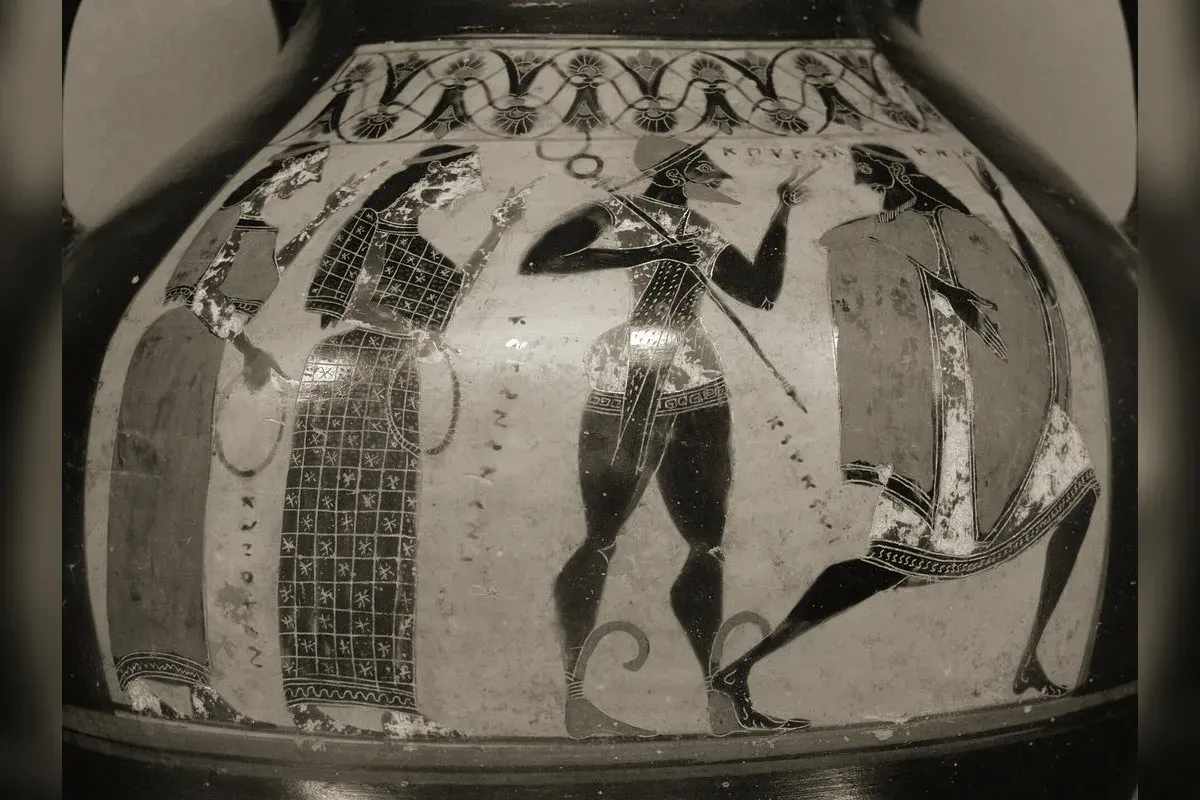
The Judgement of Paris is one of the most narratively efficient myths in the Greek tradition: within a handful of scenes — a wedding turned sour, a golden apple, three goddesses, and a shepherd — it sets the conditions for a war that will last ten years and destroy two peoples. What strikes us is the disproportion: the triggering cause is trivial (a decorative object, a missed invitation), yet the consequences are absolute. The Greeks read in this a truth about real wars: they rarely begin for reasons proportionate to their violence.
The origin: a wedding and an exclusion
Everything begins at the wedding of Peleus, king of Phthia, and the Nereid Thetis — a marriage that already carries catastrophe within it, since from their union will come Achilles, the hero whose death hastens the fall of Troy.
The wedding is magnificent. Every god of Olympus is invited — all except one: Eris, the goddess of Discord, whose presence at any gathering is synonymous with chaos. She is believed safely excluded.
Eris is not the type to accept an exclusion quietly. She approaches the feast and, from the doorway, flings a golden apple among the guests with an inscription: τῇ καλλίστῃ — for the fairest.
The apple rolls across the table of the gods. And everything shifts.
Three claimants, one object, and an insoluble problem
Three goddesses simultaneously claim the apple as theirs by right:
- Hera, queen of the gods, wife of Zeus, whose majesty and rank make her the obvious candidate in her own eyes.
- Athena, goddess of wisdom and strategic warfare, whose beauty is inseparable from intelligence and martial virtue.
- Aphrodite, goddess of love and desire, whose very domain is beauty as an irresistible force.
None of the three will yield. The tension is immediate and dangerous.
Zeus is called upon to adjudicate. His position is untenable: Hera is his wife, Athena his daughter, and Aphrodite a goddess whose favour he cannot afford to lose. Naming the most beautiful among even the first two would trigger lasting divine resentment. He refuses.
He delegates the decision to a mortal: Paris, prince of Troy, who tends flocks on the slopes of Mount Ida — renowned for his beauty, his aesthetic sensibility, and his supposed impartiality in Olympian rivalries. Hermes is tasked with leading the three goddesses to him.
The goddesses’ offers and the fatal choice
On Mount Ida, the three goddesses present themselves before Paris in turn — in their full beauty, and some versions specify that each undresses to allow a thorough assessment. But each also adds to her beauty a promise:
Hera offers Paris power: kingship over all mortal kingdoms, an empire, matchless wealth and influence. If you choose me, you will be the most powerful of kings.
Athena offers wisdom and military victory: she will teach him the art of war and strategy, make him invincible in battle, and grant him everlasting glory. If you choose me, you will be the greatest of warriors.
Aphrodite offers love — and not just any: she promises him Helen of Sparta, the most beautiful mortal in the entire world, wife of King Menelaus. If you choose me, you will have the love of the woman every man desires.
Paris chooses Aphrodite.
This choice is read in different ways throughout antiquity: as the victory of desire over reason (preferring love to wisdom), as the victory of the personal over the political (preferring a woman to an empire), or as the fatal misjudgement of a young man who cannot foresee the consequences of his actions.
Hera and Athena, humiliated and furious, become Troy’s implacable enemies. Their hostility will shape the events of the war across ten years, bearing down on every battle, every council, every individual destiny.
The abduction of Helen and the oath of the suitors
With Aphrodite’s help, Paris travels to Sparta on a diplomatic mission to King Menelaus. He is warmly received — the laws of hospitality (xenia) demand it. But Aphrodite kindles in Helen’s heart a passion for Paris.
Depending on the version, Helen leaves Sparta with Paris willingly (seduced and consenting), is carried off by force, or obeys a divine compulsion imposed by Aphrodite — ancient sources do not speak with one voice. Whatever the circumstances, Paris returns to Troy with Helen.
Menelaus is outraged. He invokes the Oath of Tyndareus: before their marriage, all of Helen’s suitors had sworn to defend whoever became her husband against any man who dared take her from him. Menelaus summons the Greek kings. They respond. The fleet assembles at Aulis. The Trojan War begins.
What the ancient sources say
The Judgement of Paris does not appear directly in Homer’s Iliad, which treats it as known background. It surfaces in allusions: Aphrodite protects Paris, Hera and Athena support the Greeks, and their enmity toward Troy is explicitly linked to the judgement.
The full narrative is transmitted by Proclus in his summary of the Cypria (Kypria), an epic poem of the Trojan Cycle now lost. Ovid, in the Heroides (V and XVI), gives voice to Oenone (Paris’s abandoned first wife) and Paris himself, opening psychological perspectives on their situations.
Euripides uses the judgement as a backdrop in several tragedies. In The Trojan Women, Helen defends herself by invoking the overwhelming power of Aphrodite: what mortal could resist the goddess of love? Lucian, in his Dialogues of the Gods, treats the scene with biting irony: the goddesses quarrel as if competing in an ordinary beauty contest.
Apollodorus (Epitome, III, 1–2) and Hyginus (Fabulae, 92) provide the most systematic and complete versions of the narrative.
Symbolic resonance
The Judgement of Paris is fundamentally a story about choice and its consequences. By offering three options — power, wisdom, desire — and having desire chosen, the myth poses a question that Greek philosophy would revisit: what is the good life? Should one prefer kratos (power), phronesis (wisdom), or eros (desire)?
The classical heroic answer would probably be wisdom or martial glory. But Paris chooses love — and his decision unleashes the greatest catastrophe in the Greek tradition. It is no accident that Aphrodite “wins”: the Greeks knew that desire is the most powerful and least reasonable force, the one that carries men and gods into adventures from which they do not emerge unscathed.
Further reading
For the ten years of war that this judgement sets in motion, read the story of the Trojan War. For the woman offered as the prize, and the ancient argument over her guilt, see the page on Helen of Troy. For the goddess who wins the apple and arranges the encounter, see the page on Aphrodite. For the two humiliated goddesses who become Troy’s implacable enemies, consult the pages on Hera and Athena. For the divine messenger who leads the three contestants to Mount Ida, read the page on Hermes. For the goddess who sets it all off, and the late history of the inscribed apple, see Eris.
Story beats
- 01Eris, goddess of Discord, uninvited to the wedding of Peleus and Thetis, throws a golden apple 'for the fairest'
- 02Hera, Athena, and Aphrodite all claim the apple
- 03Zeus refuses to judge and delegates the decision to the mortal Paris, prince of Troy
- 04Hermes leads the three goddesses to Mount Ida where Paris tends his flocks
- 05Hera offers Paris power and kingship; Athena offers victory and wisdom
- 06Aphrodite offers the love of the most beautiful mortal woman: Helen of Sparta
- 07Paris chooses Aphrodite and travels to Sparta, guest of King Menelaus
- 08Paris takes (or seduces) Helen and returns to Troy
- 09Menelaus rallies the Greek kings and launches the Trojan War
Ancient sources
- Proclus, Chrestomathy (summarising the Cypria)
- Ovid, Heroides (V and XVI)
- Euripides, Helen; The Trojan Women
- Lucian, Dialogues of the Gods
- Apollodorus, Epitome (III, 1-2)
- Hyginus, Fabulae (92)
See also
Related entries
- Paris of Troy, the exposed prince who lost his own city
- Aphrodite, goddess of love and beauty in Greek mythology
- Hera, queen of the gods and goddess of marriage
- Athena, goddess of wisdom and strategic warfare
- Helen of Troy, Sparta's queen at the heart of the war
- Eris, Greek goddess of Discord, and the golden apple
- Mount Olympus: home of the gods in Greek mythology
- Troy, the Legendary City at the Heart of Greek Mythology
Frequently asked questions
Was the apple of discord actually an apple?
In Greek, the word 'melon' (μῆλον) refers indiscriminately to apples, quinces, or any round seeded fruit. The object thrown by Eris is described as a chrysoun melon (a golden apple or fruit). The Latin and medieval tradition fixed the image of the 'golden apple', but some modern scholars believe it was more likely a quince, which was more closely associated with Aphrodite in ancient cult.
Why does Zeus refuse to judge the goddesses himself?
Zeus is in an impossible position: Hera is his wife, Athena his favourite daughter, and Aphrodite a goddess whose favour he cannot afford to lose. Ruling in favour of any one of them means permanently alienating the other two. By delegating the decision to a mortal (Paris), he removes himself from direct responsibility — but the cosmic damage remains inevitable. Some readings suggest a hidden plan: Zeus knows all along that Troy's destruction is fated and that this judgement will be its cause.
Is Helen a victim or a willing participant in the myth?
Ancient sources are deeply divided. Homer in the Iliad shows a Helen tormented by shame and guilt, yet also an Aphrodite who forces her compliance against her will. Euripides (Helen) invents a radically different version: a phantom of Helen goes to Troy while the real Helen remains faithful in Egypt. Stesichorus, according to a tradition cited by Plato, is said to have gone blind for blaming Helen, then written a palinode exonerating her. This debate over Helen's responsibility runs through all of antiquity.