Greek mythology · Mythical places
Troy, the Legendary City at the Heart of Greek Mythology
In brief
Troy in Greek mythology: divine founding, ten-year siege by the Greeks, the Trojan Horse, the city's fall, and the fates of its greatest heroes in Homer's Iliad and Odyssey.
What Is Troy?
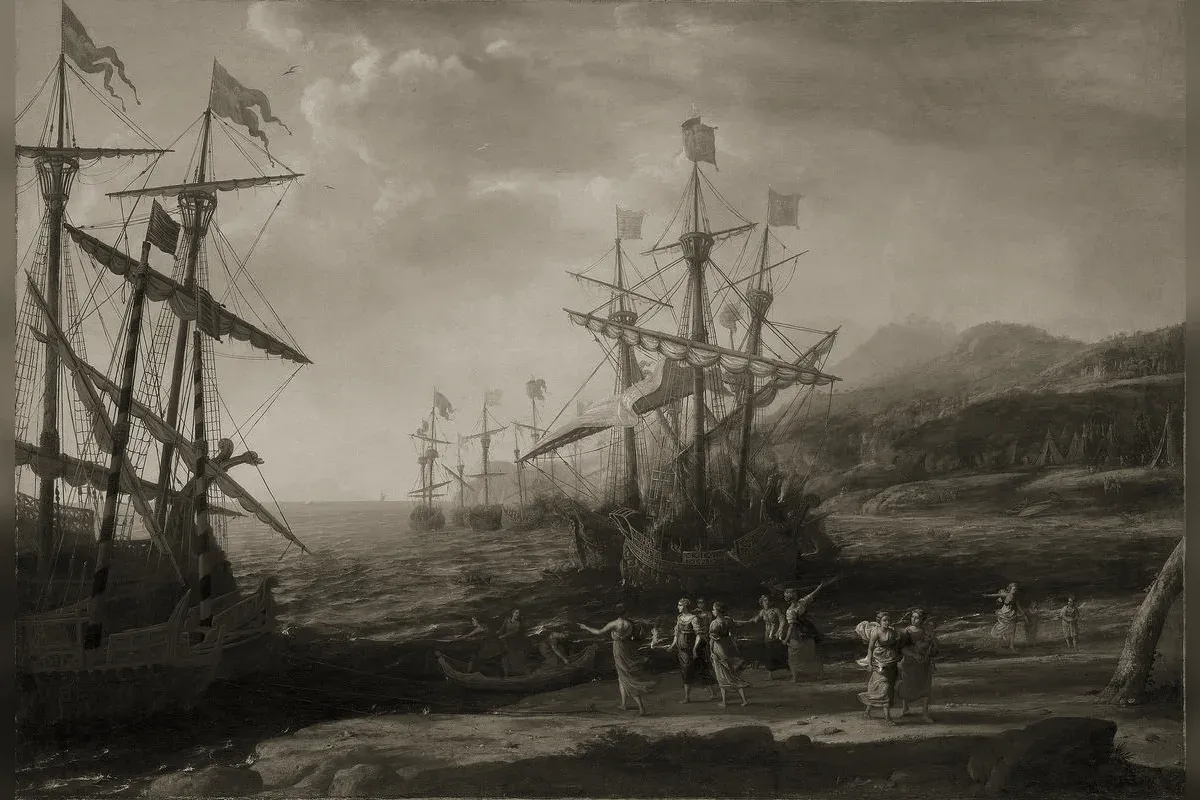
Troy (Ílion in Greek, Ilium in Latin) is the royal city of Phrygia whose siege by Greek armies forms the central event of Greek heroic mythology. More than a city, Troy is the place where threads woven by multiple generations of gods and mortals finally converge: the vengeance of Hera, the desire of Aphrodite, human arrogance, and the ambiguous games of the gods together determine the fate of a city that will ultimately collapse on itself. The Trojan War is one of the founding narratives of Western civilization, and Troy is both its setting and its martyr.
Foundation and Royal Genealogy
Mythological tradition traces Troy’s founding to a lineage rooted directly in the gods. The first ancestor is Tros, son of Erichthonius and grandson of Dardanos — himself a son of Zeus and founder of nearby Dardania.
Ilos, son of Tros, founds the city proper and names it Ilion after himself. According to the legend recorded by Apollodorus, Ilos received a divine sign: a statue of Athena that fell from the sky — the Palladium — which he buried in the citadel’s foundations. This statue was believed to protect the city as long as it remained within its walls.
Laomedon, son of Ilos, commissions the famous walls of Troy. According to several sources, Apollo and Poseidon worked on this construction in mortal form, sent by Zeus as punishment for a rebellion — but Laomedon refused to pay them for their labor. This betrayal explains why Poseidon and Apollo later support opposing sides during the war.
Priam, son of Laomedon, rules Troy during the war. He governs a prosperous city and an enormous family: fifty sons (including Hector and Paris) and fifty daughters according to some sources. His figure is that of a dignified old man crushed by fate.
The Judgment of Paris: The War’s Origin
The causal chain leading to the Trojan War begins at the wedding of Peleus and Thetis, where the goddess Eris throws a golden apple inscribed “to the fairest.” Three goddesses — Hera, Athena, and Aphrodite — compete for the apple. Zeus entrusts the judgment to Paris, a Trojan prince living as a shepherd on Mount Ida.
Each goddess offers a gift: Hera promises power and glory, Athena wisdom and victory in battle, Aphrodite the most beautiful woman in the world. Paris chooses Aphrodite. The woman designated is Helen, wife of Spartan king Menelaus. Paris travels to Sparta, is received as a guest, then abducts Helen and takes her to Troy.
This abduction is the immediate cause of the war. Menelaus, outraged, summons the Greek kings to recover his wife — and the heroic machinery of the Iliad is set in motion. The Judgment of Paris is the founding act of Troy’s catastrophe.
The Trojan War: Ten Years of Siege
The Trojan War is the siege of the city by a coalition of Greek kings led by Agamemnon, Menelaus’ brother. The two greatest warriors of the war are Achilles on the Greek side and Hector on the Trojan side. This symbolic duel — between the swiftest and the most noble — forms the dramatic heart of Homer’s Iliad.
For ten years the armies face each other outside the walls. The gods intervene directly: Hera and Athena support the Greeks, Apollo and Aphrodite defend the Trojans, Poseidon vacillates. Zeus supervises the whole, attempting to maintain a balance that his own will (Dios boulē) eventually disrupts.
The death of Achilles — killed by an arrow from Paris guided by Apollo to his vulnerable heel — is one of the most dramatic moments. But it occurs after the Iliad ends: Homer’s poem stops at the death of Hector and the funeral rites granted to him by Achilles.
The Fall of Troy: The Wooden Horse
After ten years of fruitless siege, Odysseus devises the decisive stratagem: the Trojan Horse. The Greeks build an enormous hollow wooden horse and conceal an elite force within it. They then feign departure, leaving the horse on the beach.
The Trojans, pressed by curiosity and deceived by a Greek deserter (Sinon) who lies about the horse’s nature, decide to bring it inside the city — despite the warnings of Cassandra (a prophetess condemned never to be believed) and Laocoon (a priest who is killed with his sons by serpents sent by Poseidon to silence him).
That night, the warriors emerge from the horse, open the gates to the Greek army that has returned unseen, and Troy is sacked. Fire consumes the city. Priam is killed. The women of Troy are enslaved.
After Troy: Scattered Fates
The fall of Troy is the beginning of a long series of scattered destinies, told in the poems of the Trojan Cycle.
Odysseus spends ten years finding his way home to Ithaca — his journey is the subject of the Odyssey. Agamemnon returns to Argos and is murdered by his wife Clytemnestra. Aeneas, a Trojan prince and son of Aphrodite, escapes with his father Anchises on his shoulders and his son Ascanius at his side. He will ultimately found a new city in Italy — the story of Virgil’s Aeneid — from which Rome itself will descend. Cassandra is taken as a slave by Agamemnon.
Troy is therefore not an ending in itself: it is a hinge point from which new stories unfold in every direction across the Mediterranean world.
What the Ancient Sources Say
Homer’s Iliad (c. 8th century BCE) is the foundational text: it covers only a few weeks of the tenth year of the war, centered on the wrath of Achilles. The Odyssey by the same author traces the consequences for the victors. The “Epic Cycle” — a set of lost poems surviving only in summaries — covered the full arc of the war, from its origins to Troy’s fall. Virgil (Aeneid, 1st century BCE) takes up the tradition to construct Rome’s founding mythology through Aeneas. Apollodorus (Library) and Hyginus (Fabulae) provide synthetic accounts of Trojan genealogy and war episodes.
Further Reading
For the great narrative of the war that destroys Troy, read The Trojan War. For the act that sets the catastrophe in motion, read The Judgment of Paris. For Troy’s greatest defender, read the page on Hector. For the Greek hero whose wrath structures the entire Iliad, read the page on Achilles. For the hero who devises the Trojan Horse and spends ten years at sea, read the page on Odysseus.
Ancient sources
- Homer, Iliad
- Homer, Odyssey
- Virgil, Aeneid, 2
- Apollodorus, Library, 3.12 and Epitome, 3-5
- Hyginus, Fabulae, 91-113
See also
Stories featuring this entity
Frequently asked questions
Did Troy actually exist?
Yes. A city matching Troy was identified by archaeologist Heinrich Schliemann in 1871 at Hisarlik in modern Turkey. Excavations revealed multiple layers of occupation, including one city (Troy VIIa, c. 1200–1180 BCE) that matches the traditional period of the Trojan War and shows signs of violent destruction. The exact extent of its correspondence with Homer's account remains debated among scholars.
Who are the kings of Troy in Greek mythology?
The Trojan royal line descends from Tros, then Ilos (founder of Ilion), then Laomedon (who built the walls with the involuntary help of Apollo and Poseidon), and finally Priam, the aged king who reigns during the war. His sons include Hector, Troy's greatest defender, and Paris, whose judgment set the war in motion.
How is Troy finally conquered?
After ten years of failed siege, Odysseus devises the stratagem of the Trojan Horse. The Greeks build a giant hollow wooden horse, hide a select force inside, and feign departure. The Trojans bring the horse inside their walls despite warnings. That night, the warriors emerge, open the gates to the returned Greek army, and Troy is sacked and burned to the ground.