Egyptian mythology · Death and afterlife
The Osiris myth: death, resurrection and the judgment of the dead in Egypt
In brief
The complete Osiris myth: murder by Seth, Isis's quest, dismemberment, reassembly and resurrection — the founding narrative of ancient Egyptian funerary theology.
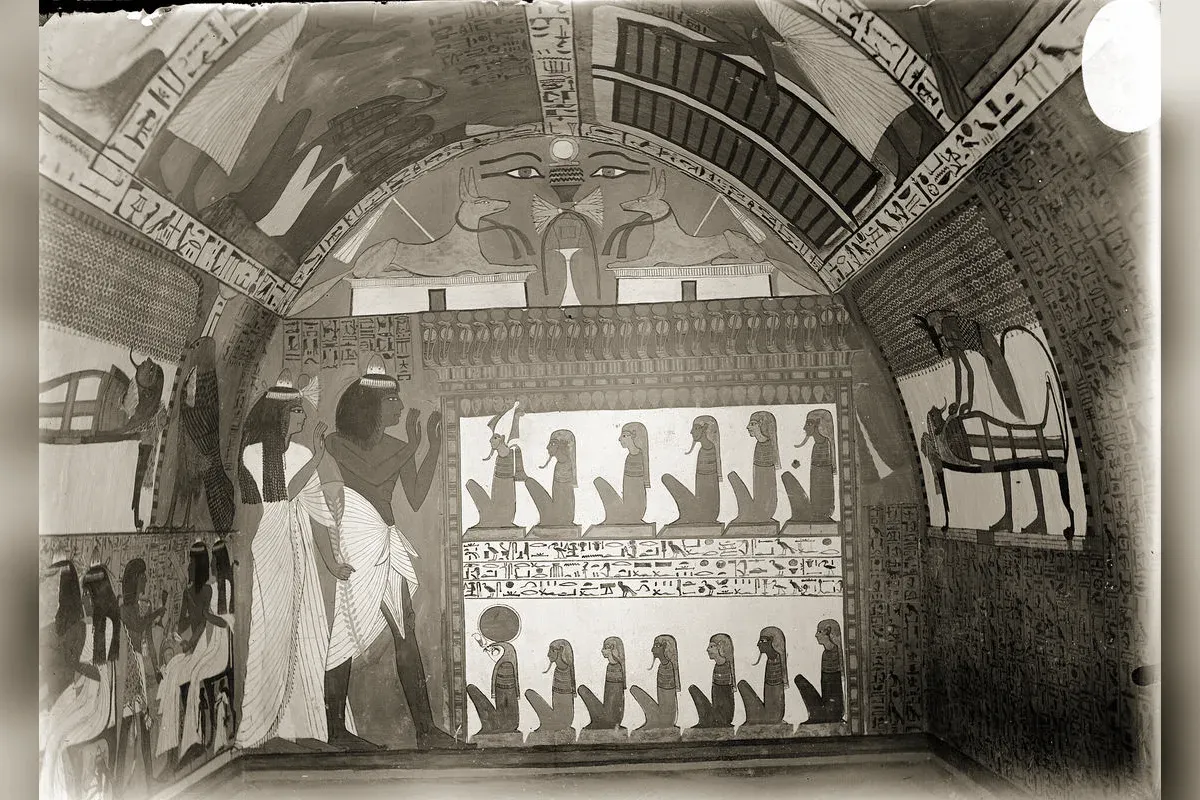
The founding myth of Egyptian theology
The Osiris myth is the most important narrative in ancient Egypt. It is not simply a story of death and resurrection: it is the foundation of all funerary thought, royal legitimacy, and the Egyptian conception of moral justice. Its cycle — murder, mourning, quest, resurrection, judgment — repeats every year in religious festivals and every day in funerary rituals.
Osiris, Egypt’s first pharaoh
In the beginning, Osiris rules over Egypt as its first legendary pharaoh. Son of Geb (the Earth) and Nut (the Sky), he embodies just and benevolent kingship. He teaches humankind agriculture, the vine, music, and law. His reign is a golden age.
His wife Isis, goddess of magic and wisdom, rules at his side. His brother Seth, god of the desert and storm, is associated with chaos — and jealousy.
The murder by Seth: the fatal chest
Seth prepares a trap. He has a chest made to the exact dimensions of Osiris’s body. At a banquet, he presents it to the guests as a gift for whoever fits inside it perfectly. When Osiris enters the chest to try it, Seth and his accomplices nail it shut, seal it with molten lead, and throw it into the Nile.
The chest drifts to sea, eventually washing ashore at Byblos (in Phoenicia, present-day Lebanon). A tree — a tamarisk or terebinth depending on the version — grows around it, enclosing it within its trunk. The king of Byblos, unaware of its contents, has the tree cut down to make a pillar for his palace.
Isis’s quest
Isis, wild with grief, sets out to find her husband. She travels the world, transforming herself into various birds to fly faster, questioning every being she meets. It is from children that she learns which direction the chest drifted.
At Byblos, she presents herself as a stranger, enters the queen’s service, and eventually reveals her divine identity. The palace pillar is opened — the chest emerges intact. Isis brings the body back to Egypt, hidden in the marshes of the Delta.
The dismemberment: Seth’s rage
Seth rediscovers Osiris’s body during a night hunt. Furious, he dismembers it into fourteen pieces (sometimes sixteen, sometimes forty-two according to different traditions) and scatters them across Egypt.
This dismemberment is an act of radical destruction: it targets not only the body, but the cosmic integrity it represents. Each fragment of Osiris becomes a sacred site, explaining why many Egyptian temples claimed to possess a relic of his body — an ear here, a foot there, his head at Abydos.
The reassembly: Isis and Nephthys
Isis, helped by her sister Nephthys, recovers every piece — except the phallus, swallowed by a fish of the Nile (the lepidotus or oxyrhynchus depending on the version). Isis replaces it with a golden replica.
The two goddesses, transformed into kites, beat their wings over the reassembled body to breathe life into it. Thoth recites the sacred magical formulae of heka that allow the soul to re-enter the flesh. Anubis oversees the embalming — Osiris becomes thus the first mummy in history.
The miraculous conception of Horus
Isis manages to conceive Horus by her husband, miraculously, despite his death. The texts describe how she takes the form of a kite and receives the vital breath of Osiris to be fertilised. This posthumous conception makes Horus a child of particularly pure divine origin — invested with the right to avenge his father and reclaim the throne of Egypt.
Osiris, his earthly mission accomplished, then descends permanently into the Duat (the Egyptian afterlife) to reign there as king of the dead.
Osiris’s reign in the Duat
In the Duat, Osiris presides over the Hall of Two Truths — a court of forty-two divine assessors before which every deceased soul appears.
The deceased must recite the Negative Confession (a list of faults they have not committed). Their heart is then weighed on a scale against the feather of Maat. Anubis oversees the scale; Thoth transcribes the verdict. If the heart is pure, the deceased is declared maa-kheru (“true of voice”) and admitted to the Field of Reeds — the Osirian paradise. If the heart is too heavy, Ammit devours it.
This moral judgment is one of the most sophisticated conceptions of divine justice in all of antiquity.
Variants and symbolic significance
The Osirian myth has many regional and chronological variants. Plutarch’s version (De Iside et Osiride, 1st–2nd century CE) is the most narrative and detailed — but it has been slightly Hellenised. The ancient Egyptian texts (Pyramid Texts, Coffin Texts, Book of the Dead) are more fragmentary, each emphasising a different aspect of the cycle.
The vegetal dimension of Osiris is fundamental: associated with the Nile floods and the sowing of grain, he dies and is reborn like the grain, like the Nilotic vegetation. His green and black skin symbolises this alternation of death and rebirth tied to seasonal rhythms.
What the ancient sources say
The Pyramid Texts (c. 2400 BCE) constitute the earliest attestation of the myth, narrating the resurrection of the dead pharaoh as Osiris. The Coffin Texts (c. 2000 BCE) democratise the hope of Osirian resurrection. The Book of the Dead (c. 1550 BCE) is the practical guide to survival in the Duat. Plutarch (De Iside et Osiride) provides the most complete narrative version, though a late one.
Further reading
For the central figure of the resurrection, read the page on Osiris. For the goddess whose magic makes resurrection possible, see the page on Isis. For the god who sets the cycle in motion by killing Osiris, see the page on Seth. For the son conceived to avenge his father, see the page on Horus. For the divine scribe who recites the formulae of resurrection and records the judgments, read the page on Thoth. For the account of the judgment of souls in the Hall of Two Truths, see The Judgment of the Dead.
Story beats
- 01Osiris's reign over Egypt and teaching of civilisation
- 02Murder by Seth: the chest at the banquet
- 03Isis's quest: recovering the body at Byblos
- 04Seth dismembers the body into fourteen pieces
- 05Reassembly of the body by Isis and Nephthys
- 06Miraculous conception of Horus
- 07Osiris descends into the Duat and becomes king of the dead
- 08Judgment of souls in the Hall of Two Truths
Ancient sources
- Pyramid Texts (c. 2400 BCE)
- Coffin Texts (c. 2000 BCE)
- Book of the Dead (c. 1550 BCE)
- Plutarch, De Iside et Osiride (1st–2nd century CE)
See also
Frequently asked questions
Why does Seth kill Osiris?
Egyptian sources do not always spell out the motive, but the most developed version — transmitted by Plutarch — points to Seth's jealousy of the prestige and love enjoyed by Osiris. Seth, the younger brother, is associated with the desert, chaos, and brute force. In this reading, Osiris's death is the first cosmic transgression, the irruption of disorder into an ordered world.
Into how many pieces is Osiris cut?
The sources vary. Plutarch says fourteen (sometimes sixteen in some versions); other texts speak of forty-two pieces, one for each nome (province) of Egypt. This symbolic dismemberment explains why many Egyptian sanctuaries claimed to possess a relic of Osiris's body.
What does 'becoming Osiris' mean in Egyptian religion?
The phrase describes the hoped-for destiny of every deceased person. In ancient Egypt, the dead person who passes judgment and proves the purity of their heart is assimilated to Osiris: they take his name, adopt his condition as king of the dead, and gain access to the Fields of Iaru (the Nilotic paradise). The entire funerary ritual is designed to make mummification a replication of the process applied to Osiris by Isis and Thoth.