Greek mythology · Creatures
Calypso, nymph who detains Odysseus on the island of Ogygia
In brief
Calypso in the Odyssey: seven years on Ogygia, an offer of immortality that Odysseus turns down, and her protest against the gods' double standard.
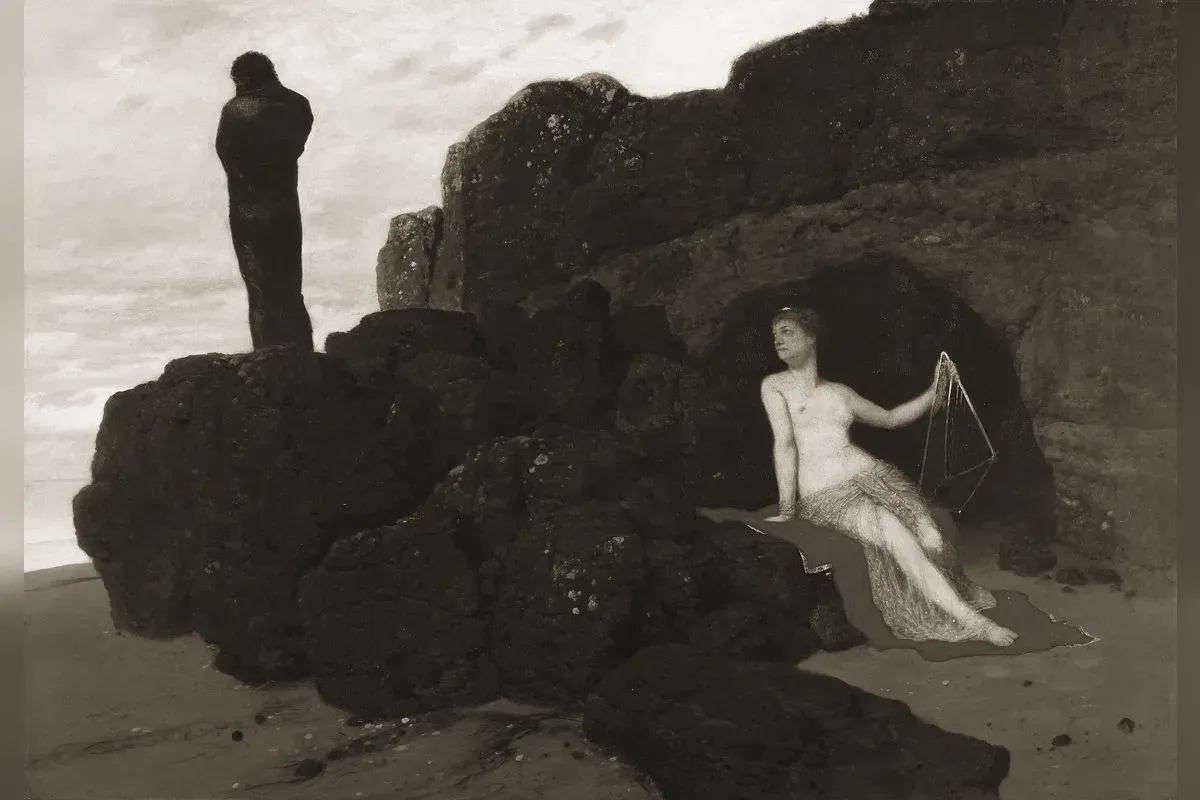
Calypso is the immortal nymph who keeps Odysseus on the island of Ogygia for seven years — longer than any other episode in his wanderings after the Trojan War. Homer gives her the one offer no other character in Greek epic makes to a mortal, and has him refuse it.
The most beautiful prison in Homer
When Hermes arrives with Zeus’s order, the poem stops to describe the place: a cave with a great fire of split cedar burning fragrantly, four springs running clear in different directions, meadows of violet and parsley, a vine heavy with grapes, and sea-birds roosting in the alders. Hermes, a god, stands and looks at it with pleasure before going in.
Homer then cuts, in a single line, to Odysseus sitting on the shore where he always sits, crying, staring at the water. The juxtaposition is the entire point. Nothing is wrong with Ogygia. It is simply not his, and abundance he did not choose is indistinguishable from captivity.
Her name says what she does. Kalypto means to cover, hide, conceal — the same root as a shroud or a veil. To be with Calypso is to be hidden from the world: not dead, but erased from the record, which for a Homeric hero is the worse outcome of the two.
An offer of immortality, refused
Calypso does not merely want Odysseus to stay. She offers to make him immortal and ageless forever — the thing every hero in Greek myth is defined by not having, and which no one else is ever straightforwardly offered.
He turns it down. His reasoning, delivered to her face and with considerable tact, is that he knows perfectly well that Penelope is a mortal woman and no match for a goddess in form or stature; and that he wants to go home anyway, even if it costs him more years at sea.
This is arguably the ideological centre of the Odyssey. The poem’s hero is offered escape from death itself and prefers a specific wife, a specific rocky island, and a specific ordinary old age. Greek epic elsewhere treats immortality as the unreachable good; here it is available, and declined.
Her complaint
Ordered by Hermes to release him, Calypso obeys — and first says exactly what she thinks of the instruction.
You gods, she says, are cruel and jealous beyond all others: you cannot bear it when goddesses take mortal men openly as lovers. She names precedents. Dawn took Orion, and Artemis shot him down. Demeter lay with Iasion in a thrice-ploughed field, and Zeus killed him with a thunderbolt. Now they begrudge her the one man she saved from a shipwreck and kept alive.
Nothing in the poem contradicts her. It is a short, accurate account of a genuine asymmetry in Greek myth, put in the mouth of the character with most reason to notice it, and Homer lets it stand without rebuttal.
What she does after losing
She then equips him to leave. She gives him bronze tools, shows him the timber, provides cloth for a sail, food, wine, water, and a warm following wind — everything needed for the raft that carries him off her island.
The genealogy on this site therefore records Calypso as Atlas’s daughter but does not record a union with Odysseus, because the Odyssey is explicit that he shares her bed unwilling, beside a woman who is willing. Hesiod knows a version in which she bears him sons, Nausithous and Nausinous; Homer does not, and the poem’s whole treatment of Ogygia depends on the relationship producing nothing.
Ancient sources
- Homer, Odyssey, 1.48-59; 5.55-268; 7.244-266
- Hesiod, Theogony, 1017-1018
- Apollodorus, Epitome, 7
See also
Related entries
Stories featuring this entity
Frequently asked questions
Why does Odysseus refuse immortality?
Calypso offers to make him immortal and ageless forever — the thing every Greek hero is defined by not having, and which no one else is ever straightforwardly offered. He turns it down, telling her to her face and with considerable tact that he knows Penelope is no match for a goddess, and that he wants to go home anyway. It is arguably the ideological centre of the Odyssey: escape from death is available, and declined.
What does Calypso say about the gods?
Ordered by Hermes to release him, she obeys — and first says exactly what she thinks. You gods, she says, are cruel and jealous beyond all others: you cannot bear it when goddesses take mortal men openly. She names precedents. Dawn took Orion, and Artemis shot him down. Demeter lay with Iasion, and Zeus killed him with a thunderbolt. Homer lets the complaint stand without rebuttal.