Greek mythology · Creatures
The Pleiades, seven star sisters of Greek mythology
In brief
The Pleiades, seven daughters of Atlas: the lost sister, the pursuit by Orion, and the star cluster that told Greek farmers when to plough and sail.
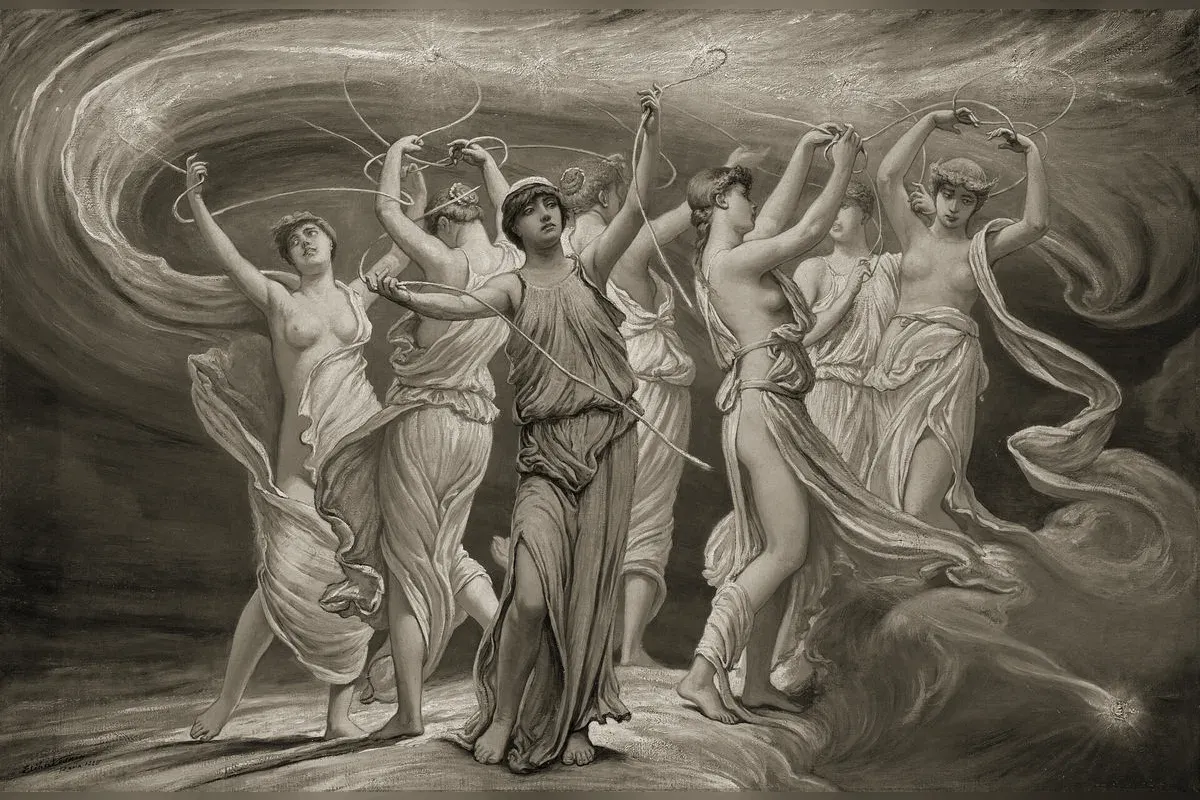
The Pleiades are the seven daughters of Atlas and the Oceanid Pleione, pursued across the sky by Orion and placed among the stars. They are one of the clearest cases in Greek myth of a story built directly on top of something people used every day — because before they were sisters, they were a calendar.
Seven sisters, one missing
Their names are Alcyone, Merope, Celaeno, Electra, Sterope, Taygete and Maia — the eldest, who bears Hermes to Zeus in a cave on Mount Cyllene. Several of the others also bear children to gods and become the ancestresses of royal houses: Electra of the Trojan line through Dardanus, Taygete of the Spartan.
Only six are readily visible to the naked eye. Greek tradition explains the discrepancy with a lost Pleiad, and offers two candidates. Merope hid herself in shame for having married a mortal, Sisyphus, while her sisters all took gods. Or Electra withdrew, unable to look at the destruction of Troy, the city her descendants founded.
This is myth doing what it does best: an observable fact — seven named, six seen — is given a cause, and the cause is made to carry meaning.
Orion
The pursuit exists in several forms. In the common version Orion sees the sisters, or their mother, and chases them for years across Boeotia until Zeus takes pity and sets them in the sky as doves — the word peleiades, doves, being one ancient etymology of their name.
The chase does not stop. Orion is placed among the stars too, and still follows them across the sky every night; the constellation rises behind the cluster and sets after it, which is exactly what the myth describes. The story is a description of what the night sky visibly does, told as a narrative.
A farming calendar
Hesiod makes their practical function explicit at the start of the agricultural section of the Works and Days: begin the harvest when the Pleiades rise, and the ploughing when they set.
That is not poetic decoration. The heliacal rising of the cluster in May and its setting in November framed the Greek working year, and the same passage advises sailing only in the roughly fifty days after the solstice, since the sea closes when the Pleiades go down. For a farmer or a captain without a written calendar, these seven stars were the schedule.
Their mythology follows from that. They are daughters of the Titan who holds up the sky, they are pursued eternally by another constellation, and their appearance and disappearance govern sowing, reaping and sailing.
Beyond Greece
Almost every culture that has looked up has named this cluster, and its rising is a calendar marker far outside the Mediterranean — used for the new year by the Māori as Matariki, and for planting and ceremony across Asia, Africa and the Americas.
The Greek version is one branch of a very widespread human habit. What is specifically Greek about the Pleiades is the genealogy — the decision to make the calendar into a family, give it a father who carries the sky, and attach the whole of it to the Titan generation.
Ancient sources
- Hesiod, Works and Days (383-387, 618-623) and Theogony, 938
- Apollodorus, Library, 3.10.1
- Pindar, Nemean, 2.10-12
- Ovid, Fasti, 4.169-178
- Hesiod, Astronomy, fragments
- Aratus, Phaenomena, lines 254-268
See also
Related entries
Frequently asked questions
Why does Orion chase the Pleiades?
He saw the sisters, or their mother, and pursued them for years across Boeotia until Zeus set them in the sky as doves — peleiades being one ancient etymology of the name. But the chase does not stop there: the constellation of Orion rises behind the cluster and sets after it, following without ever catching up. The story is a description of what the night sky visibly does, told as narrative.
Do other cultures name this cluster?
Almost every culture that has looked up. Its rising serves as a calendar marker far outside the Mediterranean — the Māori new year Matariki, and planting and ceremonial markers across Asia, Africa and the Americas. What is specifically Greek is the genealogy: the decision to turn a calendar into a family, give it a father who carries the sky, and attach it to the Titan generation.