Greek mythology · Gods & goddesses
Calliope, Muse of epic poetry in Greek mythology
In brief
Calliope, chief of the nine Muses: the Muse who stands beside kings, judge of the quarrel over Adonis, and mother of Orpheus and Linus.
- epic poetry
- eloquence
- heroic song
- writing tablet
- +3
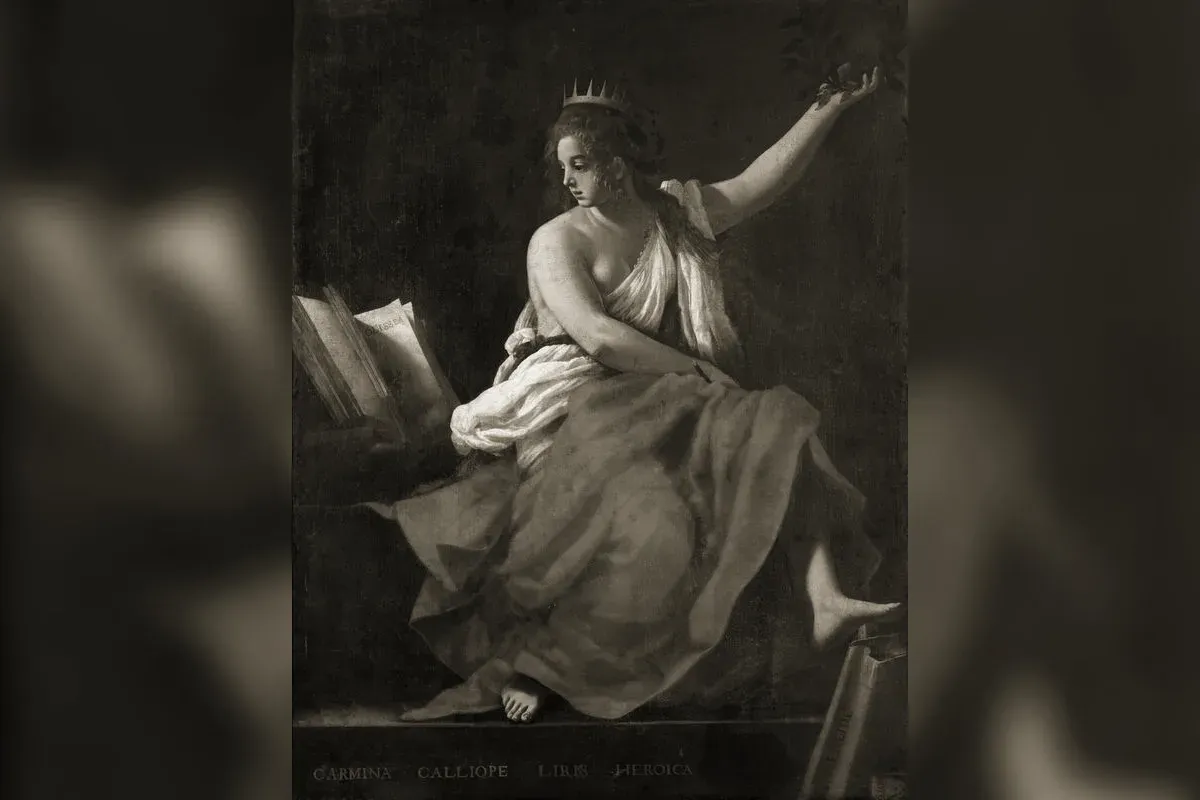
Calliope is the chief of the nine Muses, daughter of Zeus and Mnemosyne, and the mother of Orpheus. Hesiod puts her last in his list of the Muses and then says she is the most important of them all — a placement that tells you what the Greeks thought epic poetry was for.
“The most eminent of them all”
Her name means “beautiful voice”, from kallos and ops. Hesiod names all nine sisters in a single line of the Theogony, ends with Calliope, and adds that she is foremost, because she attends upon revered kings.
That reason is worth pausing over. He does not say she is chief because epic is the grandest form; he says it because she is the Muse who stands beside rulers. A king favoured by Calliope speaks with a voice that settles disputes — Hesiod describes people turning to look when such a man walks through an assembly, and quarrels dissolving because he judges straight and speaks persuasively.
Calliope therefore governs something broader than verse. She governs the authority carried by well-ordered public speech, which in an oral culture is not a metaphor for power but the actual instrument of it.
What she presides over
The clean allocation of one Muse to each art — Clio history, Euterpe the flute, Terpsichore dance — is much later than Hesiod, largely Hellenistic and Roman, and finally fixed by the mythographic handbooks. Homer usually addresses a single unnamed Muse and Hesiod treats the nine as a chorus rather than a committee.
In the developed system Calliope takes epic poetry and eloquence, and is shown with a writing tablet and stylus — an attribute that quietly contradicts the oral tradition she supposedly presides over. She is the Muse invoked at the opening of the Iliad, the Odyssey, the Argonautica and the Aeneid, whether or not the poet names her.
The judgement over Adonis
She has one myth of her own, and it is an arbitration. Aphrodite and Persephone both want the beautiful mortal Adonis, and Zeus refuses to decide between them; the case is referred to Calliope.
She splits the year in three: one part for Aphrodite, one for Persephone, one for Adonis himself to do as he pleases. It is a careful and defensible judgement, and Aphrodite — who wanted all of him — takes it badly enough to arrange the death of Calliope’s son, having the Thracian women tear Orpheus apart.
The story is transmitted by Hyginus rather than by a major poet, and it should be read as what it is: a late explanation that connects two separate myths. But it is characteristic. Calliope’s function is to make orderly speech out of an unresolvable dispute, and the outcome demonstrates the limits of that.
The mother of Orpheus
Her most consequential role is genealogical. With the Thracian king Oeagrus she bears Orpheus, and in Apollodorus a second son, Linus — killed by Heracles with his own lyre during a music lesson.
Both sons are masters of song destroyed by violence their art cannot reach. Descent from the Muse of epic gives Orpheus his voice; it does not give him protection, and the rival tradition that assigns him Apollo as father is best understood as an attempt to explain a gift that his actual mother already accounts for.
Ancient sources
- Hesiod, Theogony, 75-103
- Apollodorus, Library, 1.3.1-2
- Hyginus, Astronomica (2.7) for the judgement over Adonis
- Apollonius of Rhodes, Argonautica, 1.23-25
See also
Related entries
Frequently asked questions
What is the judgement over Adonis?
Aphrodite and Persephone both wanted the mortal Adonis, Zeus refused to decide, and the case was referred to Calliope. She split the year in three: one part for Aphrodite, one for Persephone, one for Adonis to dispose of himself. Aphrodite, who wanted all of him, took it badly enough to arrange the death of Calliope's son — sending the Thracian women against Orpheus.
Which of her sons is less well known?
Linus. Apollodorus gives Calliope and Oeagrus a second musician son, killed by Heracles with his own lyre during a music lesson after correcting the boy's playing. Both sons are therefore masters of song destroyed by violence their art cannot reach — one by a pupil, one by devotees. Greek myth clearly treats the family as a set.