Greek mythology · Gods & goddesses
Mnemosyne, Greek goddess of Memory and mother of the Muses
In brief
Mnemosyne, Titaness of Memory: the nine nights that produced the Muses, the spring of Memory against Lethe, and her role in the Orphic gold tablets.
- memory
- oral transmission and poetry
- ritual recollection
- spring or fountain
- +2
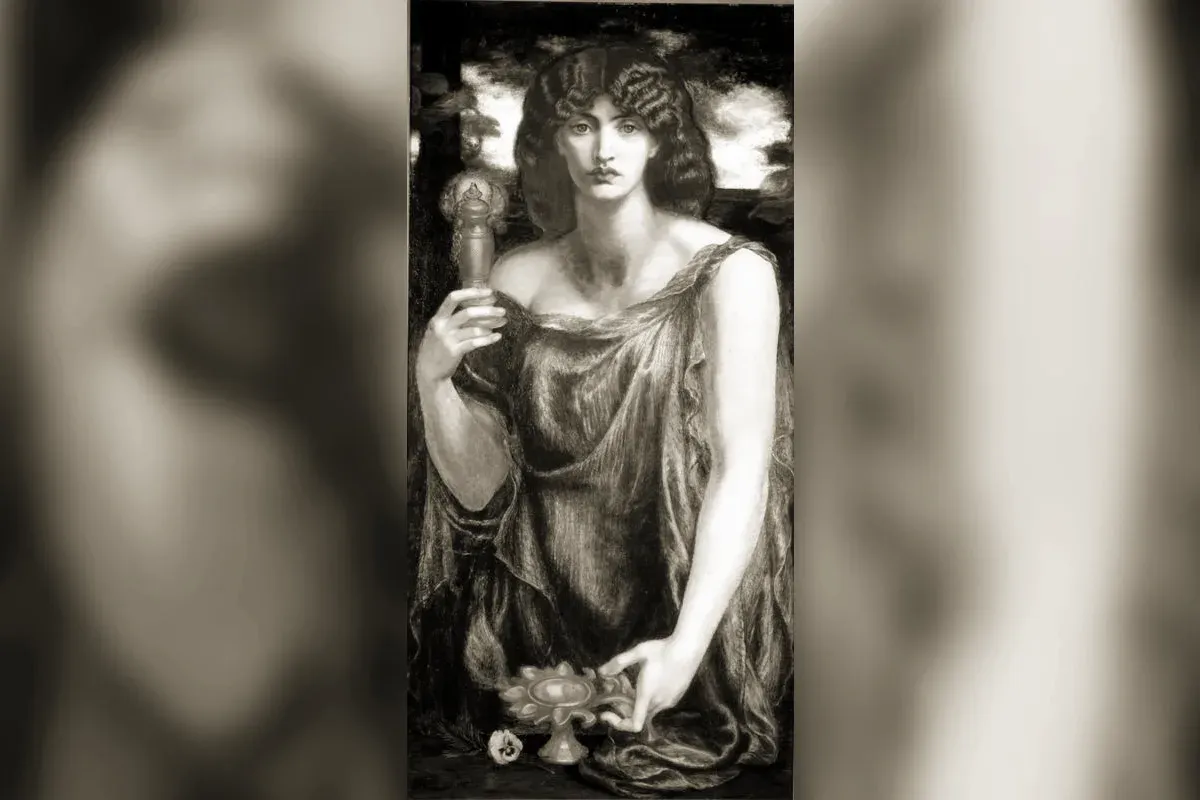
Mnemosyne is the Titaness of Memory, daughter of Uranus and Gaia, and mother of the nine Muses she conceives by Zeus. Her entry could be a single genealogical line — and that would miss the point entirely. In a civilisation where poetry, history, religious law and lineage all travel by mouth and ear long before they travel by book, Memory is not an ornament of the mind. It is the infrastructure of knowledge, and Mnemosyne is the goddess of that infrastructure.
A Titaness with no myth
Hesiod lists Mnemosyne among the twelve children of Uranus and Gaia (Theogony 132-136), beside Themis, Rhea, Theia and Cronus. Like Themis, she takes no visible part in the Titanomachy; like Themis, she passes intact from the losing side into the winner’s bed.
That is very nearly all she does. Mnemosyne fights nobody, avenges nothing, undergoes no metamorphosis, and no city competes for her patronage. That blank is worth taking seriously instead of treating it as a gap: Mnemosyne does not act inside stories because she is the condition of a story existing at all. A goddess of Memory with adventures of her own would be a category error — she would sit inside history rather than underneath it.
Nine nights, nine daughters
The one narrative episode attached to her is told twice in the Theogony, and it is an episode of conception.
At lines 53-62 Hesiod sets the scene in Pieria, at the foot of Olympus. Zeus lies with Mnemosyne “for nine nights, apart from the immortals.” A year later, when the seasons have come round, she bears “nine daughters of one mind, whose hearts are set on song.” The poet dwells on the arithmetic: nine nights, nine daughters. The symmetry says that each Muse is the child of a night — that is, of a separate act of remembering.
At lines 77-79 the list finally arrives: Clio, Euterpe, Thalia, Melpomene, Terpsichore, Erato, Polyhymnia, Urania, and Calliope, “chief of them all.” It is the oldest complete list of the nine names to survive. The tidy division of labour people recite today — Clio for history, Urania for astronomy, Melpomene for tragedy — is much later: it hardens in the Hellenistic and Roman periods, not in Hesiod, who treats the nine as an undivided chorus.
Their domain includes epic through Calliope, whose son will be Orpheus, the one singer whose song acts on things. The line of descent is coherent: from Memory comes song, and from song comes power.
Remembering, not imagining
This is the central doctrinal point about Mnemosyne, and the one most often missed.
When Homer opens the Catalogue of Ships in Iliad 2, he is not asking the Muses to inspire him in the modern sense. He asks them to know on his behalf: “You are goddesses, you are present everywhere and you know all things; we hear only a rumour and know nothing.” He then recites some one hundred and seventy names of commanders and contingents. Without prodigious memory, that passage cannot be composed and cannot be performed.
The Muses, then, are not fairies of invention. They are guarantees of accuracy. They are daughters of Memory because in an oral regime truth is a matter of preservation. What the poet calls inspiration we would call access to a database nobody else can query.
Hesiod adds one remarkable reversal all the same. The daughters of Memory, he says, bring men “forgetfulness of ills and rest from cares.” The Greek word is lēsmosynē, built exactly like Mnēmosynē but on the opposite root. Memory gives birth to forgetting — not the forgetting that destroys knowledge, but the kind that suspends pain while the audience listens. It is a theory of the consoling function of song, stated as a pun.
The water of Memory among the dead
The most concrete side of Mnemosyne’s cult is not poetic but oracular and funerary.
Pausanias describes in detail how one consulted the oracle of Trophonius at Lebadeia in Boeotia (9.39.8). Before descending into the chasm, the enquirer is led to two neighbouring springs. He drinks first from Lethe, “so as to forget everything he has been thinking until then,” and then from Mnemosyne, “so as to remember what he sees down below.” He goes down, undergoes his vision, comes back up dazed — and the priests seat him on the “throne of Memory” to take down his account before it evaporates.
The mechanism is perfectly logical: empty the memory to make it available, then secure it so the experience survives the return.
The same opposition organises the Orphic gold tablets, thin inscribed leaves placed in graves in southern Italy and Crete from the fourth century BC onwards. The text addresses the dead as a crib sheet: in the house of Hades you will find on the right a spring beside a white cypress — do not go near it. Further on you will find the cold water flowing from the lake of Mnemosyne, with guardians before it. Say to them: “I am a child of Earth and starry Heaven, but my race is heavenly; I am parched with thirst, give me quickly the cold water.”
These tablets are among the few direct witnesses to a non-Homeric Greek eschatology. They assume the soul can be lost through amnesia, and that salvation consists in remaining somebody. Against the forgetting that dissolves identity, Mnemosyne is what lets a dead person go on saying “I.” The contrast with the strengthless anonymous crowd of the Odyssey’s underworld is head-on.
Memory, knowledge, philosophy
Mnemosyne’s intellectual legacy runs well past ritual.
In Plato’s Theaetetus (191d), Socrates proposes that our souls hold “a block of wax, a gift of Mnemosyne, mother of the Muses,” on which perceptions and thoughts are stamped; we retain whatever leaves a lasting impression. The entire Western metaphor of memory as an inscribed surface — tablet, page, disc, recording — descends from this passage, which names the Titaness outright.
Pindar, for his part, states the social function without hedging: without song, deeds die with the people who saw them. He calls Memory to witness in order to say that the poet does not decorate glory, he conserves it. In the archaic period, an unsung victory is a lost victory.
One technical art descends from her directly: ancient mnemonics, which Cicero credits to the poet Simonides of Ceos and which worked by memorising sequences of places. The English word still carries the goddess’s name.
Cult and images
Mnemosyne has no major sanctuary of her own. She turns up wherever the Muses are honoured — on Helicon in Boeotia, where the Muses’ Mouseion makes her the tutelary figure, and at Lebadeia in the Trophonius complex, where her spring is a functional part of the rite. Pausanias also records her statue in groups dedicated to the Muses.
In ancient art she is hard to identify without an inscription: a draped woman, sometimes lifting her veil, sometimes with her chin resting on her hand — a gesture later Western art would codify as remembrance and meditation. At Rome, the association with Moneta, an epithet of Juno, rests on an old etymology (monere, to remind or warn) rather than on any real cultic identification.
Ancient sources
- Hesiod, Theogony, 53-62; 77-79; 132-136; 915-917
- Homer, Iliad, 2.484-493 (invocation of the Muses)
- Pindar, Nemean 7.15; Isthmian 6.74-75
- Plato, Theaetetus, 191d
- Pausanias, Description of Greece, 9.39.8
- Orphic gold tablets (Petelia, Hipponion, 4th century BC)
See also
Related entries
Stories featuring this entity
Frequently asked questions
Who is Mnemosyne in Greek mythology?
Mnemosyne is the Titaness of Memory, daughter of Uranus and Gaia. Lying with Zeus for nine consecutive nights in Pieria, she gives birth to the nine Muses, who preside over poetry, history, dance and astronomy. In a culture where most knowledge travels by mouth, she is not a decorative abstraction — she is the technical precondition of transmission itself.
Why is Mnemosyne the mother of the Muses?
Because in archaic Greece, to sing is to remember. The bard does not read; he restores a story no text holds steady. Hesiod therefore treats inspiration as an act of memory rather than of imagination. The Muses, daughters of Memory, do not invent the past for the poet — they make it present to him, with details no living witness could supply.
What is the difference between Lethe and the spring of Mnemosyne?
They are opposite waters in the geography of the dead. Lethe erases the previous life and allows an anonymous return to the cycle. The spring of Mnemosyne, described on the Orphic gold tablets and in the oracle of Trophonius at Lebadeia, preserves self-awareness instead. The whole rite consists in knowing to refuse the first and ask for the second.