Greek mythology · Gods & goddesses
Nemesis, Greek goddess of due measure and divine retribution
In brief
Nemesis, goddess of proportion rather than revenge: her statue cut from Persian marble, the egg that hatched Helen, and the curse laid on Narcissus.
- due measure
- retribution for excess
- indignation at undeserved fortune
- the balance of fortune
- +6
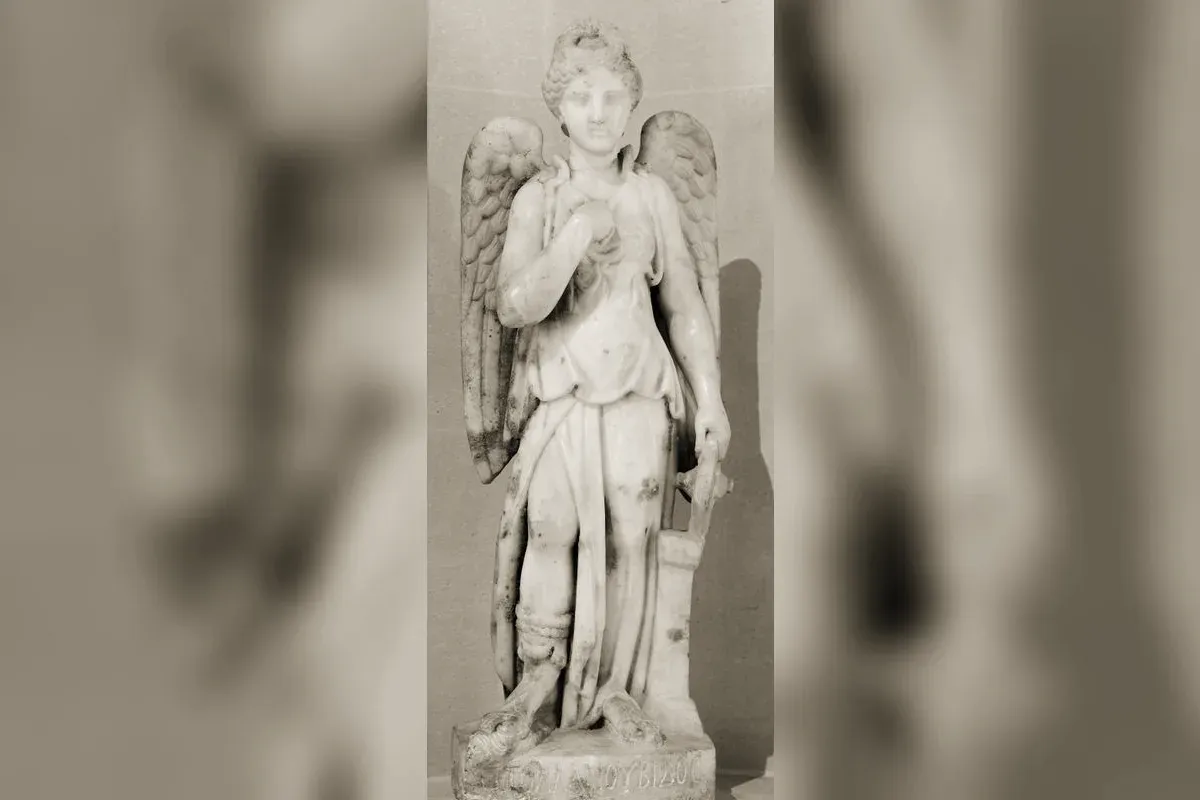
Nemesis is the goddess who returns everything to its share. She is almost always introduced as “the goddess of revenge,” and that is worth correcting immediately: her name comes from nemein, “to apportion,” and her function is not to avenge an injured party but to restore a proportion. She lowers what has climbed too high, lifts what has been crushed without cause, and strikes excess rather than crime.
Born of Night, like every other limit
Hesiod files her in the catalogue of what Nyx bears alone, between the Fates and Deceit, with a short and heavy gloss: Nemesis, “a bane to mortal men.”
The phrase is more precise than it looks. In that catalogue Nyx does not produce characters but an inventory of everything that bounds a human life: death, sleep, old age, lies, fate — and the impossibility of keeping a fortune larger than one’s share. Nemesis therefore belongs to the same conceptual family as Eris, Discord: two forces answerable to no Olympian and softened by no prayer.
A later tradition, noted by Pausanias, makes her a daughter of Ocean instead. The shift is not trivial: it pulls the goddess towards the regular cosmic powers and away from the nocturnal afflictions.
What nemesis means in Greek
The word exists before the goddess, and it repays following.
In Homer, nemesis is the indignation a community feels at disproportionate behaviour; “there is no nemesis” means “this is fair enough, nobody can object.” The term begins as social judgement, not as the supernatural.
Hesiod then turns it into a figure. In Works and Days, at the end of the iron age, Aidos (Shame) and Nemesis will leave the earth, their bodies wrapped in white, abandoning humanity to its troubles. Here the goddess is a society’s internal sanction — what is left when legal punishment no longer suffices.
The slide into the modern sense — “my nemesis,” the sworn enemy — comes much later, and it loses the essential point: in the Greek word the sanction is impersonal and proportionate. Nemesis holds no grudge.
Rhamnous: a goddess carved from the losers’ stone
Nemesis has only one major sanctuary, but it is exemplary. At Rhamnous, in north-east Attica facing Euboea, a temple stood a few kilometres from the plain of Marathon.
Pausanias describes a colossal statue there attributed to Agoracritus, a pupil of Phidias, and records the tradition that gives the monument all its force: the block of marble was supposedly brought by the Persians in 490 BC, landed in order to be carved into a trophy celebrating the conquest of Athens, of which they had no doubt. After Marathon, the Athenians are said to have used the stone for the goddess who punishes presumption.
The anecdote may be a patriotic reconstruction — archaeologists debate the dating of the block — but it is a perfect piece of theology. Excess supplies the raw material of its own condemnation.
The goddess there carried attributes that all say the same thing: a measuring cubit, a bridle, a wheel, a set of scales. None of these is a weapon. They are instruments of control.
The egg of Helen
Nemesis’s mythology reduces almost entirely to one episode, and that episode is spectacular.
The Cypria, a lost archaic epic preserved in a fragment by Athenaeus, tells how Zeus pursued Nemesis over the whole earth and sea. She fled by changing shape — a fish in the waves, wild beasts on land — until she took the form of a goose. Zeus caught her as a swan. From that union came an egg, which a shepherd found in a wood and carried to Leda; out of the egg came Helen.
The version is early and fully attested, even though later tradition preferred to make Leda the mother and the swan a direct seduction. It changes the meaning of the whole Trojan cycle. If Helen is the daughter of Nemesis, the Trojan War is not merely the product of an abduction: it is the remote consequence of an abuse of divine power, and the reckoning that follows — thousands dead over one woman’s beauty — carries the signature of the goddess who settles accounts.
Pausanias, visiting Rhamnous, notes that the statue’s base showed Leda leading Helen to Nemesis. The sanctuary itself endorsed the genealogy.
Narcissus and the prayer of a rejected suitor
The second story in which Nemesis intervenes is brief, and it has become the standard illustration of her method.
In Ovid, one of the young men spurned by Narcissus raises his hands and speaks a prayer of terrible precision: “So may he himself love, and not gain what he loves.” Ovid specifies that Rhamnusia — Nemesis — assented to that just request.
What follows is not a punishment imposed from outside. Narcissus is punished by his own disposition: the man who refused every love is locked into a love with no attainable object. Nemesis inflicts nothing on him that he does not already contain. She simply returns his share, and the exactness of that return is the whole theology of the goddess.
The ring of Polycrates, or the historian’s version
The idea of nemesis also runs through the writing of history, and Herodotus made it a compositional principle.
In his work, excessive good fortune attracts sanction: Solon warns Croesus that “the divine is jealous and disruptive,” and Polycrates of Samos, for whom everything succeeds, throws his most precious ring into the sea to inflict a loss on himself deliberately — the ring comes back inside a fish, and his Egyptian ally immediately breaks off the alliance, understanding that a man from whom nothing can be taken is a doomed man.
Herodotus does not always name Nemesis, but he applies her logic: it is not moral fault that triggers the fall, it is imbalance. That reading explains why the goddess has so few personal myths. She does not need a story; she is a rule.
Adrasteia, the arena, and the afterlife of a word
Two extensions are worth keeping apart.
Adrasteia, “she from whom there is no escape,” is sometimes an epithet of Nemesis and sometimes a neighbouring but distinct goddess, honoured especially in Phrygia. Late authors merge them freely; inscriptions occasionally keep them separate.
At Rome, Nemesis found an unexpected second career in the amphitheatre. Small shrines to her stood beside arenas from Dacia to Britain, and gladiators and soldiers alike invoked her before combat. The logic is unchanged: in a place where fortune can reverse in a heartbeat, you pray to the power that allots outcomes. It is in these imperial-period settings, too, that Nemesis is most often paired with Tyche, Fortune: one gives without measure, the other corrects the excess, and the two end up sharing the wheel in their late iconography.
The word itself travelled further. “Nemesis” today names an irreducible personal adversary — a sense neither Hesiod nor Pausanias would have recognised, though it preserves, in outline, the idea that some things always come back.
What the ancient sources say
The dossier is scattered, which explains the common confusion about her domain:
- Hesiod supplies the ancestry and the moral scope, with no narrative at all;
- the Cypria preserves her only narrative myth, and it is the one with the heaviest consequences;
- Pausanias describes the cult, the statue, the legend of the Persian marble and the Leda scene on the base — the central archaeological source;
- Ovid provides the textbook case of proportionate punishment;
- Herodotus shows the concept at work outside myth, inside historical narrative.
None of these texts shows her angry. That is precisely what separates her from the Erinyes, who hunt a named culprit: Nemesis corrects a situation, not a person.
Ancient sources
- Hesiod, Theogony, 223-224
- Hesiod, Works and Days, 197-201
- Cypria, fr. 9 Bernabé (via Athenaeus, 8.334b-d)
- Pausanias, Description of Greece, 1.33.2-8; 7.5.3
- Ovid, Metamorphoses, 3.404-406
- Herodotus, Histories, 1.34; 3.40-43
- Apollodorus, Library, 3.10.7
See also
Frequently asked questions
Is Nemesis really the goddess of revenge?
No, and the distinction matters. Her name comes from the verb nemein, 'to apportion'. Nemesis is the power that returns everyone to their share: she brings down what has risen above its due and lifts what has been unfairly crushed. She does not act on behalf of an injured party, as an avenger would, but to restore a proportion. The modern sense of 'nemesis' as a sworn enemy is a late drift.
Why is Nemesis connected to Helen of Troy?
Because an archaic epic makes her Helen's mother. The Cypria tells how Nemesis, pursued by Zeus, changed shape through fish and wild beasts before taking the form of a goose; Zeus caught her as a swan. She laid an egg, a shepherd carried it to Leda, and from that egg Helen was born. In this version the Trojan War grows directly out of an act of divine excess.
What is the statue of Nemesis at Rhamnous?
The sanctuary at Rhamnous in Attica held a colossal statue attributed to Agoracritus, a pupil of Phidias. Pausanias reports the tradition that it was carved from a block of marble the Persians had landed at Marathon to make their victory trophy. That the stone of a triumphal monument never raised should become the image of the goddess who punishes presumption is the best ancient commentary on her function.