Greek mythology · Gods & goddesses
Tyche, Greek goddess of fortune and guardian of cities
In brief
Tyche, Greek goddess of fortune: an Oceanid in Hesiod, a daughter of Zeus in Pindar, and the mural-crowned protector of every Hellenistic city.
- fortune and chance
- the prosperity of cities
- sudden reversals
- seafaring and risky ventures
- +4
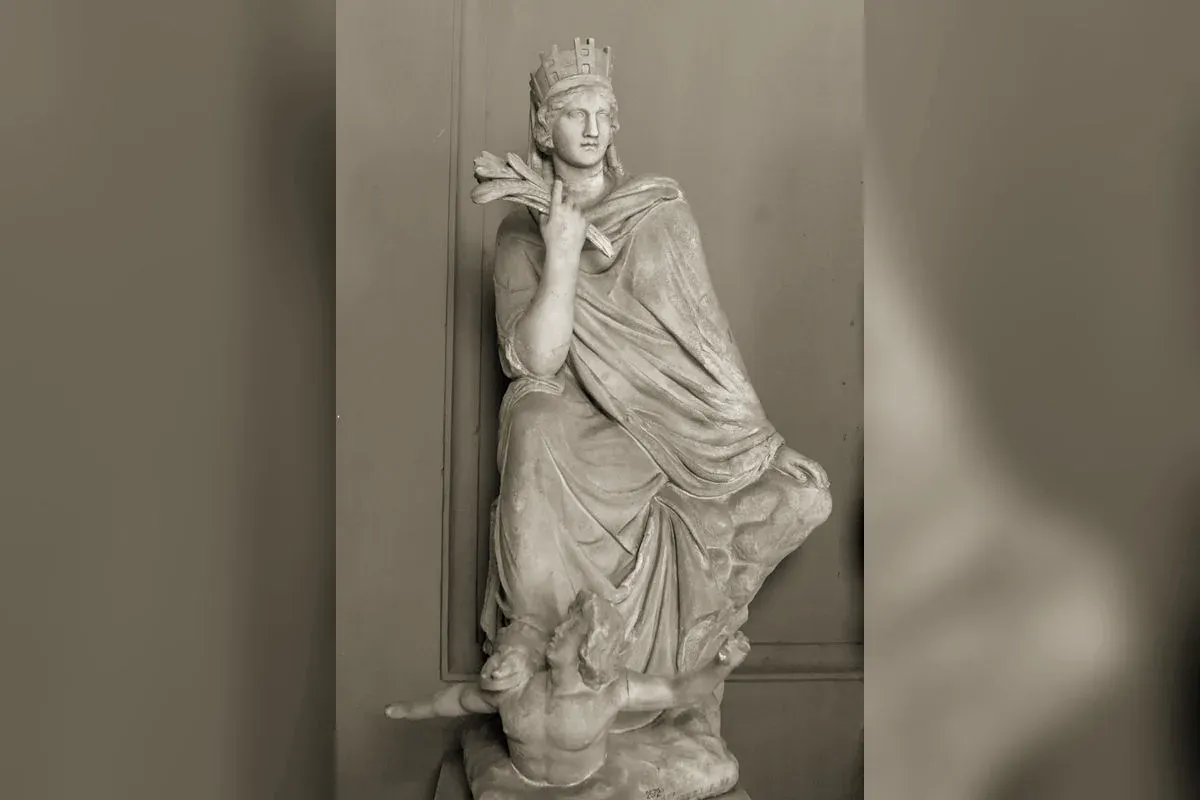
Tyche is the Greek goddess of fortune — not of wealth, but of what happens. Her name comes from the verb tunkhanô, “to hit upon, to happen,” and it names the event as readily as the power that deals it out. Barely visible in archaic poetry, she becomes after Alexander one of the most widely worshipped deities of the Greek world, to the point that every city eventually owns a Tyche of its own, crowned with its own walls.
A goddess with no settled parentage
No single tradition wins out about her birth, and that is telling: a power that governs the unforeseen sits badly on a family tree.
Hesiod files her quietly among the Oceanids, daughters of Oceanus and Tethys (Theogony 360). She stands there beside Styx, Metis and Electra — one name in a list of forty-one, with no office of her own.
The Homeric Hymn to Demeter puts her in the band of girls picking flowers with Persephone at the moment of the seizure (line 420). Tyche is present at the abduction of Persephone, and the poet spends not one further word on her. The goddess of chance begins her career as an extra.
Pindar changes everything. Olympian 12 opens by invoking “saviour Tyche, daughter of Zeus the Liberator,” asked to watch over the city of Himera. Here she is no sea nymph: her father is Zeus under his cult title Eleutherios, and she governs. Pausanias further preserves a lost fragment in which Pindar makes Tyche one of the Fates, and the most powerful of her sisters (7.26.8) — a heavy claim, since it sets chance above spun destiny.
Three texts, three irreconcilable pedigrees. Greek tradition never resolved the question, and neither did Greek art.
What Tyche actually governs
Olympian 12 gives the sharpest definition of her sphere, and repays close reading. Pindar says Tyche steers swift ships at sea, and on land directs headlong wars and the assemblies where men deliberate. He then adds that the hopes of men run up and down, cleaving a sea of false expectation, and that no mortal has ever received from the gods a reliable token of what is coming.
The ode was written for Ergoteles of Himera, a long-distance runner driven out of Crete by civil strife, who took Himeran citizenship and won at Olympia. Without the exile, no victory: the argument is proved by the very man being praised. Tyche is therefore no decorative abstraction. She is the name Greeks give to the fact that a life turns on events nobody chose.
The rudder, the horn and the wheel
Her iconography settles in the Hellenistic period around four signs, and each says something different.
The rudder makes her a pilot: she steers the course of things. The cornucopia makes her a giver of goods. The mural crown, built of ramparts and towers, ties her to one specific city. The wheel — or the globe she sometimes rests a foot on — contradicts the other three: nothing she grants stays put.
Pausanias describes at Thebes a statue of Tyche carrying the infant Plutos, Wealth, by Xenophon of Athens and Kallistonikos of Thebes. He admires the conceit: making Fortune the mother or nurse of Wealth states in a single gesture that money is born of luck and remains in its keeping (9.16.2).
The city Tyche: the Antioch model
Around 300 BC Eutychides of Sicyon, a pupil of Lysippus, made for the new Seleucid capital of Antioch a statue that set the pattern for the entire Greek East.
Tyche sits on a rock — Mount Silpius, which overlooks the city — wearing the mural crown, holding a sheaf of grain, one foot resting on the shoulder of a swimming youth who personifies the river Orontes. In a single composition the statue says: this city, this hill, this river, and the power that watches over them.
The type was copied, adapted and struck on the coinage of dozens of cities. Every Hellenistic community thereby acquired a protector belonging to it alone, independent of the traditional Olympian pantheon. That is probably the secret of Tyche’s success: in a world where kingdoms changed hands every twenty years, a city needed a deity that was its own — and chance, by definition, is what distinguishes one fate from another.
Agathe Tyche: good fortune as everyday practice
Beside the great civic goddess ran a humbler habit. Agathe Tyche, “Good Fortune,” was invoked alongside Agathos Daimon, the “Good Spirit,” in libations and in the opening formulas of decrees: countless Greek inscriptions begin agathêi tukhêi, “with good fortune,” roughly as one might say “may this succeed.”
That banality is valuable evidence. Tyche is not only a temple figure; she is a word Greeks said before undertaking anything at all, and the line between the formula and the prayer was deliberately left blurred.
Polybius and fortune as a problem for historians
The goddess poses a serious difficulty for anyone writing history, and Polybius confronts it more honestly than most.
He opens the Histories by presenting Rome’s conquest of the Mediterranean world in fifty-three years as the most remarkable work of Tyche (1.4). Elsewhere, though, he loses patience with historians who invoke Fortune for what has identifiable causes: discussing the depopulation of Greece, he refuses to consult the gods about something men have brought on themselves by ceasing to raise their children (36.17).
The position is not inconsistent; it is methodical. Tyche is the name for whatever remains once human causes have been exhausted. Polybius invents there a rule historiography has never quite abandoned.
Tyche and Nemesis, two weights on one scale
Graeco-Roman art pairs Tyche repeatedly with Nemesis, and the pairing has a logic.
Tyche gives without measure: she lifts a man above his station, enriches one city, ruins another. Nemesis carries the instruments of measure — the cubit rule, the bridle, the scales — and punishes the excess that follows favour. One grants, the other corrects. Both share the wheel in their late iconography, so much so that they are occasionally confused on coins.
This symmetry is a moral reading rather than a mythological kinship: no ancient source makes Nemesis the sister of Tyche. But it explains why the two goddesses answer each other so often in sanctuaries of the imperial period.
From Tyche to the wheel of Fortune
Romans identified Tyche with Fortuna, an Italic deity far older than the encounter, with oracular sanctuaries of her own — the best known being Fortuna Primigenia at Praeneste, where lots inscribed on wooden tablets were drawn for enquirers. The identification was so complete that Hellenistic iconography passed straight into Roman art: rudder, horn, globe.
From there the figure crossed into late antiquity. When Boethius, in the Consolation of Philosophy, stages a Fortune who turns her wheel and explains that rising and falling is precisely her trade, he hands the Middle Ages the image that would fill manuscripts, rose windows and tarot packs. The Greek goddess of chance had become a mechanism — and the word tyche survives in English chiefly through the personal names built on it.
Further reading
For the Titanic river Hesiod makes her father, see the entries on Oceanus and Tethys. For the power that restores measure where Fortune has given too much, read the entry on Nemesis. For the scene in which the Homeric Hymn places her among the companions of the daughter of Demeter, read the account of the abduction of Persephone. For the god Pindar makes her father under the title Liberator, see the entry on Zeus.
Ancient sources
- Hesiod, Theogony, 349-361
- Homeric Hymn to Demeter, 417-424
- Pindar, Olympian 12.1-12; fragment 41 (quoted by Pausanias 7.26.8)
- Polybius, Histories, 1.4; 2.38; 36.17
- Pausanias, Description of Greece, 4.30.4-6; 6.2.7; 7.26.8; 9.16.2
See also
Related entries
Stories featuring this entity
Frequently asked questions
What is Tyche the goddess of?
Tyche governs fortune in the strict sense: what happens to you without being earned or foreseen. Pindar credits her with steering ships at sea and, on land, with directing wars and public assemblies. She is not a goddess of wealth but of the unplanned event that makes or unmakes a life, a campaign or a city.
Why does every Hellenistic city have its own Tyche?
After Alexander, dozens of newly founded or refounded cities needed a protector of their own rather than a share in the Olympian pantheon. Eutychides of Sicyon's Tyche of Antioch, made around 300 BC, gave them a template: a seated goddess in a mural crown, resting on the city's own mountain, with its own river god at her feet. The type was copied on coins across the Greek East.
Is Tyche the same goddess as Roman Fortuna?
They overlap without being identical. Fortuna is an old Italic deity with oracular sanctuaries of her own, notably Fortuna Primigenia at Praeneste, where lots were drawn from inscribed wooden tablets. When Romans met Tyche they identified the two, and the Hellenistic attributes — rudder, cornucopia, globe — passed wholesale into Roman art and, later, into the medieval wheel of Fortune.