Greek mythology · Heroes & mortals
Astyanax, son of Hector in Greek mythology
In brief
Astyanax: the child frightened by his father's helmet, the two names he carried, and the disputed account of who threw him from the walls of Troy.
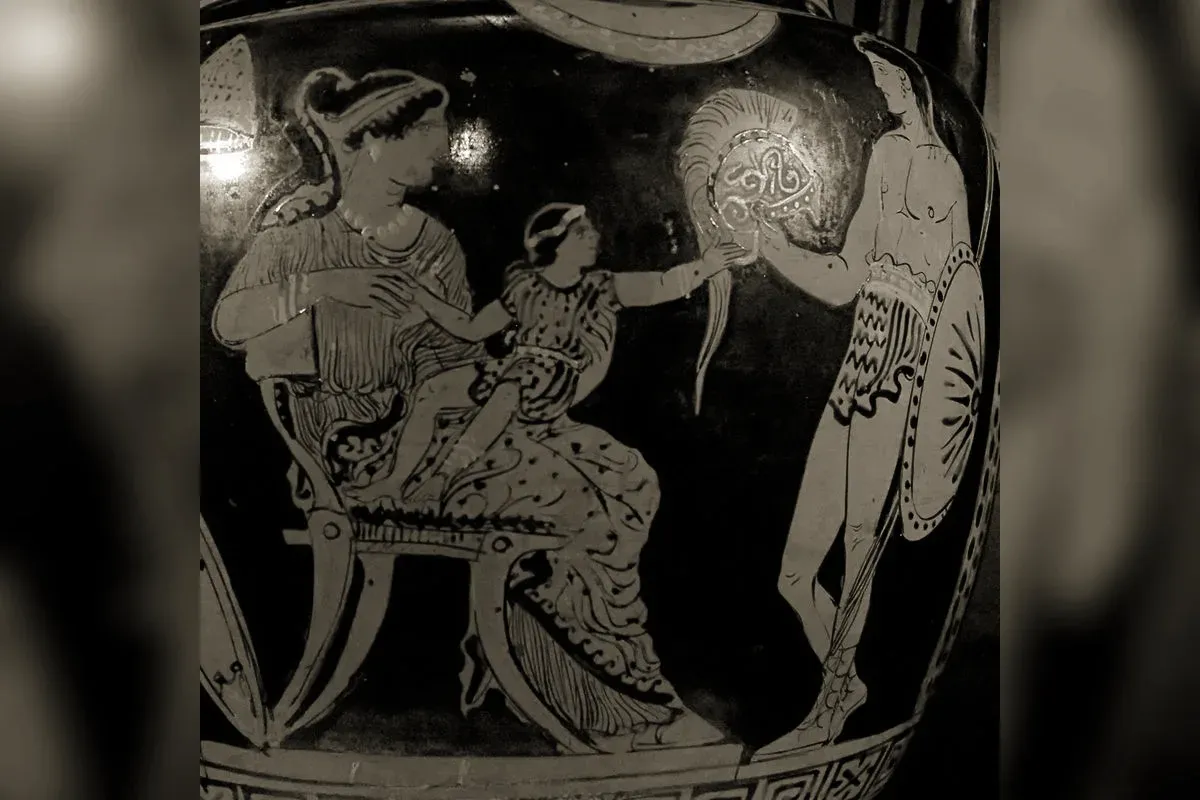
Astyanax is the infant son of Hector and Andromache, and the only character in the Trojan cycle who is killed purely for what he might have become. He never speaks. He appears in perhaps forty lines of the Iliad, and Homer arranges those lines so that everything after them is worse.
Two names
Homer records, almost as an aside, that the child had two names. His father called him Scamandrius, after the river of the Trojan plain. Everyone else in the city called him Astyanax — “lord of the city” — because Hector alone was defending Ilium.
The detail is not decorative. Scamandrius is a name; Astyanax is an argument. It states publicly that this baby is the future of Troy and that his father is currently the whole of its defence — which is precisely the reasoning the Greeks will use, a few years later, to justify killing him.
The helmet
In Book 6, Hector reaches for his son and the boy screams and twists away into his nurse’s dress, terrified by the bronze and the horsehair crest nodding at him from the helmet.
Both parents laugh. Hector lifts the helmet off, lays it shining on the ground, kisses the child and swings him in his arms, and prays aloud that people will one day say this man is far better than his father as he comes home from war with bloody spoils, and that his mother’s heart will be glad.
Not one clause of that prayer is granted, and the audience knows it while hearing it. It is the most concentrated piece of irony in the Iliad, and it works because for a few lines the poem simply stops being about the war.
Hector then predicts the alternative with complete accuracy in the same conversation: the day will come when sacred Ilium falls, and Andromache will be taken away weeping to work at another woman’s loom.
The wall
The Iliad ends before Troy falls, so Astyanax’s death belongs to the poems of the epic cycle and to tragedy — and the sources disagree about the essentials.
The Little Iliad has Neoptolemus, Achilles’ son, take the child by the foot and throw him from the tower. The Iliou Persis assigns it to Odysseus. Euripides, in Trojan Women, has the Greek assembly vote on it after the prophet Calchas — or in some versions Odysseus in debate — argues that it is folly to let the son of so great a father grow up.
That reasoning is the point of the episode. The child is not killed in the fury of a sack, by mistake, or in reprisal. He is killed after deliberation, by a council, on a strategic assessment about the next generation. Greek tragedy returns to this repeatedly because it is the moment when the sack of Troy stops being a battle and becomes policy.
The shield
Euripides gives the burial to Hecuba. The body is brought back to her on Hector’s own bronze shield — the Greeks having refused Andromache, already loaded onto Neoptolemus’ ship, permission to bury her son herself.
She washes the broken child, wraps him, and speaks over the shield that could not protect him: it fitted his father’s side so well, and the sweat of Hector’s forehead is still on its rim. Then Troy is fired behind them.
Ancient sources
- Homer, Iliad, 6.399-503; 22.482-507; 24.734-739
- Euripides, Trojan Women (709-798, 1118-1250) and Andromache
- Apollodorus, Epitome, 5.23
- Proclus' summaries of the Little Iliad and the Iliou Persis
See also
Related entries
Stories featuring this entity
Frequently asked questions
Who threw Astyanax from the walls?
The sources disagree. The Little Iliad has Neoptolemus take the child by the foot and throw him from the tower; the Iliou Persis assigns it to Odysseus. Euripides, in Trojan Women, has the Greek assembly vote on it after the prophet Calchas — or Odysseus in debate — argues that it is folly to let the son of so great a father grow up.
Why kill a child once the war was already won?
That is precisely the point of the episode. He is not killed in the fury of a sack, by mistake, or in reprisal, but after deliberation, by a council, on a strategic assessment about the next generation. Greek tragedy returns to it repeatedly because it is the moment when the sack of Troy stops being a battle and becomes policy.