Greek mythology · Heroes & mortals
Andromache, wife of Hector in Greek mythology
In brief
Andromache: the farewell at the Scaean Gate, the family Achilles destroyed in one day, and the miniature Troy she rebuilds in exile.
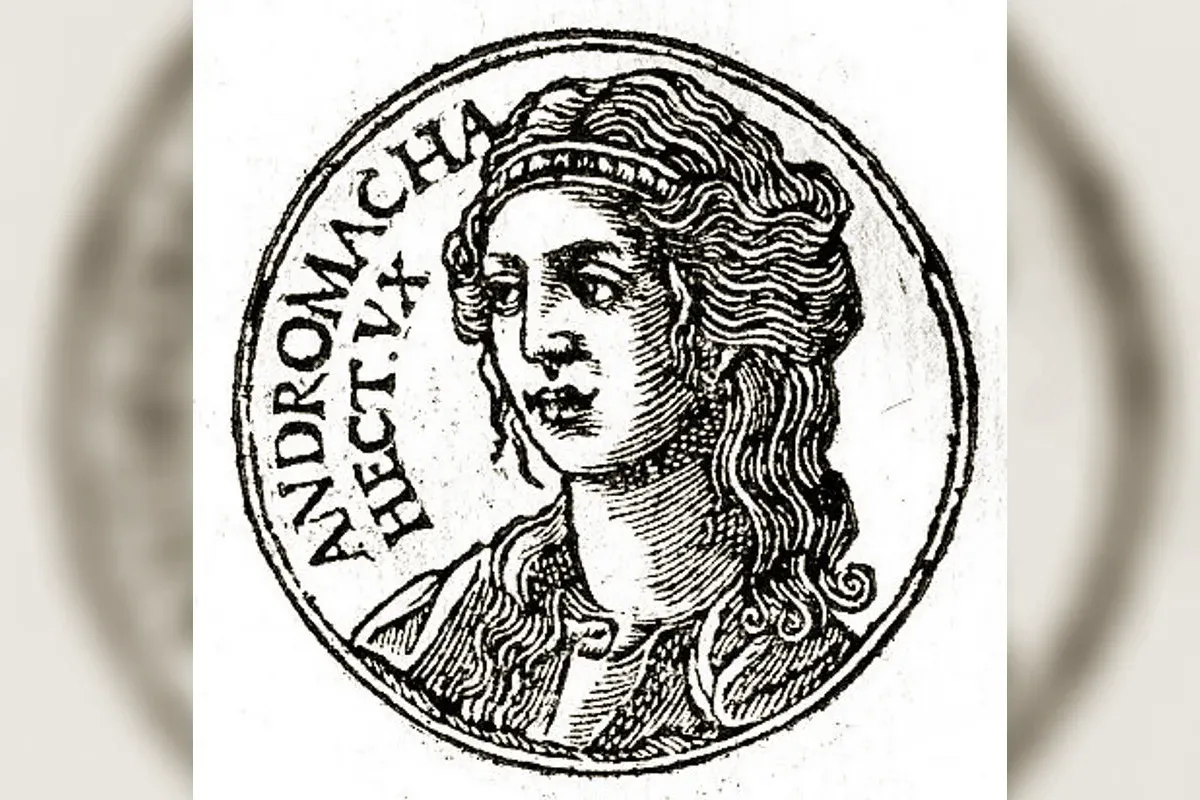
Andromache is the wife of Hector and mother of Astyanax, and the Iliad’s most sustained account of what a war costs the people who do not fight in it. Her story does not end with Troy; the tradition follows her into slavery and out the other side, and gives her the strangest afterlife of any Trojan.
What Achilles had already taken
Before the poem begins, she has lost everything except her husband and son, and to the same man.
She tells Hector so directly in Book 6. Achilles sacked her city, Cilician Thebe, killed her father Eëtion — though he did not strip the body, and burned it in full armour out of respect — and killed her seven brothers in a single day, all of them together, among their cattle. Her mother was ransomed and then died of illness at home.
Which produces the line the whole scene turns on: Hector, you are father and mother and brother to me, and my young husband besides. She is not being sentimental. She is stating that her entire kinship structure has been reduced to one man standing in front of her, and that he proposes to go outside.
The Scaean Gate
She then does something no other character in the Iliad attempts: she gives him military advice. Bring the army in close by the fig tree, she says, where the wall is weakest and where three separate assaults have already been tried.
Hector does not engage with the tactics. He answers that he would be ashamed before the Trojans if he hung back, that he knows Troy will fall, and that what troubles him is not his parents’ or brothers’ deaths but the thought of her led away weeping by a Greek to weave at another woman’s loom.
Then their son screams at the horsehair crest of his father’s helmet. Hector laughs, takes it off, sets it shining on the ground, and lifts the boy up. It is the last time the family is together, and Homer builds the whole scene so the reader knows it.
The slave of Neoptolemus
Troy falls, and Andromache is allotted to Neoptolemus — the son of the man who killed her father, her brothers and her husband, and who has just killed her child.
Euripides’ Andromache finds her years later in Phthia, having borne Neoptolemus a son, in a lethal domestic rivalry with his lawful Spartan wife Hermione, who is childless and wants her dead. The play is unsparing about the position of the enslaved concubine: entirely dependent on a man’s continued interest, hated by the household she has been forced into, with a child whose existence is her only leverage and her greatest danger.
The little Troy
Virgil gives her the ending. In Aeneid 3, Aeneas lands at Buthrotum in Epirus and finds, inland, a miniature Troy: a dry stream called Xanthus, a small gate named the Scaean Gate, a citadel called Pergamum. Andromache, passed to Hector’s brother Helenus after Neoptolemus’ death, is queen there.
Aeneas finds her at a cenotaph — an empty tomb of green turf with two altars — making offerings to Hector’s ashes that are not there. She asks after Astyanax, cannot finish the sentence, and weeps.
It is one of the great scenes in Latin poetry and a deliberate contrast: Aeneas is going forward to found something new, and Andromache has built an exact scale model of what she lost and lives inside it. The Aeneid treats this with sympathy and does not recommend it.
Ancient sources
- Homer, Iliad, 6.390-502; 22.437-515; 24.723-746
- Euripides, Andromache and Trojan Women
- Virgil, Aeneid, 3.294-355
See also
Related entries
Stories featuring this entity
Frequently asked questions
What is the little Troy that Aeneas finds?
In Aeneid 3, Aeneas lands at Buthrotum in Epirus and finds inland a miniature Troy: a dry stream called Xanthus, a small gate named the Scaean Gate, a citadel called Pergamum. Andromache is queen there. He finds her at an empty turf tomb with two altars, making offerings to ashes of Hector that are not there. Virgil treats it with sympathy and does not recommend it.
Why does Andromache give Hector military advice?
Because she is the only character in the Iliad who does. At the Scaean Gate she tells him to bring the army in close by the fig tree, where the wall is weakest and where three separate assaults have already been tried. Hector does not engage with the tactics at all — he answers that he would be ashamed to hang back, and that what troubles him is the thought of her led away weeping to weave at another woman's loom.