Greek mythology · Heroes & mortals
Daedalus, inventor and architect of the Labyrinth of Crete
In brief
Daedalus in Greek mythology: Athenian craftsman, builder of the Labyrinth, father of Icarus and inventor of waxen wings, caught between genius and hubris.
- invention and engineering
- architecture and sculpture
- prodigious craftsmanship
- Ariadne's thread, his solution to the Labyrinth
- +2
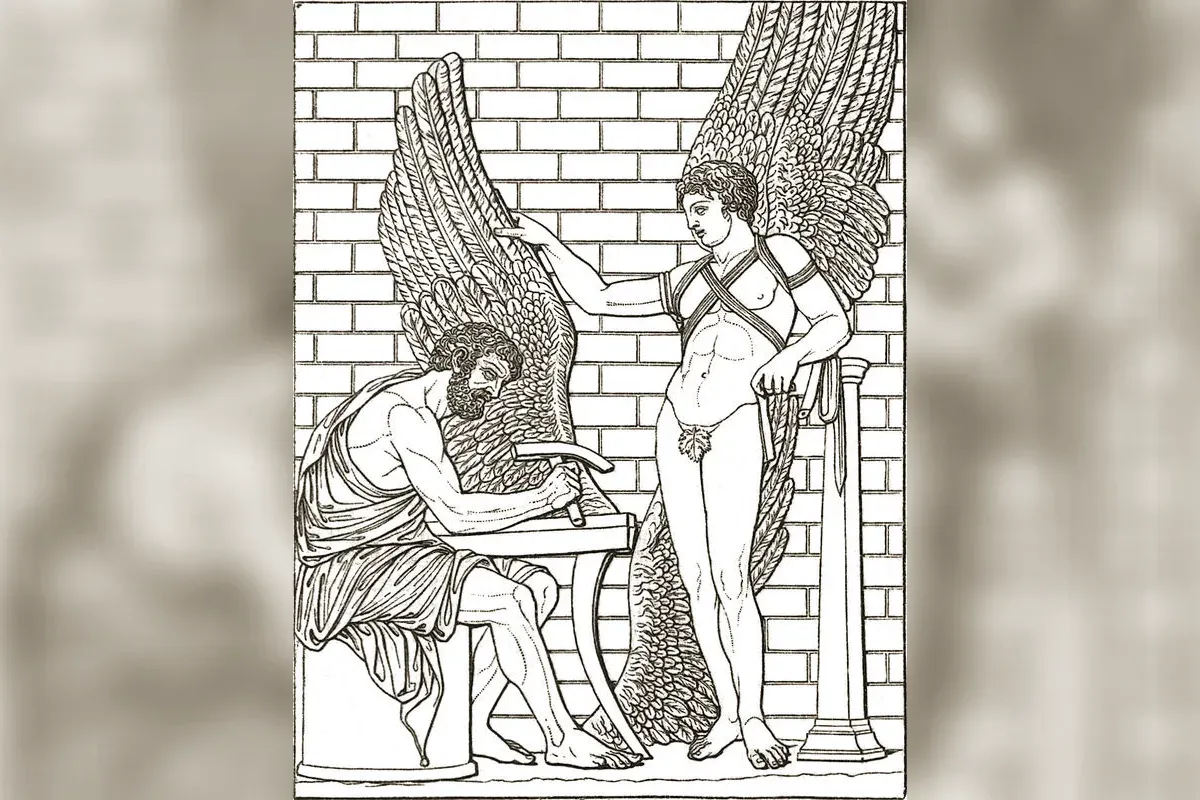
Daedalus is, in Greek mythology, the very figure of inventive genius — and of its tragic reverse. An unrivaled architect, sculptor, and engineer, he designs the Labyrinth of Crete, the perfect trap; yet his intelligence, placed at the service of every master in turn, ends by turning against those he loves. His name, meaning “the ingenious one,” has become a synonym for the labyrinth as much as for ingenuity itself.
The greatest craftsman of the Greeks
Daedalus is an Athenian, a descendant of King Erechtheus. Tradition credits him with an artistic revolution: before him, it was said, statues had closed eyes and joined legs; Daedalus made them “see” and “walk,” opening the eyelids and freeing the limbs. He is said to have invented the carpenter’s tools and ingenious mechanisms. He embodies the passage from rudimentary handiwork to true art — the art that imitates the living.
His natural patron is Athena, goddess of crafts and technical intelligence, and his genius recalls that of the smith-god Hephaestus. But Daedalus is a mortal, and no immortality shields his talent from the consequences of his deeds.
The founding crime: the death of the nephew
Daedalus’s fate turns on his own pride. He has taken as apprentice his nephew — named Talos, Calos, or Perdix depending on the source — a boy so gifted that he invents the saw (imitating the spine of a fish) and the compass. Consumed by jealousy at seeing the pupil outstrip the master, Daedalus throws him from the Acropolis of Athens.
Tried before the court of the Areopagus and condemned for the murder, Daedalus must flee his city. He reaches Crete, where King Minos welcomes him and puts his genius to work. This crime of envy is the character’s original sin: the man who masters technique does not master his own passions.
In the service of Minos: the cow and the Labyrinth
In Crete, Daedalus is caught up in the drama of the royal family. Queen Pasiphaë, struck with an unnatural passion for a magnificent bull sent by Poseidon, secretly seeks the craftsman’s help. Daedalus builds a hollow wooden cow, covered in hide, in which the queen conceals herself to mate with the animal. From this union is born the Minotaur, a monster with a man’s body and a bull’s head.
To hide this shame, Minos commissions from Daedalus a work worthy of the monster: the Labyrinth, a maze of corridors so inextricable that its own designer, it is said, nearly failed to escape it. It is Daedalus’s masterpiece and the symbol of his art: an intelligence so cunning that it traps whoever enters.
Ariadne’s thread, betrayal of the secret
Daedalus’s genius soon turns against his master. When the Athenian hero Theseus arrives in Crete among the youths destined for the Minotaur, the princess Ariadne falls in love with him and begs Daedalus to save him. The craftsman then hands her the key to his own invention: a simple thread to unwind at the Labyrinth’s entrance and follow back out. By this trick Theseus kills the monster and finds the exit — a central episode of the myth of Theseus and the Minotaur.
Furious at the betrayal, Minos shuts Daedalus and his son Icarus in the Labyrinth itself, or in a high tower. The jailer becomes the prisoner of his own masterpiece.
The flight and the fall of Icarus
Unable to escape by the sea that Minos watches, Daedalus devises his most famous invention: wings of feathers bound together with wax. He fits them to his son and warns him: fly neither too low, where the sea’s spray would weigh down the feathers, nor too high, where the sun would melt the wax.
Intoxicated by flight, Icarus forgets the warning. He soars toward the sun, the wax melts, the feathers scatter, and he plunges into the sea that will bear his name, the Icarian Sea. Daedalus, powerless, continues on alone as far as Sicily. The loss of his son is the ultimate price of his genius: the invention meant to save destroys what he held most dear. (A dedicated page on Icarus is still to be published.)
The Sicilian exile and the death of Minos
A refugee in Sicily at the court of King Cocalus, Daedalus is hunted by Minos, determined to recover the fugitive craftsman. The Cretan king uses a ruse to flush him out: he offers a reward to anyone who can pass a thread through a spiral snail shell. Only Daedalus can solve the puzzle — by tying the thread to an ant. His solution betrays him, but Cocalus protects his guest: the king’s daughters scald Minos to death in his bath. The craftsman thus outlives his last master.
Symbolic reading
Daedalus is the Greek figure of the artist-engineer, whose intelligence nearly matches that of the gods — but whose creations slip beyond his control. Each of his inventions turns on itself: the cow breeds a monster, the Labyrinth holds him captive, the wings kill his son. The myth interrogates the hubris peculiar to technical knowledge, a theme of permanent relevance.
Daedalus remains the mythic ancestor of every inventor, architect, and engineer — and a warning that their art always carries a measure of danger.
Ancient sources
- Ovid, Metamorphoses, VIII, 152–262
- Apollodorus, Library, III, 15; Epitome I
- Diodorus Siculus, Library of History, IV
- Pausanias, Description of Greece
See also
Related entries
Stories featuring this entity
Frequently asked questions
Who is Daedalus in Greek mythology?
Daedalus is the greatest craftsman and inventor of Greek mythology, a brilliant Athenian credited with lifelike sculpture, technical inventions, and above all the building of the Labyrinth of Crete for King Minos. He is also the father of Icarus and the inventor of the waxen wings that cause his son's death.
Why did Daedalus leave Athens?
Daedalus, jealous of the talent of his nephew and apprentice — Talos or Perdix, inventor of the saw and the compass — hurls him from the Athenian Acropolis. Condemned for this murder by the Areopagus, he goes into exile in Crete, where he enters the service of King Minos. His crime of pride sets his entire Cretan destiny in motion.
What role does Daedalus play in the myth of the Minotaur?
Daedalus is doubly tied to the Minotaur. He first builds the wooden cow that lets Pasiphaë mate with the bull and conceive the monster. He then constructs the Labyrinth to imprison it. Finally, he gives Ariadne the trick of the thread that lets Theseus escape the maze after killing the Minotaur.