Greek mythology · Mythical places
The Labyrinth of Crete, prison of the Minotaur
In brief
The Labyrinth in Greek mythology: the maze built by Daedalus for King Minos to hold the Minotaur, escaped by Theseus thanks to Ariadne's thread.
- inextricable maze
- prison of the Minotaur
- initiatory trial and symbol of the path
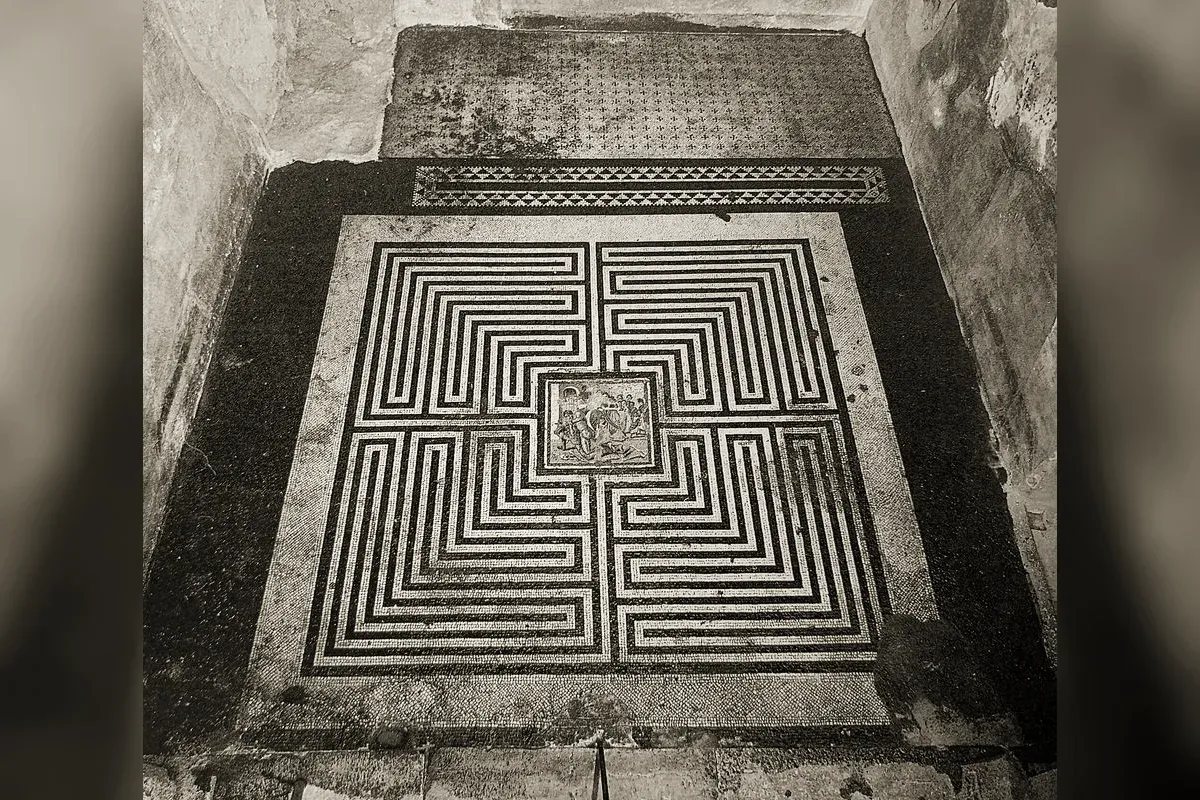
The Labyrinth is, in Greek mythology, the architectural trap par excellence: a tangle of corridors designed so that no one ever escapes. Built by the brilliant Daedalus at the command of King Minos, it holds the Minotaur deep within Crete, and it is defeated neither by force nor by chance, but by a simple ball of thread. Few mythic places have left so lasting a mark on the imagination and on language.
A place born to hide a shame
The Labyrinth is born of a royal scandal. Queen Pasiphaë, wife of Minos, struck with an unnatural passion for a magnificent bull, gives birth to a hybrid being: the Minotaur, a man’s body with a bull’s head. Unable to kill this monstrous son, yet unable to display him, Minos seeks a way to make him vanish without destroying him.
He commissions from Daedalus, the Athenian craftsman exiled at his court, a structure that is at once prison and hiding place: a maze of galleries so complex that the creature can never get out and no one can reach it. The Labyrinth is therefore, from the very start, a place of concealment as much as of confinement.
A maze of disputed structure
Ancients and moderns alike have long debated the Labyrinth’s exact form. Two conceptions coexist. In the texts, it is described as an inextricable network of branching corridors in which one is hopelessly lost: the “many-choice” (multicursal) labyrinth.
But ancient iconography — mosaics, coins of Knossos, graffiti — almost always depicts a unicursal design: a single winding path that leads inevitably to the center, with no dead ends or forks. In this version, the dread comes not from getting lost but from inevitability: one can only advance toward the monster. This tension between the labyrinth in which one strays and the labyrinth into which one is drawn feeds the whole symbolic richness of the motif.
Theseus and Ariadne’s thread
The Labyrinth is inseparable from the exploit of the Athenian hero Theseus. Athens, defeated by Minos, must periodically hand over young people to be devoured by the Minotaur. Theseus volunteers to end the tribute.
In Crete, princess Ariadne, daughter of Minos, falls in love with him. She obtains from Daedalus the secret to outwit his own masterpiece: a thread that Theseus fastens at the entrance and unwinds as he goes deeper. After killing the Minotaur at the heart of the maze, the hero rewinds the thread and finds his way out. The whole narrative of Theseus and the Minotaur turns on this gesture: patient intelligence overcomes the absolute trap where force alone would fail.
Furious at the betrayal, Minos would later imprison Daedalus himself in the Labyrinth — the designer captive within his own creation, before his flight through the air with his son Icarus.
The shadow of Knossos
Did the Labyrinth have a real model? No building matches the mythical maze exactly, but the vast palace of Knossos in Crete offers a striking candidate. With its hundreds of rooms, its corridors interwoven across several levels, its courts and storerooms, the Minoan palace could well have seemed, to mainland Greeks, an endless tangle.
The site’s emblem reinforces the link: the double axe, or labrys, a Cretan royal and religious symbol, is omnipresent at Knossos and may have given its name to the “labýrinthos,” the house of the labrys. When the archaeologist Arthur Evans uncovered the palace in the early twentieth century, he did not hesitate to recognize in it the historical source of the legend. The myth would thus have transformed the memory of a forgotten Minoan civilization into a place of terror.
A universal symbol
The Labyrinth has far outgrown the frame of Greek myth to become a universal motif. It figures the initiatory journey, the crossing of a difficult path to a center where a revelation or decisive trial awaits. It reappears carved into the pavements of medieval cathedrals, where the faithful symbolically walked the road to Jerusalem.
In modern thought, from the labyrinth of Borges to the mazes of the mind, it names any complex situation from which one escapes only by a guiding thread. The very persistence of the word keeps the memory of Daedalus’s invention alive in everyday speech.
Ancient sources
- Ovid, Metamorphoses, VIII
- Apollodorus, Library, III, 1; Epitome I
- Plutarch, Life of Theseus
- Diodorus Siculus, Library of History, IV
See also
Stories featuring this entity
Frequently asked questions
Who built the Labyrinth of Crete?
The Labyrinth is the work of Daedalus, the greatest craftsman of Greek mythology, a refugee in Crete after a murder. King Minos commissions it from him to imprison the Minotaur, the monster born to Queen Pasiphaë. The structure is so complex that Daedalus himself nearly failed to escape it.
How did Theseus escape the Labyrinth?
By means of Ariadne's thread. In love with Theseus, princess Ariadne obtains from Daedalus the solution to his own invention: a thread the hero unwinds on the way in and follows on the way out. Theseus kills the Minotaur at the heart of the maze, then finds the exit by rewinding the thread — the trick that outwits the perfect trap.
Did the Labyrinth really exist?
No identified structure matches the mythical Labyrinth, but the vast palace of Knossos in Crete, with its hundreds of interlocking rooms and its double-axe (labrys) emblem, probably inspired the legend. The archaeologist Arthur Evans, who excavated the site in the early twentieth century, saw in it the historical seed of the myth.