Norse mythology · Creatures
Fenrir, the giant wolf of Norse mythology
In brief
Fenrir, son of Loki and Angrboða: the monstrous wolf bound by the magic chain Gleipnir, prophesied to devour Odin at Ragnarök, as told in the Norse Eddas.
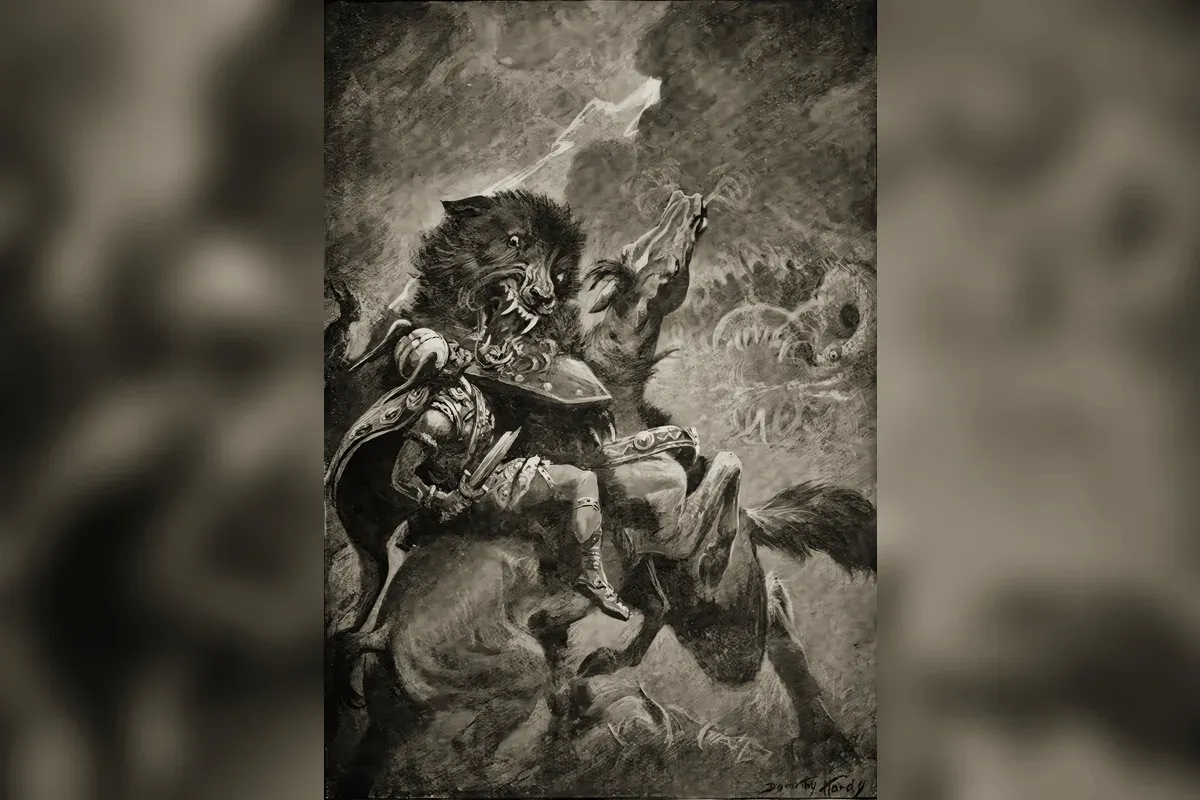
What is Fenrir?
Fenrir is the monstrous wolf of Norse mythology, one of the most feared creatures in the nine worlds. Son of Loki and the giantess Angrboða, he is one of three children of that cursed union — along with the World Serpent Jörmungandr and the goddess of the dead Hel. Prophesied to devour Odin at Ragnarök, Fenrir is less an ordinary monster than a bound cosmic force whose final release is inevitable.
Birth and growth
Fenrir is born from the union of Loki with the giantess Angrboða in the forest of Járnviðr (the Iron Wood). As soon as the Aesir learn of his existence and that of his siblings, they bring all three to Asgard — as a precautionary measure.
Of the three, only Fenrir is raised in Asgard, in full view of the gods. Thor himself watches him grow. The wolf’s growth is prodigious: each day he is larger and stronger. The prophecies confirm what the gods dread — Fenrir is destined to bring them down.
The binding: Leyding, Drómi and Gleipnir
The gods make three attempts to chain Fenrir, hoping to contain his threat.
First attempt — Leyding: the Aesir forge a chain called Leyding and present it to Fenrir as a test of strength. He agrees to the trial, gives a kick — the chain shatters.
Second attempt — Drómi: the gods return with Drómi, a chain twice as thick. Fenrir considers it, judges that breaking Drómi will bring him glory, and agrees. One effort — Drómi flies apart.
Third attempt — Gleipnir: the gods turn to the dwarves of Svartálfaheimr (the realm of the Dark Elves). The dwarves forge Gleipnir, a fetter as supple as a silk ribbon, made from six impossible things: the sound of a cat walking, the beard of a woman, the roots of a mountain, the sinews of a bear, the breath of a fish, and the spittle of a bird.
Fenrir, suspicious of this light ribbon, refuses the trial without a pledge of good faith. He demands that one of the gods place a hand in his jaws as a guarantee. No god dares — except Tyr, god of justice and honour, who places his right arm in the wolf’s mouth.
Gleipnir holds. Fenrir tears off Tyr’s hand and roars. He is chained to a rock slab, a sword wedged between his jaws to hold them open, and exiled to the island of Lyngvi on Lake Amsvartnir. There he waits for Ragnarök.
Fenrir within Loki’s monstrous family
Fenrir is not an isolated creature: he is part of the monstrous constellation fathered by Loki. His two siblings embody the other two cosmic threats:
- Jörmungandr (the Midgard Serpent): cast into the ocean by Odin, it grows until it encircles Midgard — the natural enemy of Thor, and both are destined to kill each other at Ragnarök.
- Hel: sent into the depths of Niflheim, she rules over the realm of those who did not die in battle.
This trio — Fenrir, Jörmungandr, Hel — mirrors the divine trio Odin-Thor-Freya, a counter-pantheon born from Loki’s body.
Ragnarök: the release and the end
At Ragnarök, events cascade: the death of Baldr triggers the punishment of Loki and the approaching catastrophe. Then the forces of chaos break free. Fenrir shatters his chains — even Gleipnir cannot hold against the scale of cosmic dissolution.
His jaws open from the earth to the sky. The Völuspá says he swallows the sun; some traditions say he swallows the world entire. He meets Odin on the battlefield — and devours him. Víðarr, Odin’s son, avenges his father at once: he drives his magical shoe into Fenrir’s lower jaw to pin it to the ground, then strangles him or transfixes him with his spear.
Fenrir dies with the old world. In the new world that is reborn after Ragnarök, the monsters of the night have no place.
What the ancient sources say
The key texts on Fenrir are the Gylfaginning of Snorri Sturluson (Prose Edda, c. 1220) — which describes in detail how Fenrir was raised in Asgard, the three chains, and the sacrifice of Tyr — and the Völuspá (Poetic Edda), which announces his release and his victory over Odin at Ragnarök. The Lokasenna and Vafþrúðnismál also mention Fenrir in cosmological contexts. Various skaldic kennings use Fenrir as a reference for total destruction.
Further reading
For his father, the trickster whose monstrous offspring seal the gods’ fate, read the page on Loki. For the supreme god Fenrir is destined to devour, see the page on Odin. To understand how the death of Baldr triggers the chain of events that will free Fenrir, read the page on Baldr. For the account of the final battle where Fenrir devours Odin and is slain in turn, see Ragnarök.
See also
Related entries
Stories featuring this entity
Frequently asked questions
Why do the gods fear Fenrir?
Norse prophecy foretells that Fenrir is destined to devour Odin at Ragnarök. From birth, the Aesir recognise in him a cosmic threat. His monstrous growth — soon larger than a horse, then larger than a mountain — confirms their fear. The gods resolve to bind him before he becomes uncontrollable.
What is Gleipnir, the chain that binds Fenrir?
Gleipnir is a magical fetter forged by the dwarves on the gods' orders. Ironically, it is made from six impossible ingredients: the sound of a cat's footstep, the beard of a woman, the roots of a mountain, the tendons of a bear, the breath of a fish, and the spittle of a bird. Soft as a silk ribbon, Gleipnir is nonetheless absolutely indestructible — and it is precisely its lightness that makes Fenrir suspicious.
What is Fenrir's role at Ragnarök?
At Ragnarök, Fenrir breaks free of Gleipnir as the cosmic forces unravel. His jaws stretch from earth to sky — some traditions say he swallows the world entire. He devours Odin, who is immediately avenged by his son Víðarr, who kills Fenrir by tearing apart his jaws or transfixing him with a spear.