Norse mythology · Gods & goddesses
Bragi, Norse god of poetry and husband of Idunn
In brief
Bragi is the Norse god of poetry and eloquence, husband of Idunn and son of Odin. His name comes from Old Norse bragr, 'poetry, the foremost of its kind', and runes are said to be carved on his tongue. In Snorri's Edda he is the one who tells the myths to Aegir: the god of poets is also the narrator of the mythology.
- skaldic poetry
- eloquence and speech
- mythological knowledge
- feasting and the welcome of Valhalla
- +3
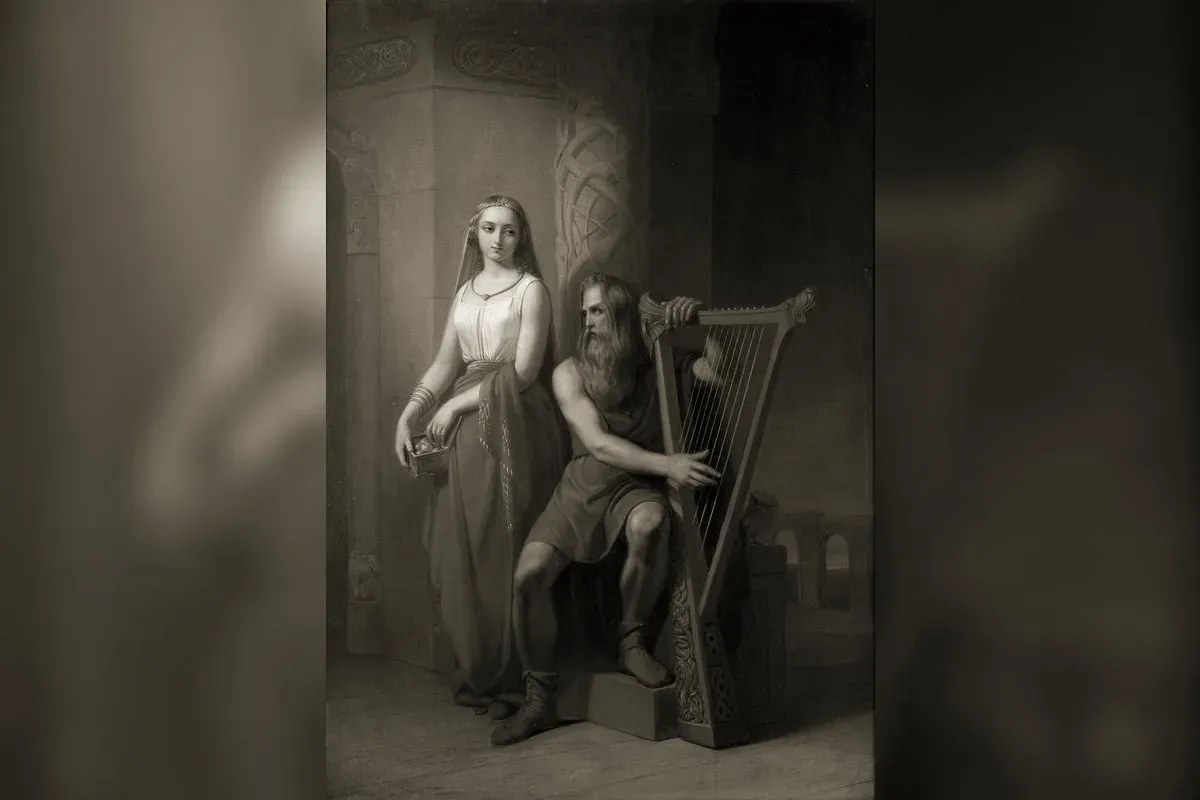
Who is Bragi?
Bragi is the Norse god of poetry and eloquence, husband of the goddess Idunn and son of Odin. Snorri’s Gylfaginning sums him up in one dense sentence: he is “renowned for wisdom, and most of all for eloquence and command of language; he knows most about poetry”.
Grímnismál puts him at the head of his class, in a stanza listing the foremost of each kind: Odin is first of the Aesir, Sleipnir of horses, Bifrost of bridges — and Bragi of skalds. He is no minor deity. He is the divine guarantor of the one craft that, in the Norse world, preserves memory.
Poetry as a domain of power
To understand Bragi you have to take Norse poetry seriously. A skald was not an entertainer: he fixed what would survive of a king. A well-made poem was worth an army of witnesses, a satire could destroy a reputation, and strict metre locked the text against alteration. Verse was the legal and political memory of the North.
That is exactly Bragi’s domain: bragr, a word meaning both poetry and the first, the best of a category. Snorri says poetry is named after the god; linguists mostly say the god is named after the word. The debate is unresolved, but either way it reveals something: Bragi is inseparable from the idea of formal excellence.
Sigrdrífumál adds a striking detail. In its catalogue of the surfaces on which runes were carved, the poem names “on Bragi’s tongue”. The sacred script is written into the god’s own organ of speech, making him the meeting point between the spoken and the inscribed — between the verse said aloud and the rune that lasts.
Genealogy: son of Odin, husband of Idunn
The tradition preserved in Skáldskaparmál makes Bragi a son of Odin. The link is coherent: it is Odin who wins the mead of poetry from the giant Suttungr and carries it back to the Aesir, and Bragi is in effect its functional heir. Gylfaginning, by contrast, does not state his parentage at all — a sign that descent was not the core of his identity.
His wife is Idunn, keeper of the apples of youth. The pairing is tighter than it looks: she preserves the gods’ youth, he preserves their memory. In a pantheon doomed to Ragnarok, the only two guarantees of duration live in the same household.
Bragi in Lokasenna
Lokasenna is where Bragi becomes a character, and the treatment is unkind.
When Loki forces his way into Aegir’s feast, Bragi speaks first, refusing him seat and place. Loki answers with the most carefully chosen insult in the poem: he calls him bekkskrautuðr, “bench-ornament”, and declares him the most fearful of the gods in battle, the most eager to flee from missiles.
Bragi offers compensation — a horse, a sword, a ring — to end the quarrel. Loki retorts that Bragi has none of these to give. The exchange turns hostile, and it is Idunn who holds her husband back by the arm, reminding him that Loki is kin by marriage and that a feast is not a battlefield.
The scene is often read as a satire of the court poet: fluent, quick with a phrase, useless in a fight. But it also shows Bragi as the keeper of the protocol of the hall, which is precisely his job — in a feasting hall, the poet decides who speaks, who is praised, and who is shut out.
The narrator of the mythology
Bragi’s most remarkable function is not inside a myth but in the architecture of the Edda itself.
Skáldskaparmál opens at a banquet held by Aegir, god of the sea. Bragi is seated beside him, and his host asks a question: where does poetry come from? Bragi answers with the killing of Kvasir, the making of the mead of poetry and Odin’s theft of it — and moves on from there through the myths, the kennings and the whole substance of the tradition.
A large share of what we know about Norse mythology therefore reaches us, within Snorri’s literary frame, from Bragi’s mouth. The god of poets is the narrator of the gods. For a thirteenth-century Christian trying to preserve a pagan craft, the choice of spokesman was anything but neutral.
Valhalla and the bragarfull
Bragi also has a role of welcome in the warrior afterlife. Eiríksmál, composed around 954 in memory of Eirík Bloodaxe, stages the uproar of Valhalla as the dead king approaches: Odin wakes Bragi and Sigmund and sends them out to meet him. The divine poet receives the heroes the Valkyries have brought in — a king is greeted with a verse.
To him is also attached the bragarfull, the “cup of Bragi” or “cup of the vow”, drunk at funeral feasts: each man emptied it while swearing a solemn oath, and Ynglinga saga tells how King Ingjald used it to vow the enlargement of his kingdom. The etymology is disputed — bragr in the sense of “the best” explains the word without any god at all. But the association is not absurd: an oath counts only once it is formulated, and formulation is Bragi’s craft.
The god and the skald
One puzzle remains. Bragi Boddason the Old is the earliest skald whose verse survives — a ninth-century Norwegian poet, author of the Ragnarsdrápa. He bears the god’s name.
Two hypotheses have competed since the nineteenth century. For some, the god is a deification of the historical poet, a founding figure raised to patron of his art. For others, the noun bragr existed independently, the god is old, and the poet simply carried a name suited to his trade. No medieval source allows a decision, and both readings remain defensible.
The blur is itself instructive: in the North the line between a god and a master of a craft was more porous than our vocabulary suggests — the euhemerising Prologue of the Edda applies the same logic to Sif, turned into a mortal prophetess out of Asia.
What the ancient sources say
The two substantial descriptions come from Snorri Sturluson: Gylfaginning (26) defines him as god of eloquence and names Idunn as his wife; Skáldskaparmál makes him a son of Odin and installs him as narrator.
In the Poetic Edda, Grímnismál (44) crowns him foremost of skalds, Lokasenna (8-18) gives him his only dramatic scene, and Sigrdrífumál (16) sets runes on his tongue — a stanza belonging to the heroic cycle of Sigurd.
Eiríksmál shows him in Valhalla, and Ynglinga saga preserves the use of the bragarfull. Together they sketch a god with few deeds but constant presence: nobody recounts his exploits, everybody hands him the floor.
Further reading
For the father the tradition gives him, and who wins the mead of poetry, read the page on Odin. For his wife, keeper of the gods’ youth, see Idunn. For the god who humiliates him at Aegir’s feast, consult Loki. For the hall where he greets dead kings, read Valhalla, and for the warrior women who bring them there, the Valkyries. For the hero whose cycle preserves the stanza of the runes on his tongue, see Sigurd.
Ancient sources
- Snorri Sturluson, Prose Edda — Gylfaginning, 26
- Snorri Sturluson, Prose Edda — Skáldskaparmál, 1 (the dialogue of Aegir and Bragi)
- Poetic Edda — Lokasenna, 8-18
- Poetic Edda — Grímnismál, 44
- Poetic Edda — Sigrdrífumál, 16
- Eiríksmál (c. 954)
- Snorri Sturluson, Ynglinga saga, 36 (bragarfull)
See also
Frequently asked questions
What is Bragi the god of?
Bragi is the god of poetry and eloquence. Snorri describes him as renowned for wisdom and above all for skill with words: he knows poetry better than anyone, and the most gifted skalds are named after him. In a culture where a king's reputation depended on the verses composed about him, that domain was not decorative — it was control of collective memory.
Is the god Bragi the same person as the skald Bragi Boddason?
The question has been open since the nineteenth century. Bragi Boddason the Old is the earliest Norse skald whose verse survives (ninth century, Ragnarsdrápa), and he shares the god's name. Some scholars see the god as the deified poet; others object that the noun bragr, 'poetry', existed independently, so the god may be far older and the poet simply bore a name fit for his trade. No medieval source settles it.
Why does Loki call Bragi a coward?
In Lokasenna, Bragi is the first god to tell Loki he will get neither seat nor place at the feast. Loki hits back by calling him a 'bench-ornament', the most timid of the gods in battle and the quickest to flee from flying weapons. The insult is precisely aimed: it sets the man of words against the man of arms, the sharpest charge that could be laid against a poet in Norse society.